
"Don't protect your knowledge; connect it." - Futurist Jim Carroll
Futurist Jim Carroll is writing his end-of-2025 / introduction-to-2026 series, 26 Principles for 2026. You can follow along at 2026.jimcarroll.com. He welcomes your comments.
"If I have an idea and you have an idea, we have two ideas. If we share those ideas, we have a movement!" That's what I wrote some years ago here in my Daily Inspiration, in a post talking about the power of collaborative insight.
In a collaborative world, the size, scope and reach of your 'idea movement' becomes even more important, and that's why you need to think about connecting your knowledge with other knowledge - rather than hoarding it.
We are on Day 10. You have set a Moonshot goal (Day 9) to grow 10x. Now you need the collaborative velocity to achieve it - you realise that more than likely, your internal 'brain trust' is too limited and too slow to gather and obtain the knowledge it needs to move forward.
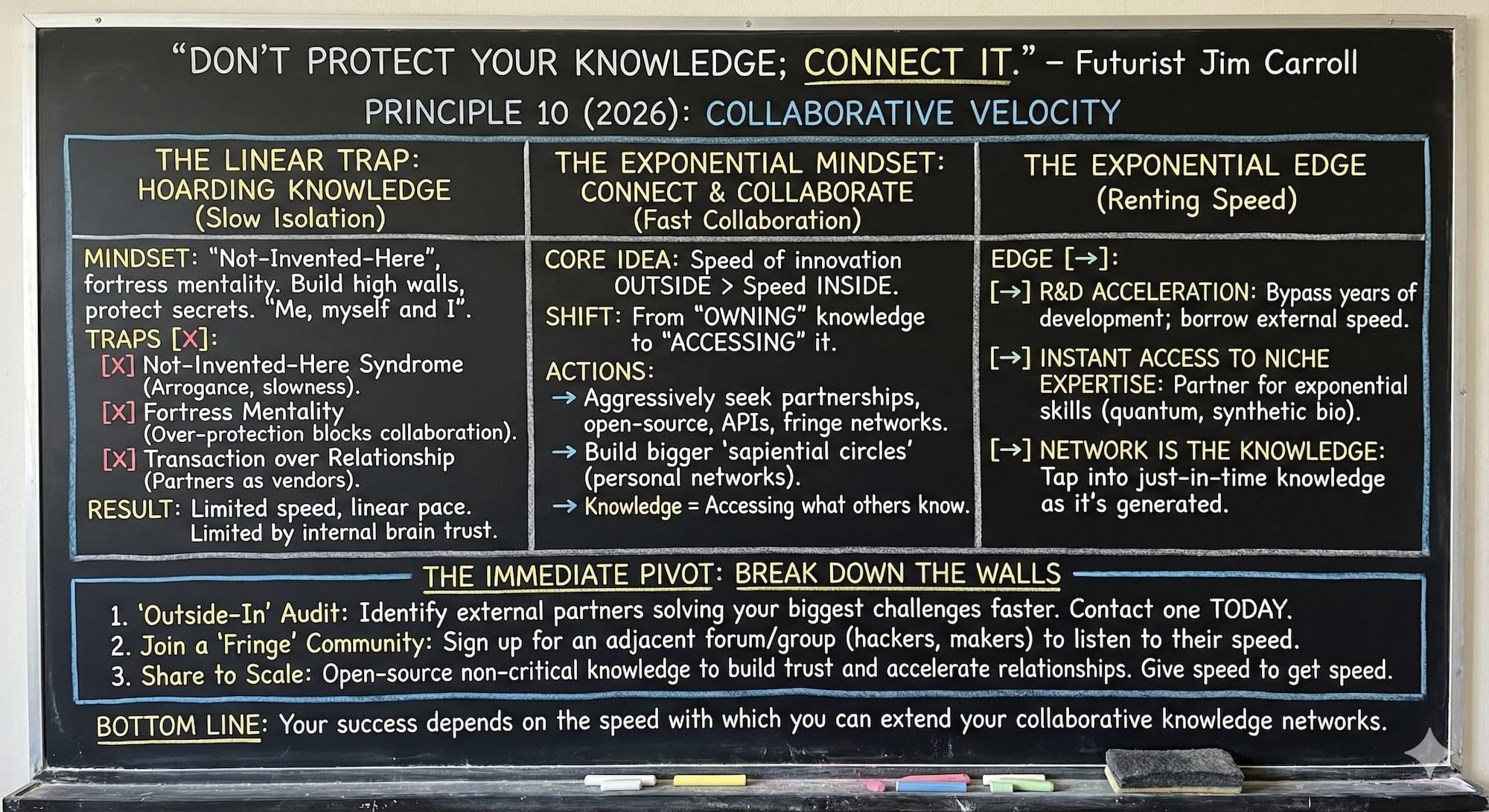
Here's your chalkboard summary!
Take a look around your current organisation or your personal network. Do you honestly believe the resources, knowledge, and talent currently within your four walls are sufficient to achieve that 10x goal?
Of course they aren't! They were assembled to achieve yesterday's 10% goals - not a 10x goal!
And therein lies the difference. In a linear world, power came from hoarding knowledge. You built high walls around your R&D lab, protected your trade secrets, and tried to hire the best people to work exclusively for you. Your internal capabilities defined your speed.
But in an exponential world, the speed of innovation outside your organisation will always exceed the speed of innovation inside it. There are more smart people outside your company than inside it. If you work on your own or in a small team, know that your knowledge is now, and will forever be, limited. There are more breakthrough startups working in your field than you have R&D teams; there are other teams who are working faster, smarter and better than you.
And in that context, you need to learn how to connect with them!
If you try to build everything yourself, you move at a linear pace. To move at an exponential pace, you must shift from "owning" knowledge to "accessing" it through rapid partnership.
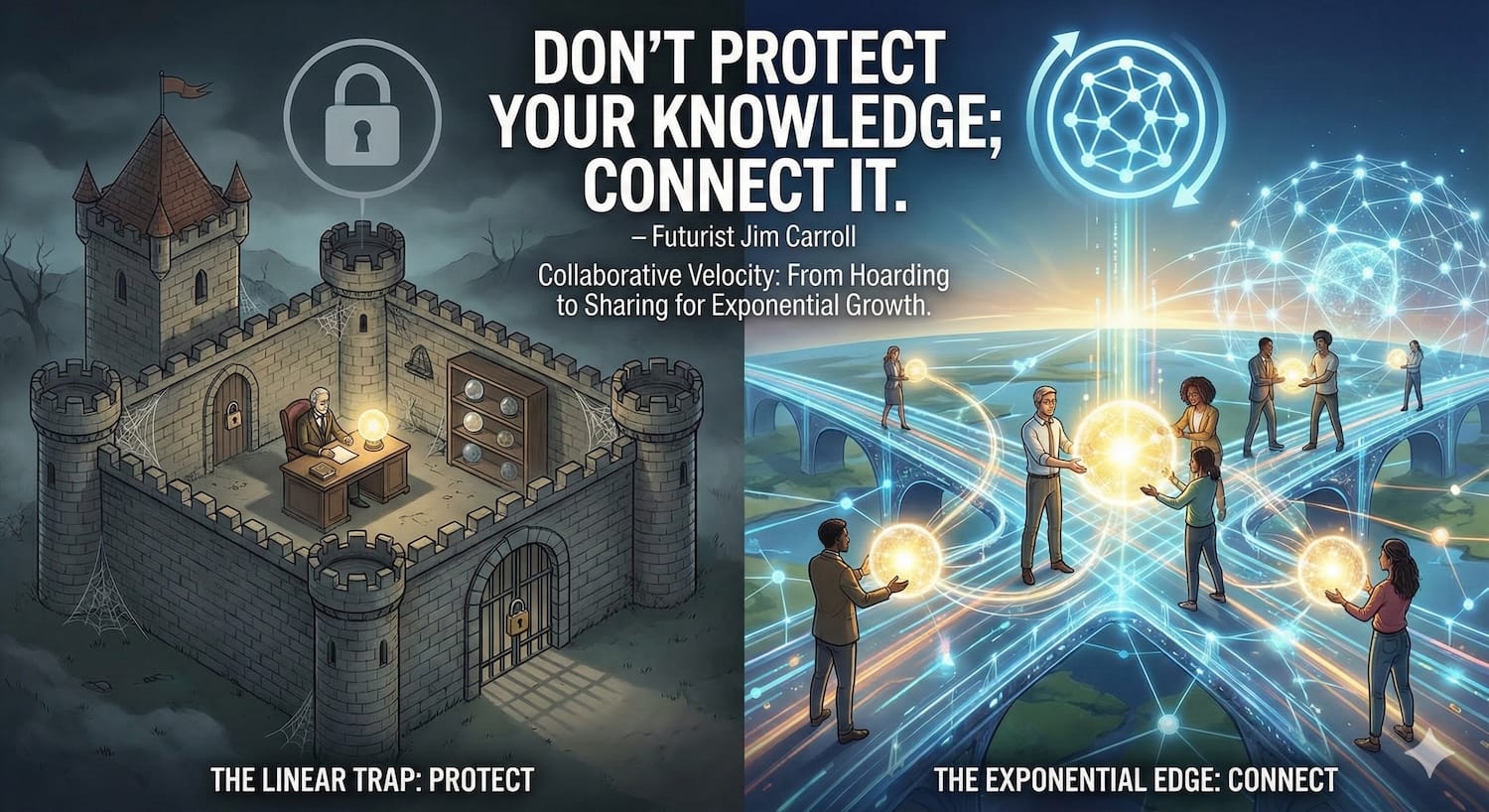
It's going from this to this!
From the Archives: A History of Collaborative Speed
I have been obsessed with this shift from "slow isolation" to "fast collaboration" for years. It is not just about working together; it is about how fast you can form the connection to solve the problem. Take a look at some of my posts through the years:
- Resilience requires a rapid connection
On April 30, 2025, in "In an uncertain economy, resilience isn't built alone. It’s built together," I argued that when the world moves fast, you cannot survive in a silo. I noted that "ideas are currency," and the organizations that survive volatility are the ones that can instantly plug into external networks to crowdsource solutions rather than trying to figure it out alone. - Collective wisdom accelerates results
On December 4, 2024, in "Build better sapiential circles," I defined these circles as the ultimate tool for speed. I wrote that "there is a massive power in collaborative online research," where the collective velocity of a group processing information far outstrips what any solitary genius can achieve. This is where I emphasized that sharing ideas creates a movement, not just a meeting. - Hoarding creates drag
On February 22, 2017, in "The Best Ideas are Shared Ideas," I looked at the cultural friction caused by internal secrecy. I wrote that organizations that move fast are those that "create a culture in which ideas float freely," removing the internal barriers that slow down the transfer of knowledge. - The edge always moves faster than the core
On December 14, 2023, in "Keep an eye on the edges," I warned that if you only look at the centre of your industry, you are seeing the past. I wrote that the future is "created out in the crowd" by open-source communities and data sharers who innovate at a pace corporate R&D can't match. - The collapse of slow, isolated R&D
Way back in February 2009, in "The Hollowing Out of Corporate R&D," I predicted the death of the slow, closed lab. I wrote about the shift to "open-sourced ideas" and "innovation-transfer partners," arguing that the complexity of modern discovery is so vast that you must "tap into the global idea cycle" just to keep up. - Renting speed vs. building it
On August 6, 2025, in "The Great R&D Capital Reallocation," I detailed how money is chasing velocity. I wrote that the dominant model is now "Open Innovation," where you don't build; you partner. It is a "distributed, collaborative ecosystem" where you rent speed from startups and universities rather than building it from scratch. - Fluid teams outpace hierarchies
On January 31, 2025, in "Innovation thrives in the building of sandcastles!" I used the metaphor of beach construction to describe fluid, fast teams. I wrote that "Experience doesn’t cloud insight" in these structures, allowing the "combined insight of several different generations" to solve problems faster than a rigid org chart ever could. - Plugging into the "global machine"
On January 14, 2020, in "Accelerate Your Ideas!," I explicitly linked collaboration to acceleration. I wrote that to create new revenue streams quickly, you must align your internal teams with the "big global idea machine" to "tap into the big global knowledge network that surrounds us." - Instant verification via the crowd
On January 3, 2025, in "Crowd thinking has replaced most forms of peer research," I highlighted how science is accelerating. I wrote that we have moved from months-long peer reviews to "instant crowd thinking," where you can "summon a crowd of vetted, quality specialists" to validate or debunk a concept in real-time. - Diversity drives faster breakthroughs
On September 19, 2025, in "Collaborate with People Who Have Different Skills," I wrote that sameness is slow. I argued that "breakthroughs often come from this type of cross-disciplinary collaboration" because colliding two different skill sets produces a spark faster than refining a single one.
My message is consistent - your success comes from the reach of your collaborative knowledge networks.
In an exponential economy, it now depends on the speed with which you can extend them and reach new ones.
In that context, the discipline you must master is Collaborative Velocity.
1. The Exponential Mindset
Collaborative velocity?
It's a recognition that your speed of innovation depends not on what you own, but on the speed at which you can connect with external knowledge, partners, and ecosystems.
It involves shifting from a "protect and defend" stance around your knowledge silos to a "connect and collaborate" stance. It involves aggressively seeking partnerships, open-source communities, API-driven platforms, and "fringe" networks to leverage external speed for your own growth.
At a personal level, it involves building bigger 'sapiential circles' - expanding and growing your personal networks to accelerate what you can know, and how you can know it.
Fundamentally, knowledge is no longer just what you know. It's how to access what others know!
2. The Linear Trap
Think about this question: Why do we try to do everything ourselves?
Our old world taught us that we had to be self-sufficient with knowledge - we had to develop a base set of skills, and perhaps develop and enhance that over time. Knowledge and skills were a solo voyage - something we did on our own. As Taylor Swift sings in The Fate of Ophelia, it's all about "me, myself and I."
And the fact is, that's a closed-minded mentality, leading to these issues:
- The "Not-Invented-Here" Syndrome: The arrogant, linear belief that if an idea or technology didn't originate inside your own team, it has no value or can't be trusted. This breeds insularity and catastrophic slowness.
- The Fortress Mentality: Over-prioritising IP protection and secrecy to the point where lawyers and compliance block valuable external collaborations that could speed up your growth. You protect your current IP so well that you miss the next wave entirely.
- Transaction over Relationship: Viewing external partners merely as vendors to be squeezed on price, rather than strategic allies who can provide exponential leverage.
3. The Exponential Edge
When you master Collaborative Velocity, you stop being limited by your own internal headcount and budget. You gain:
- R&D Acceleration: By tapping into external platforms, startups, or university research, you can bypass years of internal development time. You "borrow" their speed. Much of the future is happening out there in millions of collaborative networks, particularly through the Internet and open-source communities. If you learn how to better tap into them, you learn to operate at exponential speed.
- Instant Access to Niche Expertise: No one can know everything there is to know - all knowledge is becoming niche knowledge. That means, in this new world, trying to hire and train for a new exponential skill (e.g., quantum computing or synthetic biology) will take far too long. You need to partner with a firm or individual that has already mastered it.
- The Network is Now the Knowledge: In a world in which knowledge is growing at an explosive rate, it's now out of date as soon as it is generated. You can't master new knowledge - you can only tap into it at the moment it is generated, understand it, and watch it morph into something new.
I don't want to hammer home the point, but I can't emphasise it enough - it's all about just-in-time knowledge. Y
Your success now comes from your ability to generate the right knowledge, at the right time, for the right purpose, from the right individual, through the right network.
Understand that, and you understand the importance and power of collaborative velocity.
4. The Immediate Pivot
How do you do this?
You need to break down the walls of your organisation (or your personal career silo) today. Here are your immediate actions:
- The "outside-In" audit: Look at your three biggest current challenges related to your Moonshot goal or other big projects. For each one, identify an external partner, startup, or research group that is already solving it faster or better than you are. Contact one of them today.
- Join a "fringe" community: Sign up for a forum, LinkedIn group, association or something adjacent to your industry but populated by people very different from you (e.g., hackers, makers, academics in a different field). Just listen to the speed of their conversation.
- Share to scale: Learn how to collaborate better. Identify one piece of non-critical internal knowledge or data that you could open-source or share with a partner today to build trust and accelerate a relationship. Give speed to get speed.
Here is the reality: if you want to hit that massive 10x "Moonshot" goal we’ve been talking about, you simply can't do it alone. Your internal team was built for yesterday's slow, linear world, not today's fast-paced, exponential reality.
I call this collaborative velocity.
You need to stop hoarding your knowledge and start connecting it, tapping into the massive global networks and external "brain trusts" that are innovating faster than you ever could on your own. Success today isn't about what you own; it's about how fast you can access what others know to accelerate your speed and turn a simple idea into a movement!
Futurist Jim Carroll identified the power of collaborative networks in a 1987 document he wrote called Linkage. It predicted the emerging concept of LinkedIn, which would not appear until 20 years later.