
"To move fast, you don't need more gas. You need less drag." - Futurist Jim Carroll
Futurist Jim Carroll is writing his end-of-2025 / introduction-to-2026 series, 26 Principles for 2026. You can follow along at 2026.jimcarroll.com. He welcomes your comments.
Get rid of the anchors that are keeping you back. The weights that are holding you down. The chains that bind you to yesterday. The barriers that block your way.
And the things that are slowing you down.
We are on Day 11. You've committed to connecting externally for speed (Day 10). Now you must look inside and confront the greatest enemy of internal velocity: complexity.
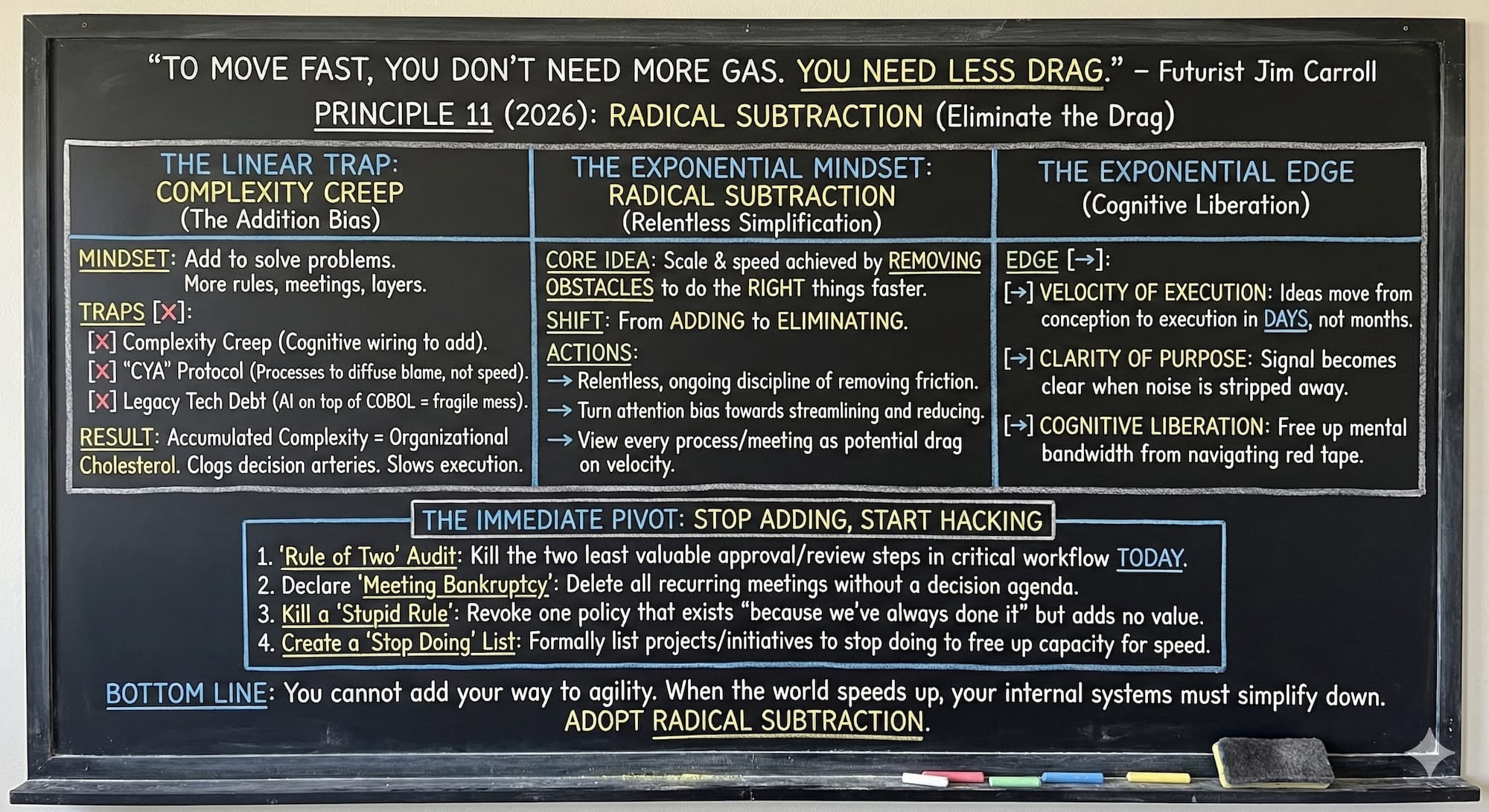
Your future depends on the idea of Radical Subtraction. It might not make sense, but to move faster in our exponential world, you need to stop adding things and start taking things away. Here's your chalkboard summary!
In our old, slow, linear world, we solved problems by adding. If there was a risk, we added a compliance step. If there was miscommunication, we added a meeting to fix it. If there was a new opportunity, we added a committee. If there were a disruption, we would develop a strategy to deal with it. Over time, this addition was seen as sophistication and control.
We added things to try to deal with the complexity the world was throwing at us.
But here's the thing - in an exponential world, this accumulated complexity is organizational cholesterol. It clogs the arteries of decision-making. Every extra approval layer, every redundant report, and every "alignment meeting" slows down your Execution Velocity (Day 8) and makes it impossible to achieve a Moonshot (Day 9).
I've long talked about this from the stage as the accumulation of 'organizational sclerosis.'
It's clogging up your future, slowing you down, killing your initiative. What is it? It's the condition where your arteries of creativity and initiative become clogged because everyone keeps doing things, even though no one remembers why they are doing them. It’s not just annoying; it’s a health hazard for your business that blocks the flow of new ideas.
And here's the thing - you cannot add your way to agility. When the world speeds up, your internal systems must simplify.
Adopting Radical Subtraction.
I've covered the idea of reducing friction as a key component of success in a faster world. For example, in my blog posts and through my keynotes, I've suggested that you need to:
- Adopt the mindset that "Complexity kills momentum." In my 101 Principles of Leadership, I observed that simplicity scales while complexity stalls growth. I shared the story of a healthcare client who cut their onboarding process from 22 steps down to eight, dramatically increasing satisfaction. In that same list, I warned that "Bureaucracy Is Just Fear Wearing an Official Badge," and that if you strip away the layers, you often just find fear of decision-making. I also urged you to "Kill the Meeting" to start doing—replacing weekly discussions with weekly prototypes—and to Kill "Sacred Cows," those legacy procedures that exist only because "we've always done it that way."
- Build "Frictionless Ecosystems." In my analysis of Temporal Commerce, I noted that the winners in the future economy will be those who ruthlessly eliminate "transactional pauses." The goal is to reduce the time cost for everyone who interacts with you. Make it easy in a faster world, not harder!
- Banish "Innovation Killers." I have repeatedly warned against the specific phrases that act as friction points in meetings—statements like "It won't work," "We don't have the budget," or "That's the dumbest thing I've ever heard." You must remove this verbal drag to clear the path for velocity.
- Eliminate Internal Friction. I’ve observed that the companies that successfully grow during economic downturns are those that use the time to remove bloat. They strip away clunky systems and rebuild for speed and simplicity while everyone else is paralyzed. There are multiple points in my new book, Dancing in the Rain: How Bold Leaders Grow Stronger in Stormy Times, where I suggest that speed of action in the face of uncertainty is critical - and you won't get there with old ideas and old, slow thinking.
Then there's what I explored in my twin books, Embracing Mediocrity and Escaping Mediocrity! Throughout, I explored the issue of friction. One book satirizes the habits that create drag, while the other provides the roadmap to velocity.

Here are a few specific nuggets from those works that highlight exactly what you need to subtract:
- Subtract "Process Bloat": In Embracing Mediocrity, Rule #14 satirically advises that to stay average, you should "Ignore Efficiency" and intentionally "prolong processes". To move fast, you must identify where you are doing this and stop it immediately.
- Create a "Stop Doing" List. In Embracing Mediocrity, I satirically pointed out that to stay average, you should keep doing useless things. To move fast, you must do the opposite: explicitly list the habits, projects, and initiatives you will stop doing to free up capacity for speed.
- Subtract "Analysis Paralysis": Rule #36 in the satire suggests you "Overthink Everything" to paralyze yourself with indecision. In Escaping Mediocrity, I counter this with Rule #36, "Act Decisively," noting that "analysis breeds paralysis" while "doers change the world". You must subtract the need for perfect certainty before acting.
- Subtract the "Clutter": Embracing Mediocrity Rule #50 tells you to "Maintain Clutter" and "let chaos dominate spaces". Real velocity requires the "Radical Subtraction" of this physical and digital noise to clear the path.
- Subtract the "Routine": The satire of Rule #123 is to "Stick to Routine" and "keep doing the same thing over and over". Escaping Mediocrity Rule #8 demands the opposite: "Defy Predictability" and "shatter your routines" because "comfort zones are desolate places where nothing grows".
- Subtract the "Distractions": Escaping Mediocrity Rule #43 is to "Eliminate Distractions" and "guard attention fiercely". This is the essence of removing the drag on your mental bandwidth so you can focus on the signal, not the noise.
Have you ever thought about the issue of speed this way? You should. Think of it this way!

That there are things that are slowing you down, and that in a world that keeps spinning faster, you need to take them away - not add more of them!
1. The Exponential Mindset
So that's where the idea of Radical Subtraction comes from.
It's the relentless, ongoing discipline of removing friction.
It is the understanding that scale and speed are achieved not by doing more things, but by removing the obstacles to doing the right things faster.
Ponder that - remove the obstacles so that you can do the right things faster.
It's coming to the decision that you are going to turn your attention bias toward elimination, streamlining, and reducing. It involves taking the view that every process, every step, every meeting, every committee, every study, and every rule is are drag on velocity that will slow you down - and make your future harder!
2. The Linear Trap
Why is subtraction so hard? Because addition feels safe, and subtraction feels risky!
We seem to be geared towards adding things to deal with change, rather than taking them away. Think about these issues that cause us challenges:
- Complexity Creep (The Addition Bias): Humans are cognitively wired to solve problems by adding new elements rather than subtracting existing ones. We add a new rule for every exception, creating an unmanageable rulebook. Organizational and personal inertia rule because we are weighted down!
- The "CYA" (Cover Your A**) Protocol: We put in place processes and rules that are not designed \for speed, but to spread responsibility around. Why? That way, we can ensure no single person gets blamed if things go wrong. This paralyzes decisive action - and meanwhile, the world speeds up around us!
- Legacy Tech Debt: We start layering new exponential technologies (like AI) on top of old, brittle linear systems, creating a complex, fragile mess that requires constant maintenance instead of driving speed. Half the world runs on COBOL. AI on top of COBOL is, well, just plain weird! Right now, companies are placing a rocket ship on top of a Model-T. Yikes!
3. The Exponential Edge
But here's the thing - once you start eliminating the things that slow you down, you do actually speed up! When you master Radical Subtraction, you stop fighting your own infrastructure:
- Velocity of execution: By physically removing friction points and approval layers, ideas move from conception to execution in days, not months.
- Clarity of purpose: When you strip away the noise of complex bureaucracy, the signal becomes clear, and the trends become easy to understand. Everyone understands the goal, leading to faster alignment.
- Cognitive liberation: You free up massive amounts of mental bandwidth for your team when they stop spending 40% of their week navigating internal red tape.
4. The Immediate Pivot
The whole issue of removing friction doesn't need to be complex - because in and of itself, it involves taking the complexity away!
You don't need a six-month consulting study to simplify. You just need to start hacking away at the unessential stuff today. Take some small steps:
- The "Rule of Two" audit: Look at your most critical current workflow. Identify the two approval steps or review meetings that add the least value. Kill them today. (If you can't kill them, make them optional "FYI" steps).
- Declare "meeting bankruptcy": Look at your recurring meetings. Delete every single one that doesn't have a clear decision-making agenda. Tell the attendees that if it's truly vital, they can reschedule it with a stated purpose. Watch how many never come back.
- Kill a "stupid rule" right now: Find one policy or procedure that exists "because we've always done it that way," but frustrates everyone and adds no customer value. Revoke it publicly. Share my video on organizational sclerosis with your team.
- The "Stop Doing" list: In your next strategy session, don't just list what you will start doing. Create a formal list of projects and initiatives you will completely stop doing to free up capacity for speed.
In our fast-moving, exponential world, you can't just step on the gas to get ahead; you have to cut the things that are holding you back.
Here's what I know: too many organizations and too many people try to fix problems by adding more meetings, rules, and complexity, but all that does is clog up your innovation arteries like organizational cholesterol.
To achieve real velocity, you need to stop adding layers and start removing the "drag"—the fear, the useless routines, and the bureaucracy—so you can clear the path for the future.
Think about starting that today!
Futurist Jim Carroll has long been intensely frustrated with bureaucracy and organizational sclerosis - with that, perhaps, being the reason why he has worked as a solo entrepreneur for 35 years!