
"The hubris of experience guarantees failure." - Futurist Jim Carroll
Futurist Jim Carroll is writing his end-of-2025 / introduction-to-2026 series, 26 Principles for 2026. You can follow along at 2026.jimcarroll.com. He welcomes your comments.
We are on Day 12.
We’ve spent the last two weeks stripping away the internal barriers to speed—the fear, the linear forecasting, the lack of collaboration, and the organizational complexity (Day 11).
Now, we face the final, most formidable internal enemy. It’s not out there in the market. It’s looking back at you in the mirror.
It's you.
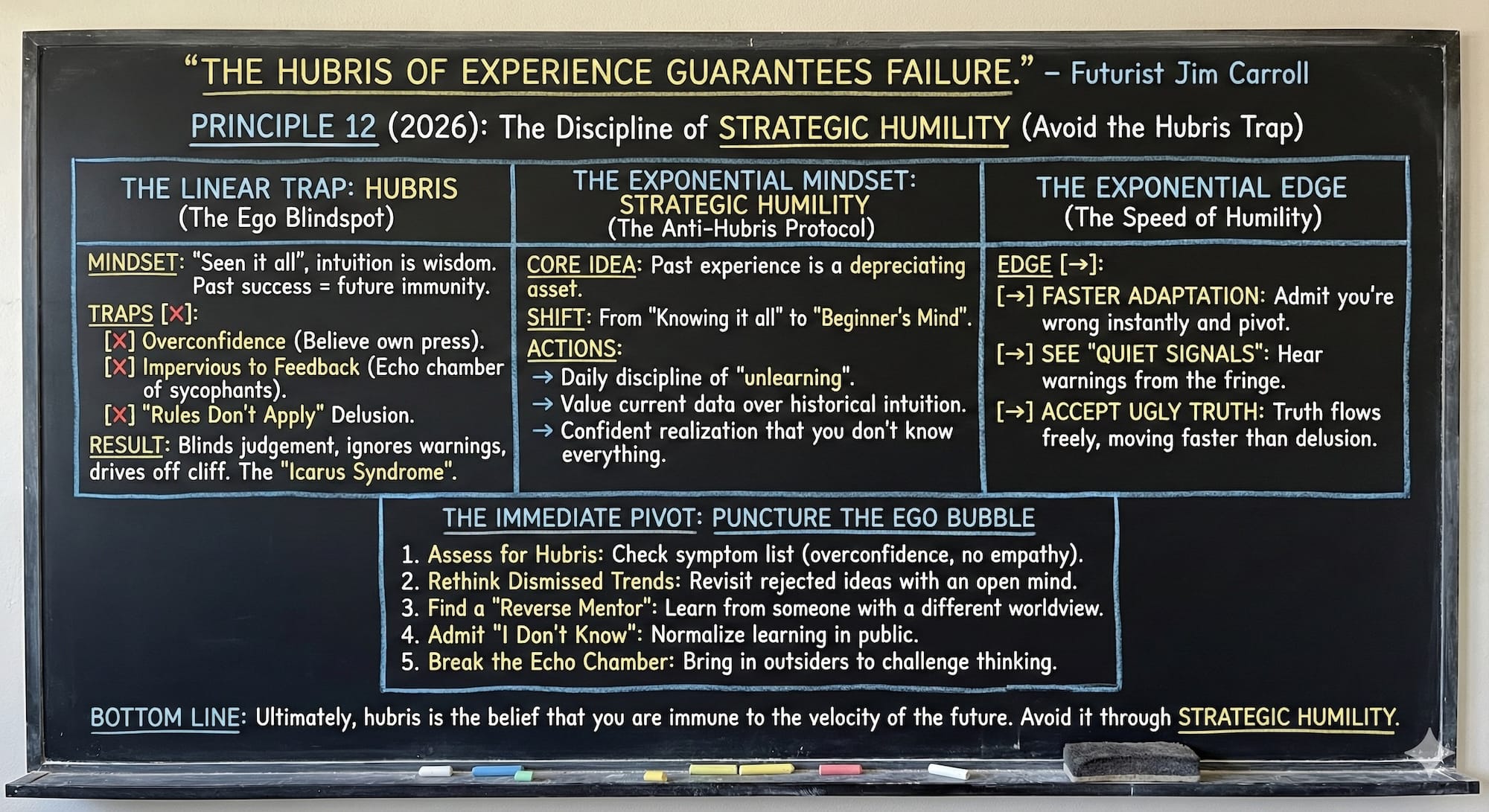
It is the ego of the successful leader. To really get ahead in 2026, you need to understand the trap of hubris and why your past success can be your biggest future liability. Here's your chalkboard summary!
What do you need to think about? The challenge of successful experience and why it can get in your way.
In a linear, slow-moving world, 30 years of continued success was your most valuable asset. It proved you knew the formula. You had "seen it all." Your intuition was unimpeachable wisdom. You knew exactly what to do, when it needed to be done, and how to do it.
Those days are gone.
In an exponential world, where entire industries are being reinvented every few years, that same 30 years of experience can become a catastrophic liability. Why? Because it can get in the way. It blinds you. It clouds your judgment. It can bring to light your lack of skills in how to respond to the profound changes that are underway. It conditions you to believe that the future will behave like the past.
It locks you into old pattern recognition for entirely new patterns!
When you combine a track record of linear success with an exponential shift in reality, you get a dangerous psychological condition I have written about extensively, and that's the trap of hubris.
It’s the arrogance that says, "I know better than anyone else." It’s the belief that your past wins grant you immunity from future disruption. It is the ultimate drag on velocity because a leader or individual blinded by hubris will drive full speed off a cliff, ignoring every warning sign along the way because they are convinced their internal map is better than the external terrain.
The discipline you must master to avoid this fate is Strategic Humility.
To understand why this discipline is so critical, we must first perform a forensic autopsy on the mindset it replaces. We need to talk about hubris.
The Arrogant Damage of Hubris
Hubris always ultimately kills.
And it happens a lot.
I wrote about it extensively in a blog post that today can be found at, where else, hubris.jimcarroll.com.

I wrote it when Elon Musk bought Twitter, and he began to spiral into his descent into what some believe is madness. To many, he has become the modern-day Howard Hughes - although brilliant, he seems to be lost inside the recesses of his increasingly volatile mind. It's worthwhile to go back and read the past - it was pulled together after I carefully studied 40 years' worth of leadership failure that was directly tied to the disease of hubris.
But here's the key thing: today, in an exponential world, the damage from hubris happens faster. Think of it this way.

In the olden days—10 or 20 years ago—it took decades to watch organizations like Sears, Kodak, and Blockbuster implode. They died a slow, agonizing death of a thousand cuts.
Now, in the era of hyper-connectivity and AI, you can watch CEO arrogance destroy value in real-time. You are watching the "Icarus Show" live.
In organizations, the Icarus Syndrome characterizes leaders who initiate overly ambitious projects that come to naught, causing harm to themselves and others. Fuelled by excitement and let loose by the adulation, particularly so in the swirl of social media, they display the classic symptoms I’ve tracked for decades: a harbouring of feelings of omnipotence, a reckless restlessness, and a fatal contempt for the advice and criticism of others.
Take a look at the list I prepared based on my research:
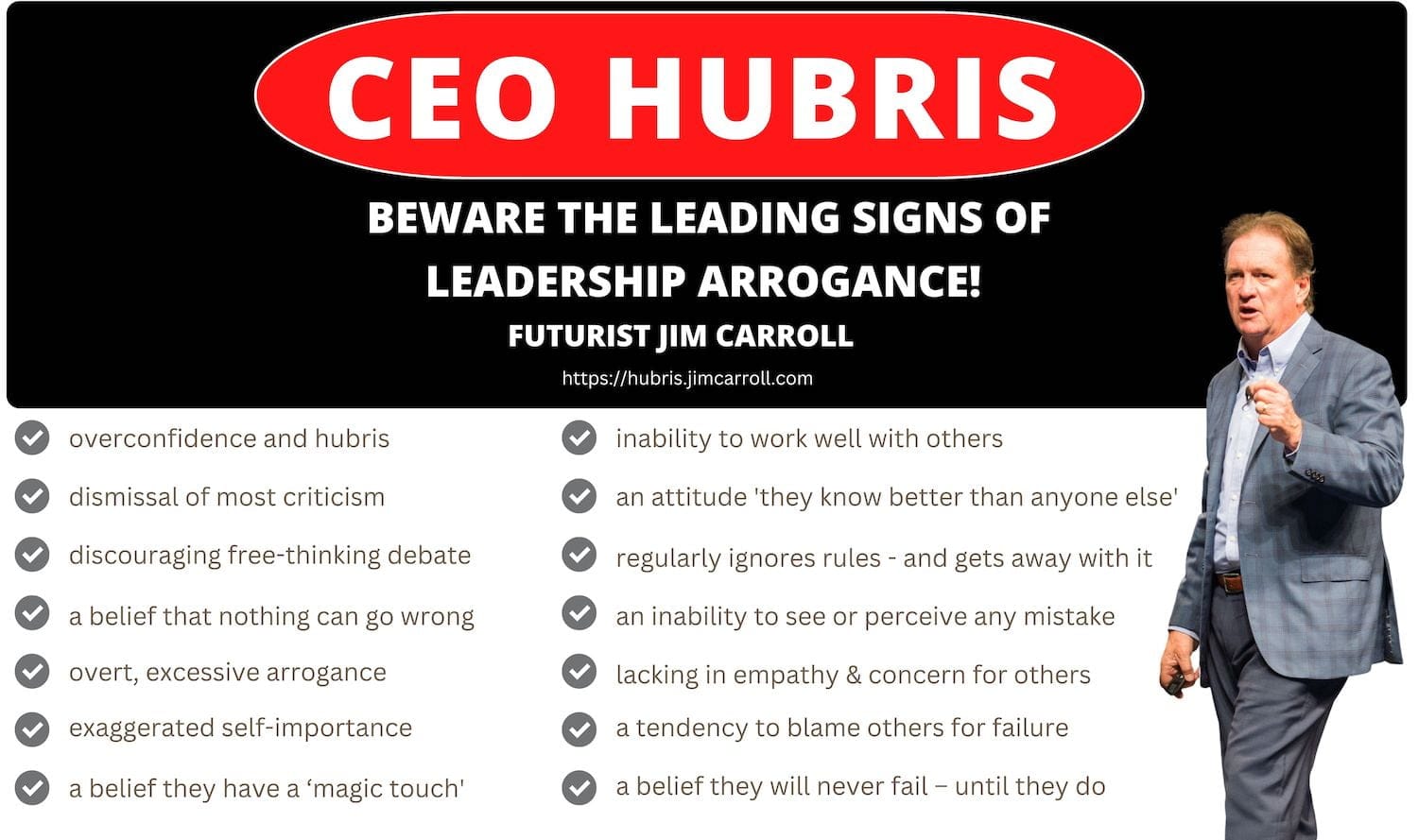
Are you guilty of any of those issues?
I've seen hubris up close. My home office is just 23 km from the former headquarters of Research In Motion (RIM) in Waterloo< Ontario, Canada. I watched the makers of the Blackberry—the device that once owned the world—spectacularly implode. Why? Because of the hubris and arrogance of its founders. I knew Jim Balsillie; I spoke at dinners where he was an eager participant. But I also know he was blind to the future in the face of a staggering onslaught of disruptive innovation from Apple. He believed his own press. He believed the "invincibility myth"—that nothing would ever come along to challenge their success because they had the "magic touch."
Oops! That didn't go well!
When hubris settles in, the results are deadly. The CEO fails to see that customers are changing, R&D is stagnating, and the product line is wildly out of date. They suffer from "risk perception bias"—a belief that they can modify and lower risk simply by willing it so. They surround themselves with sycophants who feed them the addictive drug of constant praise, creating a reality distortion field where bad news is taboo and disagreement triggers contempt.
This leads to what I call the "Reign of Error." It is the period where a leader’s past success convinces them they can do no wrong, even as they are actively destroying the future. They drift from their core mission, like Jim attempting to buy an NHL team while the iPhone was eating his lunch. They believe they along can fix a fractious world while their own house burns!
It never ends well.
The arrogant leader doesn’t just fall; they destroy others on the way down. The lack of empathy drives a knife-edge of cruelty into the lives of employees who are the first to be hammered, bruised, and beaten by the collapse.
Ultimately, hubris is the belief that you are immune to the velocity of the future. It is the delusion that you can dictate reality rather than adapt to it.
And this is what you need to avoid in 2026 and beyond.
1. The Exponential Mindset
Strategic humility? Think of it as an anti-hubris protocol!!
This is not about being meek or unsure.
It is the profound, confident realization that in a rapidly changing world, your experience is a depreciating asset.
It is the active, daily discipline of "unlearning" what used to be true to make space for what is currently true.
It involves cultivating a "beginner's mind," consciously seeking out evidence that contradicts your deeply held beliefs, and valuing current data over historical intuition.
It is coming to understand that the moment you think you have it all figured out is the precise moment you have started to lose.
2. The Linear Trap
You need to figure out if you are trapped inside a cycle of hubris, even if you don't think so.
Drawing from my analysis of collapsed companies and fallen leaders, these are a few of the stages of the Hubris Trap.
I wrote about this in my Hubris post some time back. Everything I read in the 120 pages of articles and research papers I pulled down is neatly summarized into these characteristics. This is what happens to people who fall into the trap of a destructive ego.
- Overconfidence – they can do no wrong
- belief in the praise that surrounds them
- dismissal of criticism
- discouragement of free-thinking debate
- lack of pushback by self-assembled sycophants
- your reality is impacted by excessive laudatory PR
- a belief that nothing can go wrong
- exaggerated self-importance
- a belief that they have a unique ‘magic touch
- overt, excessive arrogance
- inability to work well with others
- a belief that they are truly accurate in predicting the future
- lacking in empathy, demonstrated by not caring for others
- an excessive pride is driven by previous success
- countless histories of not following the rules and getting away with it
- overconfidence in their judgment
- a belief that they know better than anyone else
- a belief that they will *do better* than anyone else
- suffer from ‘risk perception bias’ – a belief that they can easily modify and lower risk and thereby act accordingly
- a tendency to blame others for failure – it’s ‘not their fault.’
- a belief they will never fail – until they do
It’s a pretty stunning list. Ask yourself – does this sound like anyone you know today? Do you recognize any of them in yourself or your organization? Here are some other risks and warning signs to think about:
- Mistaking luck for genius: You attribute all your past success to your own brilliance and foresight, ignoring the role of favorable market conditions or timing. This leads to a belief in your own infallibility.
- The competency trap: You become so good at the old way of doing things that you cannot conceive of a new way. You double down on the obsolete model because it's where you feel most masterful.
- Imperviousness to feedback: As I wrote in my post on hubris, the successful leader begins to tune out dissenting voices. Anyone who questions the dominant logic is seen as "not getting it" or being "negative." You construct an echo chamber of sycophants who only validate your existing worldview. (Sound like anyone you know in politics today?)
- The "rules don't apply" delusion: A belief that because of your size, history, or past dominance, the fundamental laws of market economics or technological disruption won't affect you. You believe you can dictate reality rather than adapt to it.
Are you guilty?
3. The Exponential Edge
Now that you know more about hubris, here's what you need to know when you learn how to shed it: you gain a massive speed advantage:
- You learn more about the speed of adaptation: Because you aren't fighting to defend your past decisions, you can admit you were wrong instantly and pivot to the new reality faster than an arrogant competitor.
- You get better at seeing the "quiet signals": Hubris is loud; it drowns out the weak signals of coming disruption. Humility is quiet; it allows you to hear the warnings from the fringe of your organization before it’s too late.
- You learn to accept the ugly truth, even when it hurts: When people know you won't "shoot the messenger," they bring you the hard, ugly truths about your business faster. An organization where truth flows freely moves exponentially faster than one living in a delusion.
Overall, once you become conscious of the dangers that come with hubris, you learn to recognize it, watch for it, guard against it - and how to avoid the awful path it can take you down!
4. The Immediate Pivot
So how do you get there?
It's about acceptance - and knowing that puncturing your own ego bubble is painful but necessary. Here are some things you should think about as you wrap your mind around this principle
- Assess whether you are guilty of hubris: Go through the list above - I put a lot of time into it. Are you guilty of any of that type of thinking?
- Rethink a trend you dismissed. Find something that you rejected because of your hubris. Visit it again with an open mind.
- Find a "reverse mentor": Identify a bright, young employee, confidant, or partner who grew up with technologies and worldviews you don't fully understand. Have coffee with them with one rule: You are only allowed to ask questions; you are not allowed to teach or explain anything. Your job is to learn what you don't know. Consider this to be a 'hubris-cleanse!' Practice this regularly!
- Be prepared to admit you don't know - in public! In your next major meeting, when asked a difficult question about the future, resist the urge to bluff with an answer based on experience. Be prepared to say, "I don't know the answer to that yet, because the rules have changed. Let's find out together." Normalize the state of learning - and admitting that you don't know!
- Ask yourself if you have surrounded yourself with an echo chamber. Look at the 5 people you trust most for advice. Do they all look like you, think like you, and have similar backgrounds? If so, fire your "cabinet" and deliberately bring in an outsider with a radically different perspective to challenge your thinking!
The bottom line for Day 12 is simple: in an era of high-velocity change, your ego is the heaviest anchor you carry.
To survive the journey to 2026, you must realize that what got you here won't get you there.
You need to trade the "hubris of experience" for the discipline of "Strategic Humility."
By admitting you don't have all the answers and actively unlearning the past, you stop defending your history and start inventing your future.
Don't let your past success become your future failure!
Futurist Jim Carroll has seen a lot of hubris within the leadership teams has has spoken to, as part of his keynote preparation process - and that insight has shaped the way he has pulled together his trends and innovation keynote.