
"Know when to get your age out of the way." - Futurist Jim Carroll
Futurist Jim Carroll is writing his end-of-2025 / introduction-to-2026 series, 26 Principles for 2026. You can follow along at 2026.jimcarroll.com. He welcomes your comments.
We are on Day 13. We just spent Day 12 dismantling your personal hubris - getting your ego out of the way. One of the most important aspects of that? Showing your wisdom the door!
We need to dismantle the collective, generational delusion of your organizational hierarchy!
We need to talk about age.
Yup.
Sorry.
Depending on who you are while reading this, there might be a major reality you need to consider - it might very well be the case that your grey hair is now a strategic liability.
The unique nature of our times? I call it "The Wisdom Inversion!" Here's your chalkboard summary!
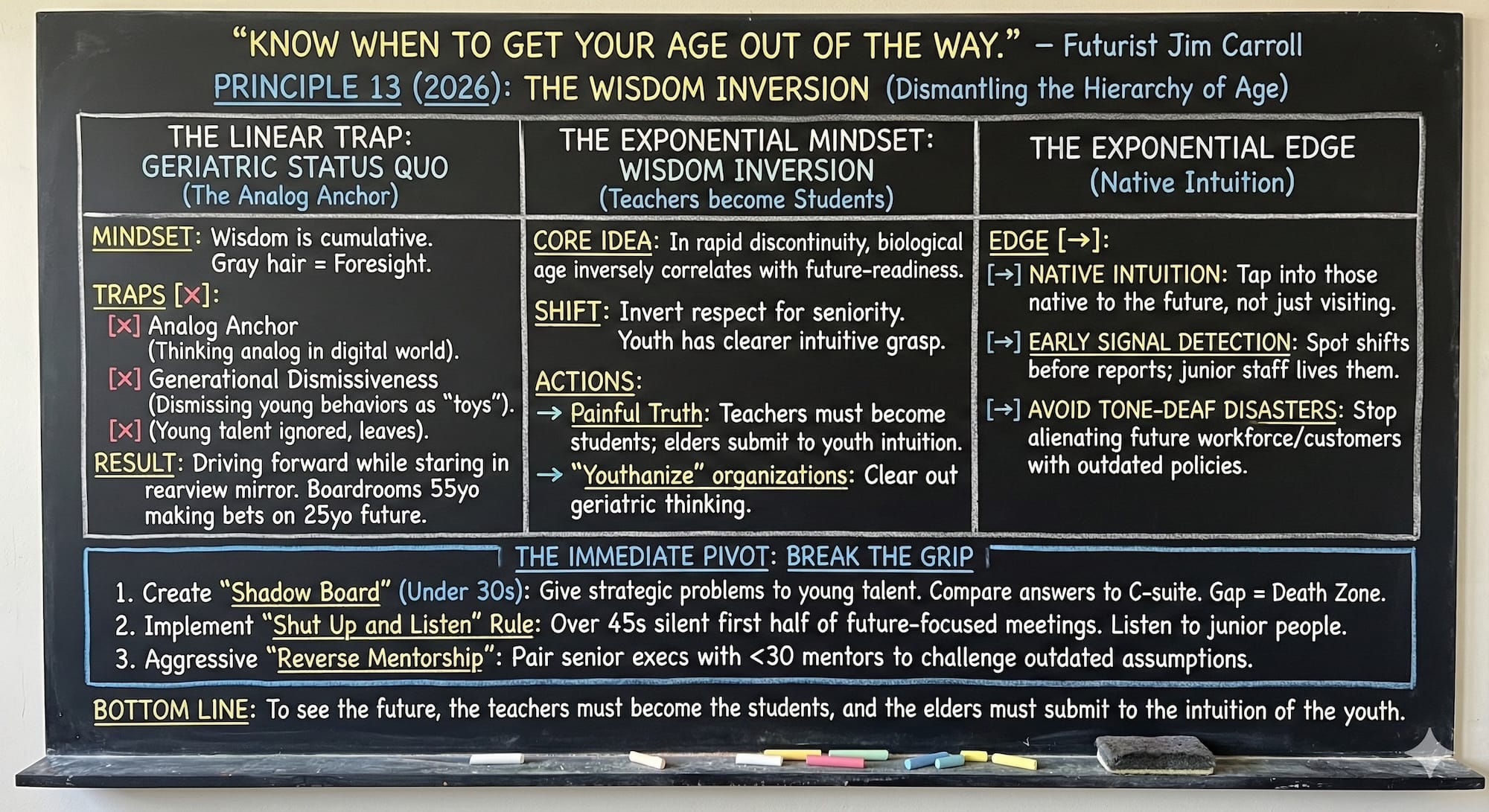
Think about where we are at this moment in time.
In a slow-moving, linear world, wisdom was cumulative. Grey hair was a proxy for foresight. The people at the top of the pyramid had seen the most, so they knew the most. You paid your dues, waited your turn, and eventually, you got to hold the steering wheel.
In an exponential world, that model is completely broken.
When technology, culture, and consumer behaviour shift radically every 36 months, your 30 years of experience isn't just irrelevant; it’s often a dangerous anchor to an obsolete past. You might have earned your way to the top, but by the time you get there, your experience, insight, and wisdom are probably wildly out of date.
The result? Right now, in boardrooms across the world, rooms full of 55-year-olds are making massive strategic bets on a future built by, and for, 25-year-olds.
They are trying to interpret TikTok dynamics through a PowerPoint lens. It's this, right here. That's our reality right now!
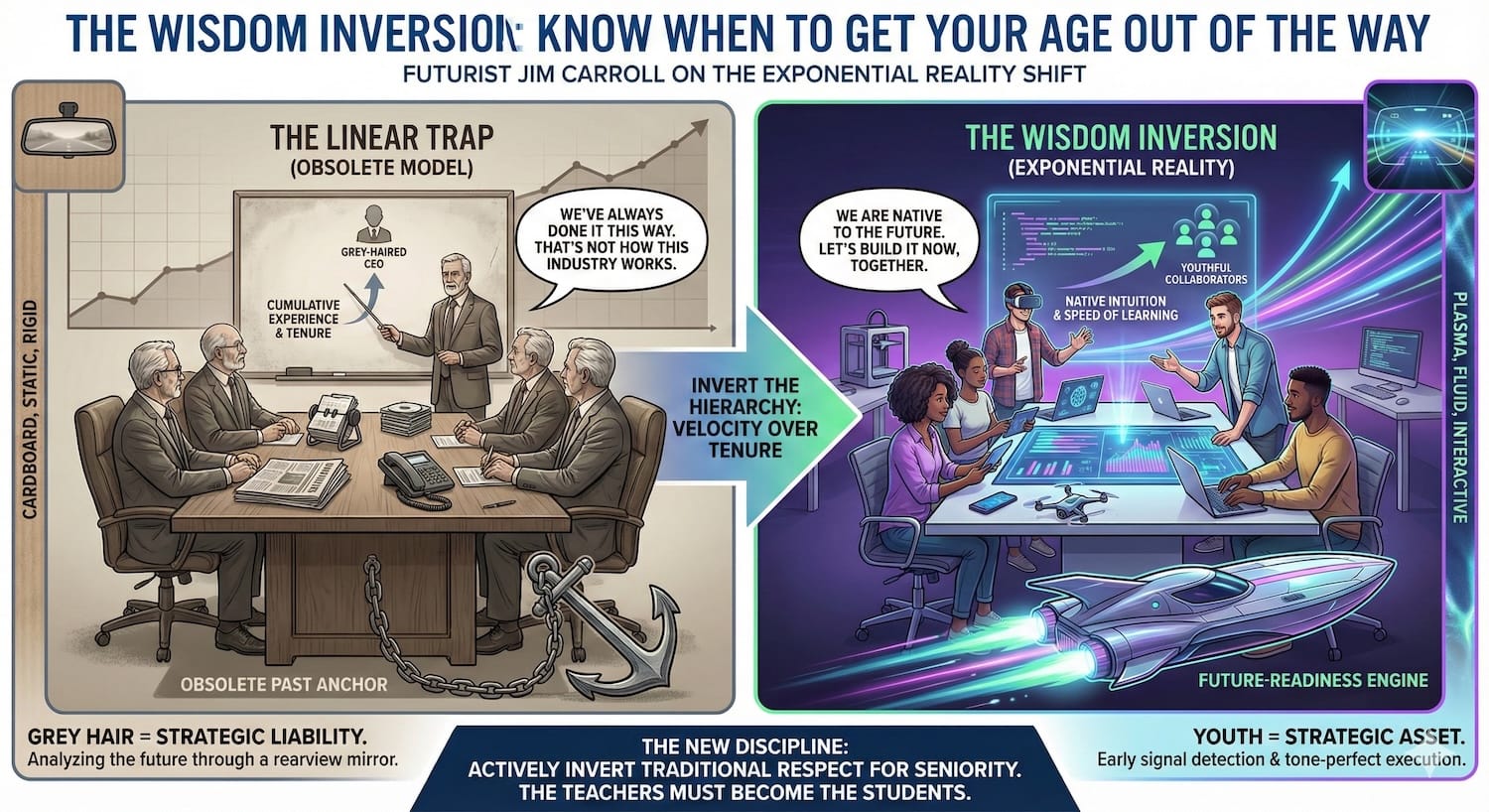
Need an example? They are analyzing decentralized finance business models - weird things involved crypto and blockchain and stuff like that - using banking models from 1995.
And your younger employees? They are rolling their eyes. They are quietly laughing. They are sitting in the back of the room, biting their tongues, watching leadership steer the ship toward an iceberg they spotted five miles back. They are frustrated because they are native to the future that senior leadership is only visiting as tourists.
If your strategy is being dictated solely by the oldest people in the building, you are driving forward while staring into the rearview mirror.
That's why a discipline you must master in 2026, and beyond, is Wisdom Inversion.
This is not a new topic to think about. In my case, I have been covering the issue of generational dynamics for quite some time in my posts and in my keynotes. In fact, if I look back at the keynotes of the last 25 years, I've been hammering this home as one of the most significant trends of our time - because it is.
Here is what I emphasized—the key points I've observed, the implications of what these stories represent, and what it means in terms of our exponential world going forward:
1. The "Cardboard" vs. "Plasma" Leadership Gap
- The Observation: After speaking at a conference in the advertising and promotion industry, I wrote about the distinction between "Cardboard People" and "Plasma People." I noted that the older generation of leadership was "cardboard"—static, fixed, one-dimensional, and structurally rigid. In contrast, the incoming generation was a "plasma"—fluid, high-definition, interactive, and constantly changing state. The event at which I witnessed the dynamic actually had older folks promoting innovative new ideas involving cardboard display cases, while the younger generation was busy building a future built on innovative new in-store screen technology. The dichotomy in thinking was real - and stark!
- The Implication: You cannot run a "plasma" organization with "cardboard" management techniques. When rigid leaders try to force fluid talent into static org charts, the talent evaporates.
- The Exponential Reality: The point I started emphasizing from that moment? Innovation today requires "generational collaborative capability." If your leadership style is low-resolution and static, you are invisible to the high-definition workforce you are trying to lead.
2. The Velocity of Obsolescence: "The Olden Days."
- The Observation: I have told the story countless times of my children asking me, regarding technology that was only a few years old (like 35mm film or TV knobs), "Daddy, is that from the olden days?" I began to emphasize that in our lives, everything has become but a fleeting thing - business models, technologies, products, ideas, and concepts. We are living in a time in which something can seem new and exciting, powerful and relevant, and then - wham! It's from the olden days! That means we need to pick up the pace, align to speed, and elevate our velocity.
- The Implication: This wasn't just a cute story which was a crowd pleaser from the stage (it was and it is!); it was a strategic warning. It proved that for digital natives, the "modern" world of the 50-year-old executive is actually an archaeological dig. My emphasis was that these digital natives knew that everything around them was fleeting and adapted accordingly; older generations needed to.
- The Exponential Reality: You need to come to grips wth the fact that your "experience" is often just a deep familiarity with things that no longer matter. If you are proud of a process that your junior staff views as an artifact, your organization is already a museum.
3. The "Powder" Principle: Values over Ladders
- The Observation: I chronicled the story of a brilliant engineering grad who rejected a prestigious corporate job offer because it interfered with his skiing lifestyle. The CEO was baffled, but the kid’s logic was simple: "Don't mess with my powder, dude." This was an early harbinger of what happened with the pandemic and the shift to working from home. I still believe that in this unique global economy, we have an entire generation of highly skilled workers who refuse to accept the idea of 'return to work' and the need to go into an office. It's not just that - the next generation doesn't just define success on titles and the traditional career path - lifestyle matters!
- The Implication: The "career ladder" is a broken incentive model. This generation does not want tenure; they want a portfolio of experiences. They get bored easily and need to be challenged. They are "transactional" in their career approach—they work to live, they do not live to work. And if they have highly specialized skills that you need, they'll dictate the terms of how and where they will work - not you.
- The Exponential Reality: In a talent-scarce future, you cannot bribe people with status. You can't force them into increasingly obsolete office structures. If you try to force them into a 20th-century "pay your dues" model, they will simply leave for the gig economy or a competitor who offers flexibility.
4. The Death of the "Float" and The Emergence of Instant Finance
- The Observation: In my banking keynotes, I warned that "Gen-Connect" (my term for the hyper-connected generation) does not believe in "the float." The balance they see on their phone is the money they have. A bank executive once told me, "They don't reconcile chequebooks... for them, the balance is the balance." They live in the era of instant finance - auto loan approvals in 45 seconds or less on their mobile phone, insurance quotes that bind them moments before undertaking something new, and real-time updates with anything that has to do with the financial aspects of their lives.
- The Implication: They rely on real-time data, not institutional processing time. They are living in a fast world built on slow COBOL platforms. Furthermore, they trust "peer-to-peer authority" (social proof) more than they trust institutional advice. Brands built for an old financial world bear little relevance in a new one.
- The Exponential Reality: If your business model relies on information asymmetry or processing delays (the float), you are dead. This generation demands radical transparency and immediacy.
5. The Origin of Reverse Mentorship: "Surviving the Information Age."
- The Observation: In my book Surviving the Information Age, I identified that the Baby Boomers were the first generation in history forced to rely on their children to explain the tools of the trade (computers, internet connectivity). Think about it - how many parents do you still see who have their kids fix the technology in their lives?
- The Implication: This flipped the historical flow of wisdom. For the first time, the "elders" were the novices and the "children" were the experts.
- The Exponential Reality: This book was the birth and realization of my idea of "Wisdom Inversion." It established that in a tech-driven world, tenure is no longer a proxy for competence; speed of learning is.
6. The "Nintendo" Governance Clash
- The Observation: As early as 2006, I predicted a massive friction point when the "Nintendo Generation" (gamers, collaborative, global) collided with a political and corporate class that "couldn't manage their iPhone." The younger generation had a brain and mind wired for speed, while those in charge were building a future based on business models and ideas from the 60s, 70s, and 80s. That lasts to this day - much of our political dysfunction comes from 70, 80, and 90-year-old politicians who won't let go.
- The Implication: We are seeing a clash of generations, with extreme frustration by young people with our current reality., Expect continued seismic earthquakes in our not-too-distant future.
- The Exponential Reality: We must "Youthanize" our organizations, companies, and political institutions. This isn't a slur; it’s a strategy. We need to clear out the "geriatric by design" thinking that clogs our arteries and replace it with the collaborative speed of the gaming generation.
7. The "Uber-ization" of Authority (Healthcare)
- The Observation: In healthcare, I noted that while man’s best friend was the dog, "the Millennial's best friend is the mobile phone." They pushed for "Shared Medical Appointments" and "Open Notes," viewing the doctor as a partner, not a god. My tag-line? The "centuries-old" relationship between doctor and patient is changing, and the implications for the health care system (and virtually every other industry) are profound.
- The Implication: They reject authority figures who hoard information. They expect a "negotiation" based on data they’ve already Googled. All relationships going forward - with finance executives, insurance sales executives, doctors, and construction managers - need to be collaborative, not one-way. This trend will only become more profound as future generations are weaned on AI and have an information empowerment model that we probably barely understand!
- The Exponential Reality: The hierarchy of expertise has collapsed. Whether you are a doctor, a CEO, or a consultant, your title commands no respect unless it is backed by real-time value and transparency - and the same in-depth information that they have!
8. The Intra-Generational Fracture
- The Observation: By 2017, I was warning that technology moves so fast that we can no longer even speak of "generations" like Gen Z or Millennials as monolithic blocks. The difference between a 25-year-old and a 15-year-old is now massive, defined by the platform they "grew up" on (e.g., Facebook vs. Snapchat). My 34 and 32-year-old sons sometimes seem generations apart, even though there is only a 2-year age difference. Today's 10-year-old, already using ChatGPT, is in a world that we no longer understand.
- The Implication: Broad generalizations fail. We are moving into an era of micro-generations where the "culture"changes every 3 to 5 years, if not faster.
- The Exponential Reality: You need a strategy that adapts and aligns to multiple different age categories, and categories within those categories. If your HR policies or marketing strategies are built for a "generation" that spans 15 years, you are missing 80% of the target.
1. The Exponential Mindset
The Wisdom Inversion?
It's an aggressive realization that in an era of rapid discontinuity, biological age often inversely correlates with future-readiness. Let me be blunt - increasingly, old people don't get it, and young people do. I say that with a straight face - I'm 66 as I write this.
It is the discipline of actively inverting the traditional respect for seniority, recognizing that your newest, youngest employees often possess a clearer, intuitive grasp of emerging behaviours than the C-suite.
It means accepting a painful truth: to see the future, the teachers must become the students, and the elders must submit to the intuition of the youth.
2. The Linear Trap
Why is this generational divide paralyzing companies? Ego and dismissal. Hubris - the very thing I covered in the last post.
Think about what's happening out there - take a look around and you'll it everywhere.
- The "analog anchor": People are still thinking analog in a digital world. They're stuck in a world of CDs and LP records in a Spotify era! Some senior leaders are psychologically incapable of letting go of the business models that defined their careers. They view new behaviours through an analog filter, forcing square digital pegs into round legacy holes.
- Generational dismissiveness: Generational arrogance knows no bounds. There is a wild tendency of older leaders to dismiss the behaviours of younger generations (gaming, crypto, the creator economy) as "toys," fads, or wastes of time, failing to recognize them as the early signals of massive economic shifts.
- The frustration feedback loop: Young talent offers an insight, gets patted on the head by a senior leader, and is told, "That's not how this industry works." Well, actually, that is how things work NOW! The young talent stops offering insights, disengages, and eventually leaves for a company that gets it.
3. The Exponential Edge
This new world demands a dramatic shift - because when trends exponentiate, wisdom becomes irrelevant - and young experience matters. When you execute The Wisdom Inversion and stop letting seniority dictate strategy, you gain an immediate advantage. One of my fundamental beliefs as a futurist is that the younger generation has better insight into the trends that define tomorrow than older generations do. This leads to some pretty significant changes!
- Native intuition vs. acquired analysis: When you 'get young,' you tap into people who live in the future rather than just read executive summaries about it. They don't need to analyze the shift; they are native to it.
- Early signal detection: You spot cultural shifts years before they show up in a McKinsey report, because your junior staff is already living those shifts. They're already there, and they've been trying to tell you about it. Start listening!
- Avoiding tone-deaf disasters: You stop launching marketing campaigns, products, and HR policies designed by Boomers and Gen X that completely alienate the Millennials and Gen Z workforce and customer base that actually drive future growth.
4. The Immediate Pivot
You need to forcibly break the grip of the geriatric status quo. Here are your immediate actions:
- Create a "shadow board" (under 30s only): Select 8-10 high-potential employees under the age of 30. Give them the same strategic problems the senior executive team is wrestling with. Ask for their unvarnished recommendations. Compare their answers to the C-suite’s answers. The gap between those two documents is your organization's death zone.
- Implement a "shut up and listen" rule: In your next strategy meeting on a future-focused topic (AI, new demographics, etc.), implement a rule: No one over age 45 is allowed to speak for the first half of the meeting. They must sit on their hands and listen to the junior people in the room.
- Practice aggressive "reverse mentorship: Flip the traditional mentorship model on its head. Pair every senior executive with a "mentor" under 30. The mandate isn't a polite coffee chat. The mandate is for the junior mentor to aggressively challenge the senior leader's outdated assumptions about technology, culture, and work. If the senior leader isn't uncomfortable, it's not working.
Quite simply, in today's rapidly changing world, decades of experience are a disadvantage - because they are using old methods to solve modern problems.
Get your ego out of the way. Forget wisdom - think generational collaboration instead!
Jim Carroll's 1997 book, Surviving the Information Age, continues to be a powerful indictment of the change barriers that come with slow-moving minds in an era of fast change.