
"Scale immediately or fail slowly. There is no middle ground."- Futurist Jim Carroll
Futurist Jim Carroll is writing his end-of-2025 / introduction-to-2026 series, 26 Principles for 2026. You can follow along at 2026.jimcarroll.com. He welcomes your comments.
We are on Day 15!
You’ve listened to the edge (Day 13) and filtered out the hype to find a real structural signal (Day 14).
You have identified a real trend!
Now, you face the moment where most legacy organizations fail.
People often talk about something called "pilot purgatory," and the fact that people and organizations get stuck there. It's the tendency to test or trial a new idea - and then get stuck there, never moving beyond the testing or 'pilot' phase. Yup, it's a form of purgatory!
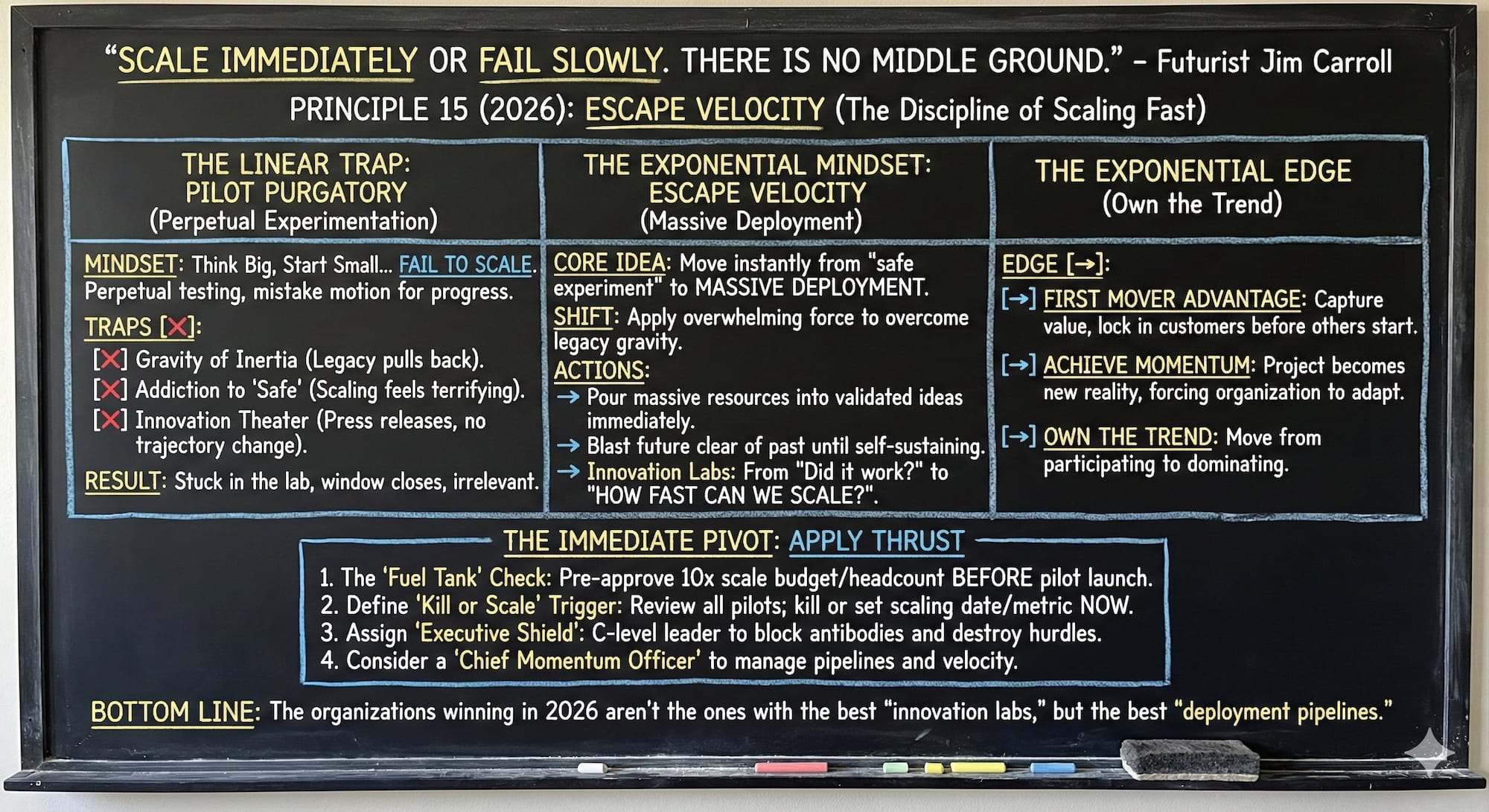
Here's your chalkboard summary!
Let's put the challenge in context. For years, I have advised leaders to follow a simple, powerful mantra for innovation in a fast world: Think Big, Start Small, Scale Fast.
Most organizations are pretty good at the first two. They "think big" in strategy sessions. They "start small" with innovation labs and proofs-of-concept.
But they completely fail at the third and most critical step: scale fast. They end in a state of perpetual experimentation where they run dozens of small, safe tests that generate interesting things - but never make it out of the starting gate. And in doing so, they mistake motion for progress - they believe that the mere fact that they are testing a bunch of things means they are making progress.
They aren't.
Here's the problem - in a linear world, you could slowly roll out a new initiative over two or three years. You had the luxury of all the time in the world.
But in an exponential world, that doesn't work. You are surrounded by the problem of legacy - existing processes, IT systems, organizational sclerosis, and bureaucratic inertia designed to keep doing things the same way. That means to move fast, you need more effort than ever before - because in this new fast world, you need to move instantly from a "safe experiment" to "massive deployment."
The discipline to do that? Let's call it! Escape Velocity.
I have been covering the issue of velocity and scale for years. When I look back through my own archive of blog posts, keynotes, and Daily Inspirations, I see a clear pattern of organizations that understood how to achieve this momentum. But some did.
1. The $200 Million Pouch (StarKist)
Oh, I love this story! And in fact, it's one of the most trafficked videos on my site!
- The Observation: For 110 years, StarKist sold tuna in tin cans. Then someone finally asked: "What if we didn't do it this way?", referring to tests of a new, resealable plastic tuna pouch. And yet, they launched it into not just a few stores; they scaled it instantly for wide distribution.
- The Scale: A simple shift in packaging format generated $200 million in additional revenue in year one alone.
- The Exponential Reality: Ask yourself this - what's your 'tin can '? What legacy object, idea or process is holding you back? In 2026, the most massive scaling opportunities often hide in the most mundane "legacy"objects. Scaling fast doesn't always mean inventing a new technology; often, it means applying a new form factor to an old asset, or a new idea to an old concept. It involves going from a tin can to a reusable tuna pouch!
2. Cannibalizing the Cash Cow (Apple)
- The Observation: Apple has certainly been (maybe up until now) one of the most interesting, innovative companies out there. I've long shared the statistic that for a time, 60% of their revenue comes from products that didn't exist 5 years ago. (I don't know if that is still true) Part of that involves continuous product reinvention - I’ve often highlighted how Apple dared to cannibalize its own massive iPod business to create the iPhone. They got rid of one product - quickly - to move up the chain of innovation. While others protected their legacy revenue, Apple realized that if they didn't kill their own product, someone else would. Self-cannibalization, as it were.
- The Scale: They didn't "test" the iPhone as a niche accessory for iPod owners; they bet the entire future of the company on it, shifting resources aggressively. Think about the day a new iPhone comes out - it's fast scaling at a national and global level.
- The Exponential Reality: True scaling requires "letting go of the past." You cannot achieve escape velocity if you are tethered to the safety of your declining legacy revenue. The winner is always the company willing to destroy its primary revenue stream today to own the platform of tomorrow.
3. The Logistics Pivot (Walmart & Target)
- The Observation: By 2018, analysts predicted Amazon would devastate traditional retail. They simply had too much momentum going. Instead, Walmart and Target achieved massive e-commerce growth by taking a liability—expensive physical real estate—and reimagining their thousands of stores as mini fulfillment centers. They built the software, infrastructure, and systems to support home delivery, taking on the behemoth on the block.
- The Scale: Walmart used this strategy to fuel 40% e-commerce growth and turn its physical footprint into a rapid-delivery network that rivalled Amazon's. By the time the pandemic hit, they were well-positioned to survive - and thrive!
- The Exponential Reality: Scale is often about "asset flipping." You don't always need to build new infrastructure to scale; you need to re-code the purpose of what you already have. In an exponential world, a physical store is just a node in a logistics network.
4. Speed as an Operational Asset (Honda)
- The Observation: In the world of manufacturing, scale is critical. For years, I shared the story of how Honda industrialized flexibility, developing the ability to switch manufacturing models in just 10 days while competitors took months. Much of this was pioneered at a plant in Graz, Austria - a facility that turned out to be the model test case for manufacturing flexibility.
- The Scale: This wasn't a one-time project; it was an architectural shift that allowed them to scale production of popular models instantly in response to demand. That began to lead to a fundamental shift in the automotive industry, and the concepts continue to this day throughout the world of manufacturing.
- The Exponential Reality: Speed is not a project; it is an architecture. You cannot "scale fast" if your underlying infrastructure is hard-coded. In 2026, your physical operations must be as fluid as software. If retooling takes months, you are already dead.
5. The Process Pivot (Kitchen Cabinet Manufacturer)
- The Observation: From 2004 to 2007, the global software powerhouse SAP booked me to headline dozens of events, where I would combine a keynote with a discussion with key customers (CIOs of major companies). One organization I spoke to had put in the hard work of a massive IT upgrade to automate inefficient manual processes in their back office. The result? They were able to move faster from the idea of mass production of product to mass customization, which today, almost 20 years later, is one of the core concepts taking hold throughout the manufacturing industry.
- The Scale: They moved 3.5 people from order processing to custom sales. Moving them from being a direct cost to folks who were adding real value. The result? A 40% increase in sales and a 60% increase in profits within one year.
- The Exponential Reality: Scaling isn't always about "more technology"—sometimes it's about shifting human talent. By automating the "boring," you unleash the "exponential." You scale by moving human intelligence from the back office to the front line.
In all of these cases, the organization had an idea, tested it, and then managed to get beyond pilot purgatory into implementation reality.
That's one of the most critical skills you need to learn for 2026 and beyond.
The External Reality: 10 Examples of "Escape Velocity" in 2025
But those are stories from the recent past. What does "Escape Velocity" look like right now, in the AI-fueled reality of 2025 and 2026?
The fact is, it is happening. Here are some real-world examples.
- Mercari’s Agentic Scale (500% ROI): While others play with chatbots, Mercari deployed autonomous AI agents for customer service. They didn't stop at a pilot; they scaled to full deployment, anticipating a 500% ROI and reducing employee workload by 20%, moving from having a "human-in-the-loop" to "a human-on-the-AI-loop." There is no doubt that customer support is one of the 'low-hanging fruits' for AI deployment - and literally everyone is testing the idea. Yet, this organization reports they've been able to scale the opportunity from testing to reality
- Waymo’s Robotaxi Reality: Waymo finally broke the "perpetual pilot" barrier of self-driving technology. They are now logging 200,000 paid rides per week, moving from a science experiment to reality. One of the ways they have done this is by mastering the ability to learn from continuous new data - every mile driven trains the entire fleet instantly.
- Klarna’s Support Revolution: Another support story - Klarna’s AI assistant handled 2.3 million conversations (two-thirds of customer service chats) in its first month of broad release. It did the work of 700 full-time agents with equal satisfaction scores. They scaled from 0 to 2.3 million in a heartbeat. This should serve as a real-world example to everyone experimenting with such an idea today.
- Albemarle’s "Solve One, Scale Everywhere": Instead of running 50 pilots, this chemical giant used AI to solve one critical problem: the variability of quality in different production batches. They then immediately scaled that single solution globally to generate $50 million in savings. Scale. fast!
- Schneider Electric’s "AI Hub": By centralizing talent into a 350-person "AI Hub," they forced standardization, allowing them to deploy a supply chain model that improved accuracy and cut safety stock by a third in just six weeks. They built a "scaling machine," not just a model.
- Pfizer’s "Velocity Alignment": Using GenAI, Pfizer cut the drafting time for complex medical documentation by a reported 70% (Sometimes, we have to take such claims at their word). They report that they turned their process upside down - rather than having AI "assist" writers, they went to a model in which the AI writes and humans review. This is fundamental process re-engineering at scale. (Back in 2009, I keynoted a group called the International Society of Medical Publishing Professionals. Scary to think about what my keynote slides might look like in the context of this reality!)
- Domina’s Logistics Leap: This Colombian logistics firm integrated Google’s Vertex AI to predict package returns directly into their core workflow, improving real-time data access by a reported 80% and delivery effectiveness by 15%. The project involved one of the most likely paths for AI deployment - a private AI model that can be customized to specific needs.
- Rocket Lab’s Cadence: While legacy aerospace plans launches for years, Rocket Lab is treating rockets like software releases, scaling launch frequency to unprecedented levels and proving "Time to Market" is now a commodity service in space.
- Morgan Stanley’s AI Strategy: They built an AI assistant that listens to client conversations and drafts follow-up materials instantly. The assistant, called Debrief, keeps detailed logs of advisors' meetings and automatically creates draft emails and summaries of the discussions. CNBC has reported that over 98% of advisor teams now actively use the system. Scale? They scaled this "bionic analyst" to thousands of advisors overnight, fundamentally upgrading their workforce's capability.
- Mercedes-Benz’s "Talking Car": They moved past linear voice commands to exponential conversational agents using LLMs. Crucially, they deployed this via Over-The-Air (OTA) updates, upgrading the entire fleet instantly without a single dealer visit. Cars have become iPads on wheels, upgradable in an instant, and this is a great example of what happens with 'scale' when the architecture is put in place.
What can we learn from such ideas? The organizations winning in 2026 aren't the ones with the best "innovation labs." They are the ones with the best "deployment pipelines" - the ones who can take the ideas in those labs and turn them into reality.
Added: In that context, the idea of innovation labs is moving from "did it work?" to "how fast can we scale?"
Let's put all this in context in light of the mind model I've been using to get you thinking about how to approach 2026 and beyond - the mindset you need, the trap you are within, the edge that change will get you - and how you might get there!
1. The Exponential Mindset
You need to lock the idea of "escape velocity and scaling fast as one of the key skills you need to master.
And it's coming to understand that this is really tough to do.
To launch a new exponential business model, you must apply overwhelming force to overcome the gravitational pull of your legacy operations. To roll out an actual new product or service means cutting through layers of organizational inertia. It's recognizing that the innovation killers are all around you and are designed to slow you down.
In that context, it's all about developing the organizational capability to take a validated "small start" or tiny, test idea - and immediately pour massive resources into it, including talent, capital, and executive support.
It's coming to understand that you don't slowly integrate the future; you blast it clear of the past until it becomes self-sustaining and too big to kill!
2. The Linear Trap
Why do companies get stuck in pilot purgatory, never breaking free?
- The gravity of inertia: Think of this way: your current business is a massive planet with huge gravity. It naturally pulls resources and attention back to the way things were, rather than propelling them forward to the way they could be. Without sufficient escape thrust, every new initiative eventually crashes back to the surface of "how we've always done it." Go back and read my innovation killers - that's what you are up against!
- An addiction to "being safe": Starting small feels safe. Scaling fast feels terrifying. Linear leaders hide out in the "lab" and testing phase because it feels comfortable. And this eventually kills the opportunity - because they require 100% certainty before scaling, they wait too long, and the window of opportunity has closed.
- Innovation "theater": Too many organizations 'play' at innovation, but never actually get anything out of the starting gate. Who are they? Organizations that love to issue press releases about their pilots. CEOs who get on stage and boast about new products and new services that are never delivered. Companies that attach themselves to the global hype machine as a way to boost a stock price, but never follow through. It looks like innovation. But without a mandate to achieve escape velocity, it’s just theater designed to placate shareholders, changing nothing about the company's trajectory.
3. The Exponential Edge
2026 and beyond is all about learning how to scale - because when you master Escape Velocity, you move from participating in a trend to owning it:
- Moving fast and making things: It's long been a reality that when it comes to digital trends, the first player to scale captures disproportionate value. By moving fast, you lock in customers and data before others leave the starting gate.
- Achieving momentum: A pilot project is easily killed by internal antibodies (resistors to change). But a project that has achieved escape velocity quickly becomes the new reality, forcing the rest of the organization to adapt to it.
4. The Immediate Pivot
You need to stop running science experiments and start applying thrust - again, think of this like a rocket launch
Here are a few ideas to get you going.
- The "Fuel Tank" Check: Before approving any new "Start Small" pilot, demand to see the scale plan. If the pilot hits its metrics in 90 days, exactly how much budget and headcount is pre-approved to release on Day 91 to scale it 10x? If there is no fuel in the tank for scaling, do not launch the rocket.
- Define the "Kill or Scale" Trigger: Review every pilot project currently running in your organization. Force a decision for each: It must either be killed today because it's not working, or it must be given a specific date and metric trigger for massive scaling. No more indefinite orbits.
- Assign an "Executive Shield": A scaling project needs protection from the gravity of the core business. Assign a C-level leader whose primary job is not to manage the project, but to aggressively block corporate antibodies, secure resources, and destroy bureaucratic hurdles that slow its ascent.
Last but not least, consider the idea of a "Chief Momentum Officer" to get you going! I wrote about this idea way back in 2009 (!) in a post. Here's what I wrote!
This individual will carry several responsibilities, such as:
- managing the product innovation pipeline, so that the organization has a constant supply of new, innovative products, as existing products become obsolete, marginalized, or unprofitable
- managing the talent pipeline, so that the organization can quickly ingest all kinds of specialized new skills
managing the technology pipeline, so that the organization can adapt itself to constantly improving and ever-more sophisticated IT tools - that will help to better manage, run, grow, and transform the business
- maintain and continually enhance brand and corporate image; as I've written here many times before, brands can become "tired" and irrelevant if they aren't continually freshened and refreshed
- ensuring that the organization is continuing to explore new areas for opportunity, and that it has the right degrees of innovation momentum
that the business processes and structure of the organization are fine-tuned continuously so that it can keep up with all the fast-changing swirl around it - ensuring that a sufficient number of "experiential" programs are underway with respect to product, branding, markets, and other areas so that the overall expertise level of the organization is continually enhanced

In other words, the CMO has two key responsibilities:
- keeping a fine-tuned eye on the trends which will impact the organization in the future, and which will serve to increase the velocity that the organization is subjected to and;
- keeping their hands on the appropriate levers throughout the organization, such that it can keep evolving at the pace that these future trends will demand.
I don't know if that makes perfect sense, but I think it's a good issue to think about.
If you take that second last bullet - that's your issue of scale and escape velocity right there!
Futurist Jim Carroll has seen way too many organizations stuck in a state of perpetual pilot purgatory.