
“Your brain is built for addition. The future is built on multiplication.” - Futurist Jim Carroll
Futurist Jim Carroll is writing his end-of-2025 / introduction-to-2026 series, 26 Principles for 2026. You can follow along at 2026.jimcarroll.com. He welcomes your comments.
When exponential change arrives, it never goes well.
That's because most people fail to understand what it means and don't act, which is a problem. After all, there is a remarkably narrow window between "this will never work" and "how did we miss this?"
We are on Day 16. Earlier in this series (go back to Day 2), we confronted the staggering velocity of change—the doubling of scientific knowledge, the acceleration of technological breakthroughs.
But there is a massive, invisible chasm we have not yet crossed:
It is the gap between intellectually knowing the numbers and viscerally comprehending what they mean for your reality in 36 months. It's called the scale-blindness epidemic, and why your brain cannot comprehend what is coming.
Here's your chalkboard summary:
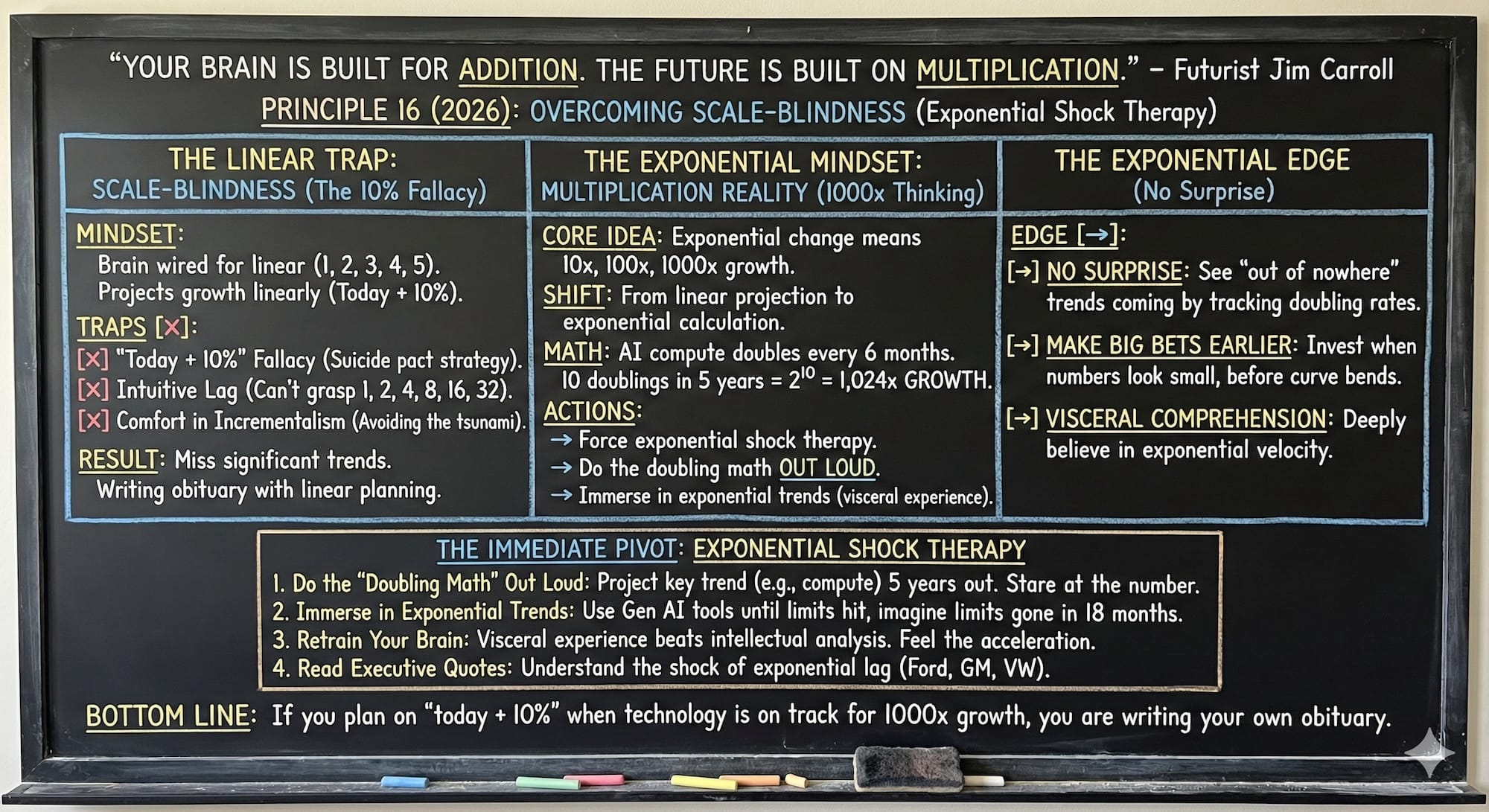
(Even this image should give you pause. Just a few months ago, most AIs couldn't spell. They can now generate incredibly text-dense images like this - that are mostly error-free - in but seconds!)
Consider this: you can read the reports on AI growth, computing power, or synthetic biology until your eyes bleed. You can nod your head and agree that things are moving fast.
But deep down, you don't believe it.
Why? Because you are a human being. We are linearly wired creatures living in an exponential world. Our brains evolved to track linear threats—a lion moving across the savannah at a constant speed. We understand “1, 2, 3, 4, 5.” Slow, linear growth.
But it seems we are biologically incapable of intuitively grasping “1, 2, 4, 8, 16, 32.” Wildly fast exponential growth.
Because of this evolutionary flaw, the vast majority of leaders suffer from "Scale-Blindness." When we look at an emerging exponential technology, our brains instinctively project its growth linearly. We do a 1-2-3-4-5 - not a 1-2-4-8-16-32. We look at what it can do today—which is usually underwhelming—and assume next year it will be maybe 10% better. And the fact is, it could be 100% better, or 1,000%, or maybe even 10,000%
And because of our blindness, we fail to miss out on the significance of the trend.
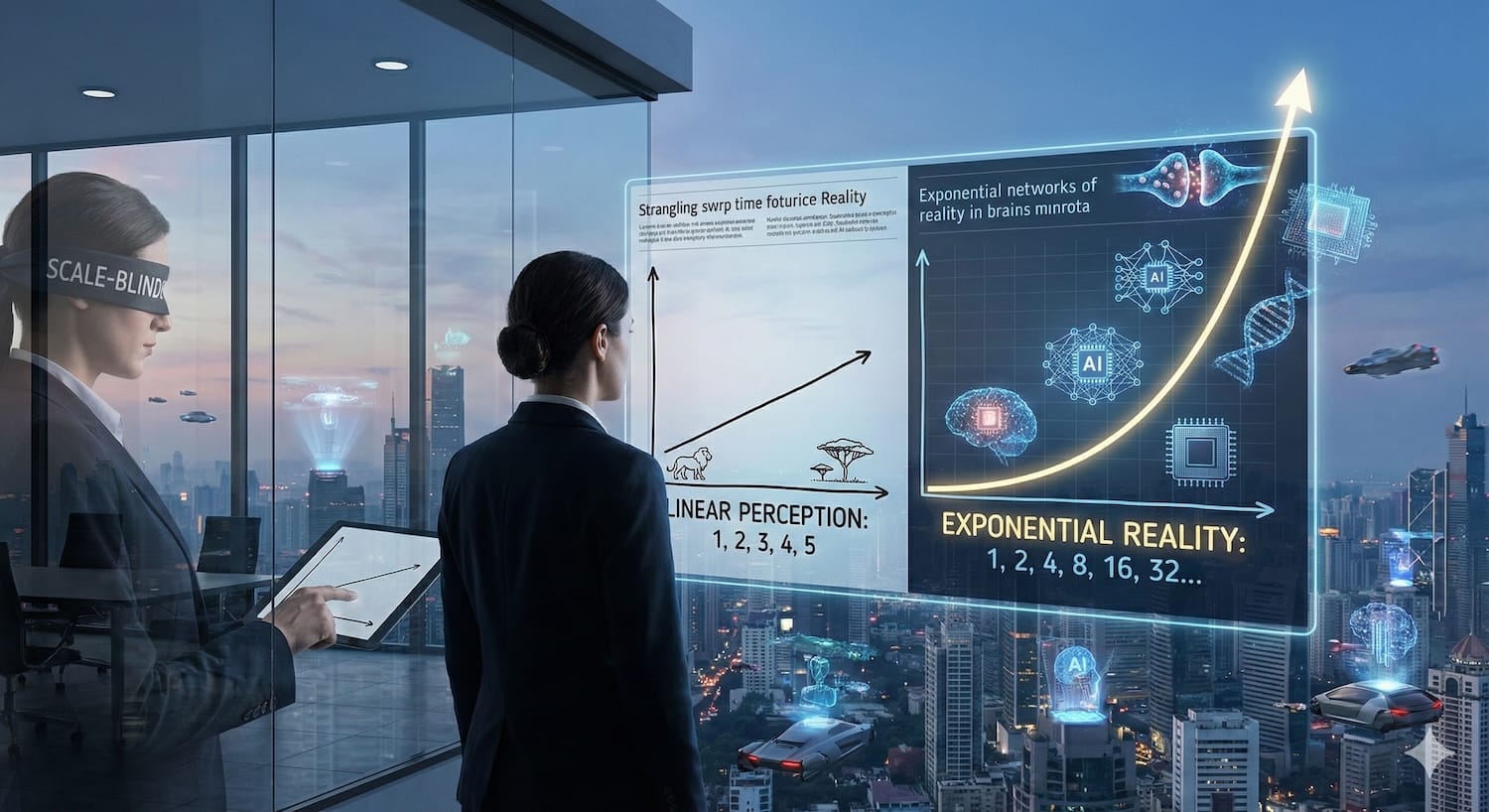
Think about it another way - if we see a 10-foot wave coming and prepare accordingly, completely blind to the fact that the exponential function will turn it into a 100-foot tsunami by the time it reaches shore.
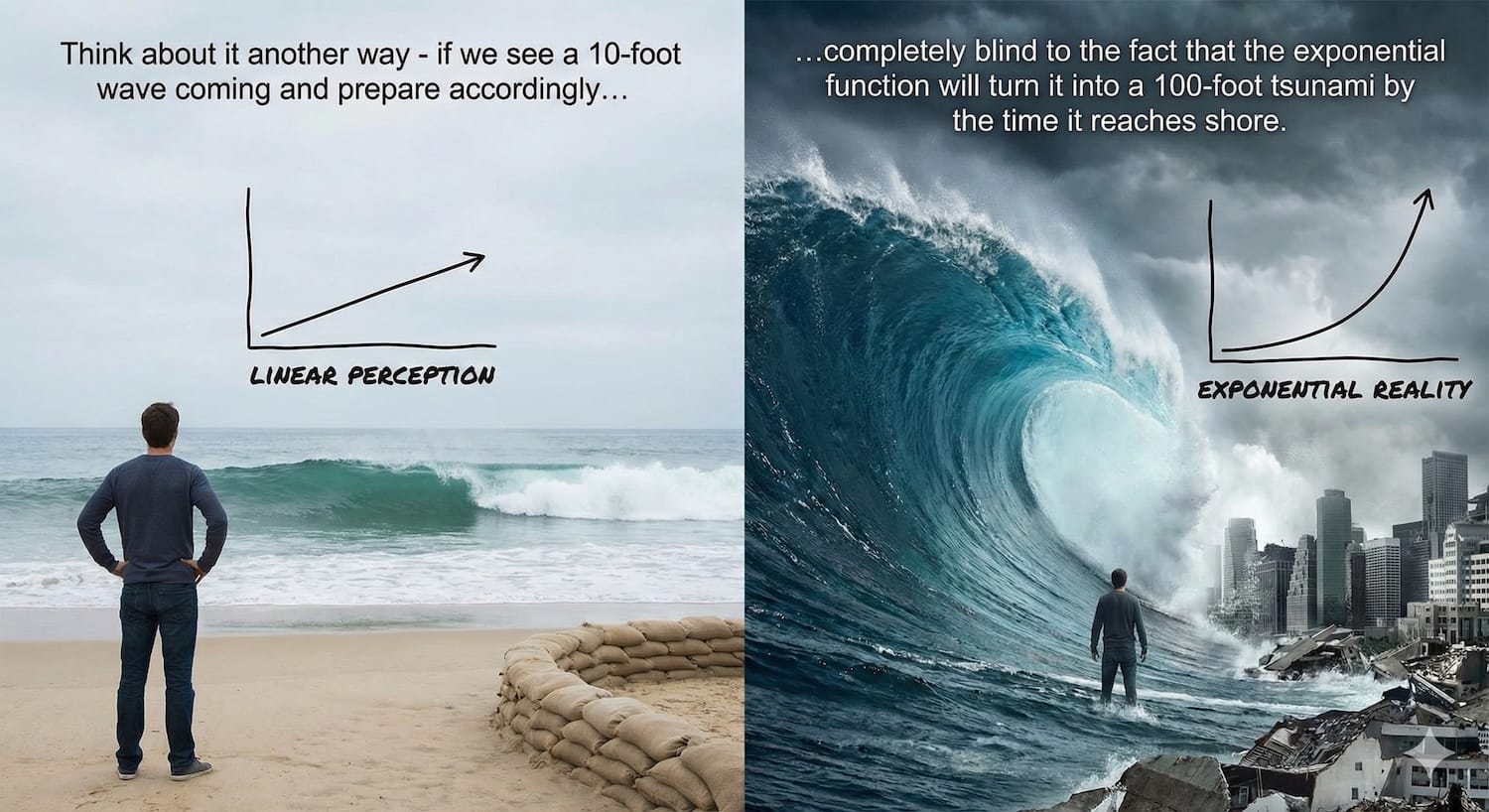
That's why principle #16 in this series isn't about learning more facts; it's about forcing your brain to undergo a sort of exponential shock therapy so you can cure this blindness before it's too late. That's because there is comfort in incremental thinking!
The Exponential Edge: Economic Whiplash
I want you to go back just a few years - not for the typical Blockbuster, Kodak, and Nokia stories - but for more recent events. We have witnessed an unprecedented collection of corporate reckoning moments from 2020 to 2025—executives publicly admitting shock as billions in value were destroyed or created in months rather than decades.
Some of this was due to this exponential lag - they were strategizing for a linear world in which exponential change was taking hold. The implications of that blindness are stark!
Automotive: The "Humbling" Reality of China's EV Scale
For years, legacy auto treated electric vehicles (EVs) as something that would always be just a niche market. And now, even as EV mandates are rolled back in the US, the rest of the world marches on. Norway is almost 100% EVs! China owns the future of the automotive market because of EVs. And that data proves how quickly "niche" becomes "dominant."
- The Velocity: EVs were 2% of global car sales in 2018. By 2023, they were 18%, with weekly registrations roughly equal to the entire year’s total in 2013.
- The Shock: Ford CEO Jim Farley admitted that China’s EV lead was "the most humbling thing" he had ever seen.
- The Consequence: Ford’s Model E division accumulated approximately $15 billion in losses since 2021. This is not a "sales dip"; it is an entire national auto industry realizing a foreign bloc can undercut their economics and industrial base in less than a decade.
Semiconductors & AI: The Trillion-Dollar Jump
While other industries worry about 10% growth, the infrastructure of the future is rewriting energy plans and national budgets.
- The Scale: Global semiconductor revenue is projected to jump from $650 billion in 2024 to over $1 trillion by 2029.
- The Demand: The AI server market alone is forecast to grow 6x—from $140 billion to $850 billion—by 2030.
- The Power: Goldman Sachs estimates data center power demand will grow 160% by 2030, consuming 3-4% of global electricity.
Strip away these numbers, and it's pretty evident the US would be in a pretty significant recession if it weren't for the AI buildout. Tech companies like Crucial, which provided technology to the consumer sector, have suddenly abandoned those markets to take part in the AI frenzy.
Retail & Logistics: Automate or Evaporate
The definition of "fast" within this has been rewritten by software.
- Fashion: Traditional design cycles took months. Shein now adds roughly 7,200 new styles per day, using real-time predictive data to test micro-batches. An influencer wears a new design on Instagram? It's in production in hours on the other side of the world.
- Logistics: Maersk pivoted from "shipping" to "integrated logistics," using AI to flip physical assets into data engines. This mirrors the "Asset Flipping" strategy seen where logistics firms integrate AI to predict package returns before delivery, improving effectiveness by 15%.
Biotech: The Collapse of Time
In a linear world, drug discovery took a decade. In an exponential world, biology is programmable and now takes months, if not weeks.
- The Old Way: Traditional drug development takes 4-6 years to reach trials.
- The New Way: Insilico Medicine took a molecule from target identification to Phase 2 clinical trials in just 18 months.
- The Vaccine: Moderna compressed a typical 10-15 year vaccine development timeline by 90%, going from sequence to authorization in 11 months.
The Math: A Visceral AI Reality Check
If you want to understand why your current 5-year plan might be obsolete, grab a calculator. Consider AI training compute:
- The Trend: Compute used to train leading AI models has been doubling roughly every six months since 2010.
- The Calculation: Ten doublings in five years is 2¹⁰, which equals 1,024.
- The Implication: If a frontier model in 2025 uses "1 unit" of compute right now, a continuation of this trend means models in 2030 will train on roughly 1,000 times more compute.
General human knowledge, which once took a century to double, now doubles approximately every 12 hours. Consequently, the half-life of a professional skill has plummeted from 30 years to a mere five years. We are now leveraging this 1,000 times exponential growth on top of that - what's going to happen with knowledge and careers?
Insurance: Data as a Differentiator
- The Win (Progressive): Progressive built a 30-year advantage in telematics, accumulating 10 billion miles of driving data. Executives confirmed that telematics was "3x more predictive than any other rating factor". By 2023, their market share grew to 15.3% while competitors stumbled.
- The Miss (GEICO): GEICO’s late adoption of telematics contributed to the largest auto underwriting loss in its 100-year history ($1.9 billion in 2022). The result was a forced 60% workforce cut, dropping from 50,000 employees to 20,000.
Automotive: The Teardown Shock
- The Win (Battery Costs): While OEMs struggled, battery economics defied forecasts. Pack prices dropped to $115/kWh in 2024, with some Chinese cells hitting $44/kWh—a 97% decline since 1991.
- The Miss (Ford & GM): When Ford tore down a Tesla Model 3, engineers were shocked to find their own Mach-E contained 1.6 kilometers more electrical wiring. Meanwhile, GM’s Cruise unit—once confident they had "the lead"—burned through $10 billion before a safety incident forced a total shutdown and a "reset".
Energy: Forecasts vs. Reality
- The Win (Xcel Energy): In 2017, Xcel received "shocking" bids for solar-plus-storage at $36/MWh and wind at $21/MWh - lower than the operating cost of existing coal plants.
- The Miss (The IEA & Big Oil): The International Energy Agency’s 2022 solar forecast for the year 2040 was nearly met in 2024, missing the mark by 16 years. Meanwhile, Shell and BP took combined write-downs exceeding $40 billion in 2020, explicitly acknowledging the risk of stranded assets.
Agriculture: The Robot vs. The Vertical Farm
- The Win (John Deere): Deere successfully transformed a 185-year-old heavy iron business into a robotics leader. By acquiring Bear Flag Robotics and iterating fast, they launched fully autonomous tractors by 2025 that process visual data in 100 milliseconds. They were rapidly aligning with the new world of smart farming.
- The Miss (Vertical Farming): High-tech farming startups Bowery and AppHarvest burned through over $3 billion in capital before collapsing. They failed because they tried to defy basic economics (selling $16/lb lettuce vs $6/lb store brands) rather than solving a scalable problem. (I still believe there is a real path forward for vertical farming - see my post on it.)
Professional Services: The AI Implementation Gap
- The Win (Allen & Overy): The legal giant deployed Harvey (GPT-4) to 3,500 lawyers, processing 40,000 queries in beta and saving a reported 7 hours per contract negotiation.
- The Cautionary Tale (Klarna): Klarna initially bragged about AI doing the work of 700 agents and froze hiring. By May 2025, they had to reverse course and rehire humans, admitting that prioritizing cost over quality led to degraded service.
Conclusion: The Imperative of Velocity!
If you are planning on "today plus ten percent" in a market where the underlying technology is on track for 1000x growth over your planning horizon, you are not planning. You are writing your own obituary.
The greatest risk today isn't the speed of change; it is your failure to pick up your pace. To survive, you must move from "safe experiments" to "massive deployment" instantaneously - the scale issue covered in Principle #15.
The future belongs to those who can do the math—and then have the courage to scale.
Remember - scale blindness is hard to cure - because linear thinking feels safe. We fall to the “Today + 10%” Fallacy."We build ourselves a suicide pact built on linear assumptions, taking last year's results, adding 5-10% for growth, and call it a strategy. That thinking no longer works!
I've been covering this challenge for quite some time, calling it the 'acceleration gap', often in the context of particular industries and issues.
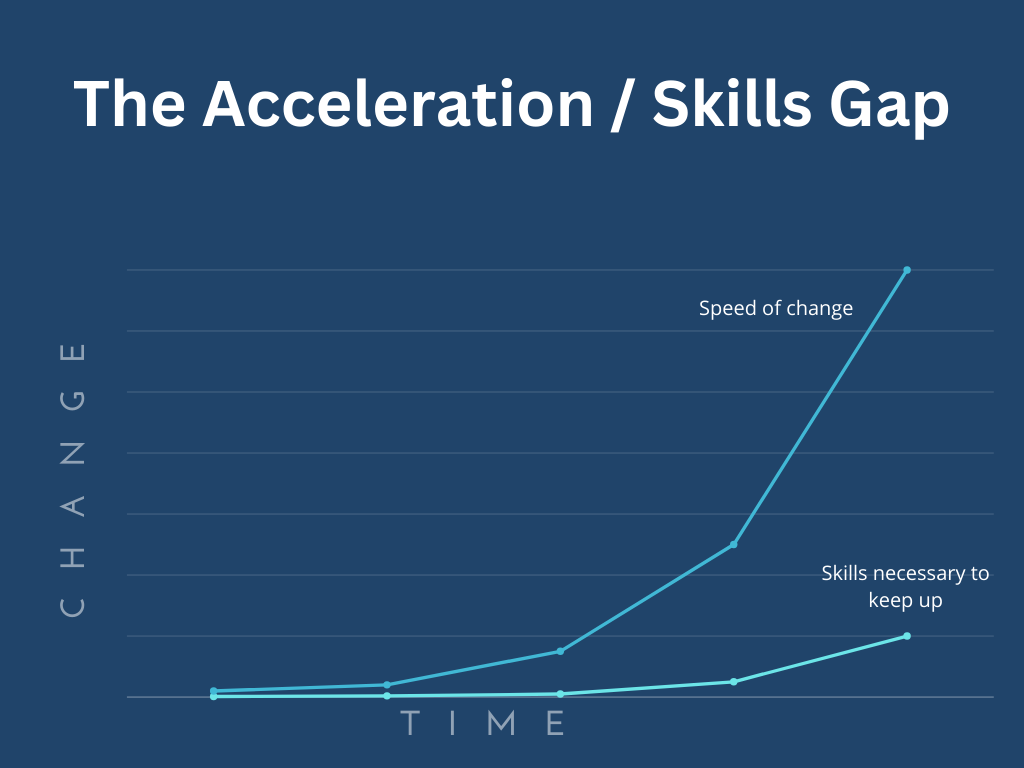
The acceleration gap, driven by exponential change, is real, it's growing, and your inability to narrow it will increasingly impact your future!
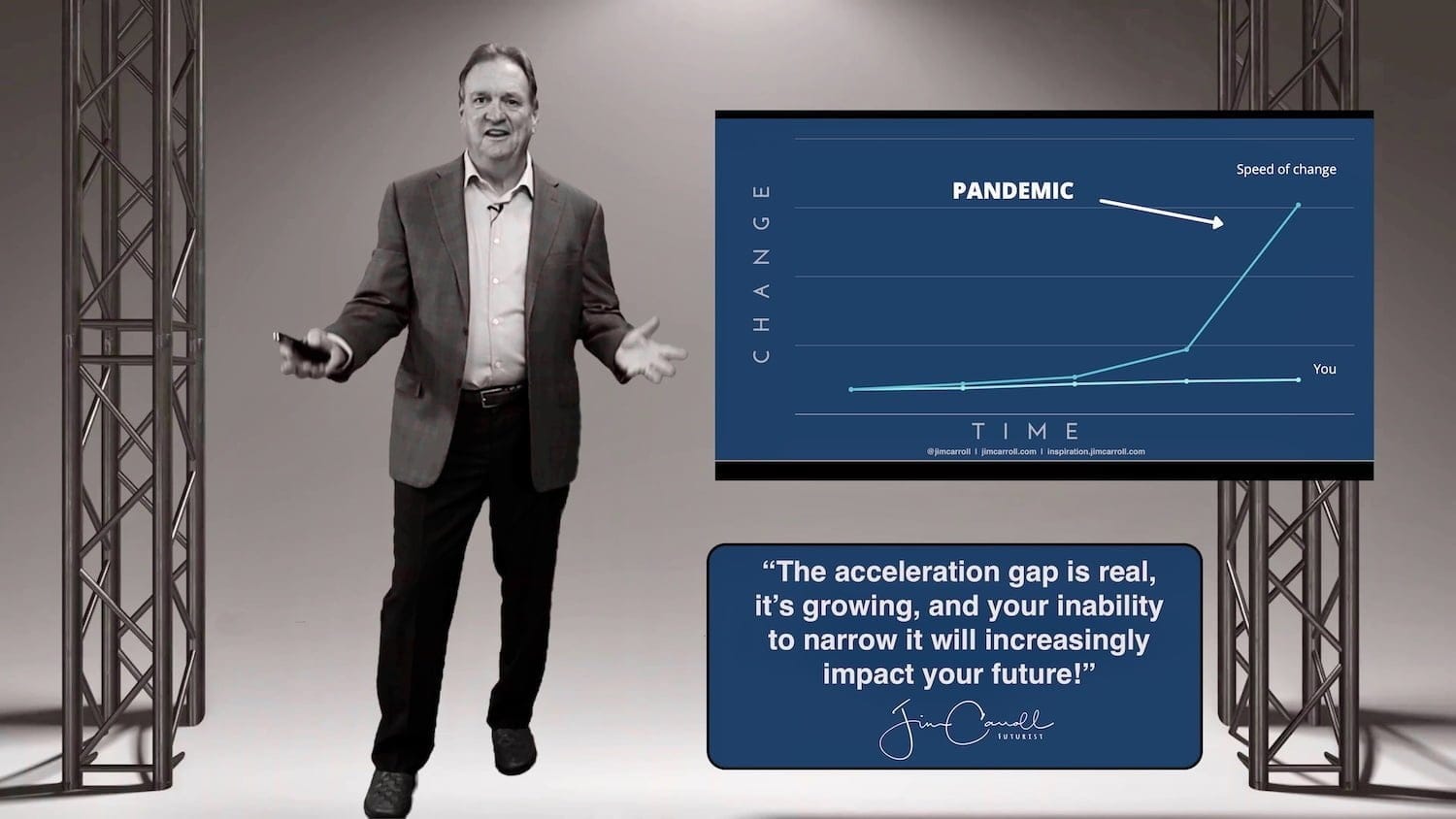
In that context, here's what you need to do.
1. The Exponential Mindset
This isn't about being intellectually smart. It's about changing the way you think!
It is understood that in an exponential environment, the phrase "that will never happen" is usually just code for "my linear brain cannot process that growth rate."
2. The Linear Trap
Why is this blindness so hard to cure?
Because linear thinking feels safe!
It’s comfortable because it relies on the past to predict the future.
But in an exponential world, if your future targets are linear, you are actually planning to shrink relative to the velocity of the market.
3. The Exponential Edge
When you decide to try to cure your scale-blindness, the world starts to look VERY different:
- The element of surprise disappears: You come to understand, accept, and align with some of the exponential change around you. While competitors are shocked when a technology seemingly comes "out of nowhere" to dominate an industry in 24 months, you saw it coming. You were tracking the doubling rate, not the current market share.
- You make the 'big bets' earlier: You understand that in exponential growth, "early" looks indistinguishable from "wrong" for a long time, right up until the moment the curve bends upward and it becomes "everything." You have the stomach to invest when the numbers look small.
4. The Immediate Pivot
This means forcing yourself to change your thinking., Get rid of your old intuitive 'thinking' - and work harder to actively retrain your brain to see the scope of change. Think of it as a form of exponential shock therapy:
- Do the "doubling math" out loud: When looking at a critical trend affecting your industry (e.g., computing power, AI capability, battery density), stop looking at today's numbers. Put them out into the future, and exponentiate them. Don't. do 1-2-3-4-5 - do 1-2-4-16..... Find its doubling rate. Now, grab a calculator and project that doubling out five years. Write that number down. Stare at it. That is your reality. Plan for that, not today + 10%.
- Immerse yourself in exponential trends: Get away from your traditional sources of trends insight and find some new ones. You have to feel the acceleration, understand its pulse, and think about what it's telling you. Example? Don't just read about generative AI; force yourself and your team to use it for a critical task until you hit its current limits—and then imagine those limits evaporating in 18 months. Go in and generate a short video clip on Google Gemini - and realize that with exponential change, we'll see an entire TV series produced totally in AI, probably within a year. Visceral experience beats intellectual analysis every time.
If you want a visceral sense of how far your intuition lags behind the curve, look at AI training compute. Epoch AI and Our World in Data estimate that the computing used to train leading AI models has been doubling roughly every six months since 2010, a growth rate of about 4 to 5 times per year.
What does that mean?
Ten doublings in five years is 2¹⁰, which is 1,024. So if a frontier model in 2025 used “1 unit” of compute, a continuation of the same trend would mean models in 2030 train on roughly 1,000 times more compute.
Try and think about what that means.
Let's close with this: I used Google Gemini to find some great observations of senior executives and the issues of exponential change. Read them - and think!
- Ford CEO Jim Farley on tearing apart Chinese EVs:
"It's the most humbling thing I have ever seen. Seventy percent of all EVs in the world are made in China. Their cost, the quality of their vehicles is far superior to what I see in the West." - GM's Kyle Vogt after $10 billion Cruise shutdown:
"In case it was unclear before, it is clear now: GM is a bunch of dummies." - Insilico Medicine CEO Alex Zhavoronkov on AI drug discovery skepticism:
"When we first presented our results, people just did not believe that generative AI systems could achieve this level of diversity, novelty, and accuracy. Now that we have an entire pipeline of promising drug candidates, people are realizing that this actually works." - VW CEO Herbert Diess (before being fired over software failures):
"The development of our own software expertise is the biggest switch that the automotive industry has to make—much bigger than the transition to e-mobility." - Wood Mackenzie's Luke Parker on Shell/BP's $40 billion write-down:
"Just a few years ago, few within the oil and gas industry would even countenance ideas of climate risk, peak demand, stranded assets, liquidation business models, and so on. Today, companies are building strategies around these ideas." - SAG-AFTRA President Fran Drescher on AI:
"Artificial intelligence poses an existential threat to creative professions." - Klarna CEO Sebastian Siemiatkowski is reversing his AI-replaces-humans strategy:
"Cost, unfortunately, seems to have been a too predominant evaluation factor... what you end up having is lower quality." - Former PwC Partner Alan Paton on accounting's future:
"Most structured, data-heavy tasks in audit, tax, and strategic advisory will be automated within the next three to five years, eliminating about 50% of roles." - Ohio State professor Scott Shearer on John Deere's autonomous tractor:
"Before its introduction at CES, everybody thought [full autonomy] was pie in the sky. But when Deere, with 60% of the tractor market share in North America, comes out with one, that's when reality sets in." - GM CEO Mary Barra (2022): "We have the lead right now. Those who are writing that it's not going to work and that it's decades off haven't taken a ride in the vehicle." (Said two years before shutting down Cruise entirely)
Futurist Jim Carroll believes that most organizations are falling way behind when it comes to the 'acceleration gap,' with the gap growing wider each and every day.