
"Always remember that conformity is where tomorrow's greatness goes to die." - Futurist Jim Carroll
Futurist Jim Carroll is writing his end-of-2025 / introduction-to-2026 series, 26 Principles for 2026. You can follow along at 2026.jimcarroll.com. He welcomes your comments.
I've long suggested that one of the best ways to align with the future is through this thinking: when everybody is running one way, run the other way!
Be the contrarian. The hole in the bucket, the square peg with a bunch of round holes, the one who says "why not?' when everyone else is saying 'why?'
We are on Day 17. Yesterday, we looked at the terrifying math of the future—the sheer scale of change that is coming. 1-2-4-16-64 vs. 1-2-3-45.
When faced with that kind of overwhelming scale, the natural human instinct is to feel overwhelmed. And I am willing to admit that one reaction I see in common with all of my audiences is that this feeling is universal. I've been doing text-message-based polling from the stage for over 15 years, and one overwhelmingly consistent attitude is that people feel universally overwhelmed by the speed of the future.
So they try to avoid it. They try to fit in. They take the cautious route.
They choose the comfortable over discomfort.
The result? When we feel a need for comfort, to fit in, to follow the herd instinct, we try to be like everyone else. We look for safety in numbers. Case in point: we look at our competitors and say, "Well, they are doing AI this way, so we should too." Korn Ferry made this observation about AI: "Among the most expensive keeping-up-with-the-Joneses games in corporate history."
Need more proof? We seek out "best practices," which is usually just a fancy word for "copying the average."
I rest my case.
In a linear world, fitting in was a survival strategy. You survived by being a cog that fit perfectly into the machine.
In an exponential world, conformity is a death sentence.
Here's your chalkboard summary - Google's AI decided today it was just going to change the format!
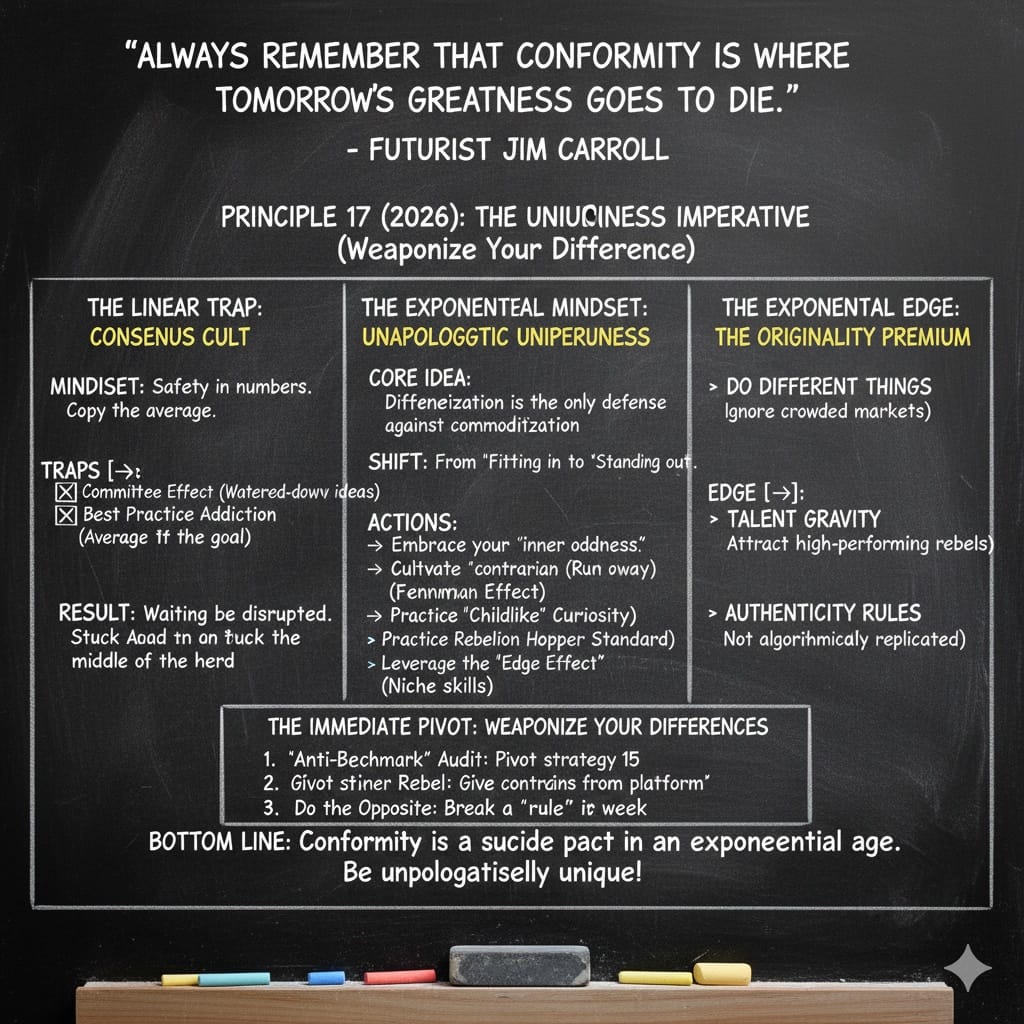
It’s being unique LOL!
The truth? If you are doing exactly what everyone else is doing, you are not innovating; you are just waiting to be disrupted by the same force that eventually kills them. As I’ve been writing in my book Being Unique, the safe path to tomorrow is now the riskiest route. In that context, one of the most significant opportunities for moving forward in a faster world is to practice the idea of Unapologetic Uniqueness.
Let's put it this way: the future doesn't belong to the people who fit the mold. It belongs to the misfits, the rebels, and the "industry expatriates" who see the world differently. It belongs to the people who understand that their "inner oddness" isn't a flaw—it's their strategic superpower. It goes to the heart of that famous Steve Jobs quote:
“Here's to the crazy ones. The misfits. The rebels. The troublemakers. The round pegs in the square holes. The ones who see things differently. They're not fond of rules. And they have no respect for the status quo. You can quote them, disagree with them, glorify or vilify them. About the only thing you can't do is ignore them. Because they change things. They push the human race forward. And while some may see them as the crazy ones, we see genius. Because the people who are crazy enough to think they can change the world, are the ones who do.” Steve Jobs
The discipline you must master is Unapologetic Uniqueness.
The Acceleration of the Odd: Why Uniqueness is Your Only Strategy
You can't buy uniqueness. You can't take a course on it and instantly discover its secrets. You can't wake up one day and decide you are going to be unique.
But you can learn what makes it special and perhaps do a little more about it, in the context of what to do about your future.
I have spent the better part of the last year pouring my soul into a new book, Being Unique: Turning Curiosity, Creativity, and Courage into Your Competitive Edge. It is about 90% done, and as I write the final chapters, one terrifyingly clear conclusion has emerged that is critical for our discussion on 2026: The safe path to tomorrow is now the riskiest route.
Yesterday, on Day 16, we looked at the idea of "Scale-Blindness" and the math of exponential change. That's the reality that knowledge, technology, and competition are doubling at rates our linear brains struggle to comprehend.
In that kind of environment, "being average" is not a safe harbor. It is a mathematical guarantee of obsolescence.
Why? Because in a world of exponential trends, the center of the bell curve moves faster than you do. If you are standing in the middle of the herd, doing what everyone else is doing, seeking "consensus" and "best practices," you are actually standing still while the world accelerates away from you.
The ones who are getting ahead? Those who aren't thinking like everyone else, but are thinking their own thoughts. People who are busy doing something while everyone else is doing the same 'other' thing. Those who look at a trend and say, "let's go for it!" while everyone has yet to spot the trend.
Here's what you need to know for 2026 and beyond: conformity is a curse.
It whispers the lie that safety lies in sameness. But in 2026, conformity is just an anchor dragging you down into the past.
Let's dig into a little bit of what I've covered in my book. I'm not aiming to have it out in Q1 2026!
The Science of the Shift: Why Outsiders Win
To understand why you must pivot to uniqueness, we have to look at the science of how breakthroughs actually happen. We need to look at the work of physicist and philosopher Thomas Kuhn, the man who coined the term "paradigm shift". He's in the book!
Kuhn taught us that "normal science" is just a process of puzzle-solving within an accepted framework—it is the definition of conformity. Every scientist tends ot chase the same idea that everyone else is chasing. But eventually, anomalies pile up. The old rules are broken. We enter a crisis, and then, a revolution. And here is the key: these shifts never come from the establishment. They come from the outsiders, the people at the margins, the individuals who aren't indoctrinated into the "old way". The ones who don't follow established science, but follow the unestablished!
Right now, we are living through the mother of all paradigm shifts. If you are clinging to the "normal science" of your industry - the way things have always been done - you'll be stuck. To borrow from my favorite phrase: The future belongs to the "odd one out".
The Three Powers of Uniqueness in an Exponential World
Uniqueness is not just about being "quirky" or "artistic." In the context of 2026, uniqueness is a hard-edged acceleration strategy. Based on the research for my book, there are three specific powers that unique individuals weaponize to move faster than the speed of change.
1. The Power of "Childlike" Curiosity (The Feynman Effect)
In an exponential world, knowledge doubles every 12 hours. You cannot survive on what you learned a decade ago. You need a new engine for learning. Here's a bit of the story I tell in the book.
- The Spaghetti Principle: Nobel Prize winner Richard Feynman spent evenings breaking spaghetti noodles in his kitchen and watching plates wobble in a cafeteria. Why? Because he approached the world with a "childlike curiosity" that others dismissed as trivial.
- The Exponential Link: This wasn't wasted time; it was the foundation of his genius - he made great discoveries as a result of these experiments (it's in the book!) He understood that looking where no one else is looking is the only way to see what no one else sees. In 2026, your "curiosity quotient" is the metric that matters. It’s the engine that drives differentiation.
The lesson? Learn - uniquely!
2. The Power of Rebellion (The Grace Hopper Standard)
She's in the book too, a computer expert, and the one who invented the phrase "computer bug." Her story is one that emphasizes that innovation is inherently an act of rebellion. It requires you to break the "Legacy Load" we talked about on Day 2.
- Breaking the Binary: She rebelled against the idea that computers could only speak math. She fought the most dangerous phrase in the language: "We've always done it this way". By refusing to accept the status quo, she essentially invented modern programming.
- The Exponential Link: Rebels don't wait for permission. In a fast-moving world, if you wait for consensus, the opportunity is gone. Rebels spot opportunities that others miss because they refuse to blindly accept "what is".
The lesson? Learn - by rebelling!
3. The Power of The "Edge Effect."
Also in the book? A prophetic New York Times editorial from 1987 predicted a future where organizations would be fluid networks, and competitive advantage would rest solely on unique human resources. That article changed my entire life and career trajectory; I've written about it often, because that future is here.
- The Niche Advantage: As AI commoditizes general knowledge, the value of "standard knowledge" drops to zero. The real opportunities are emerging in the spaces between traditional disciplines—at the edges. In uniqueness.
- The Exponential Link: When you possess a unique combination of skills, you don't compete on price. You command it. You become a "market of one."
And the reality is this: uniqueness is REALLY going to matter in the AI, because authenticity will rule. More on that later.
The Resilience of the "Pointless" Forest
Finally, we must address the cost. Being unique is hard. It is lonely. As I explore in the book, through the story of Lady Gaga, it requires a massive amount of grit to sustain disruption.
Not only that, it requires the mindset of Oblio from the classic story The Point!. You might feel like the only round-headed person in a village where everyone has a point. You might feel banished to the "Pointless Forest". That's a whole chapter in the book!
But it is in that forest—away from the crushing weight of conformity—where you will find the perspective that allows you to return and lead. (There's a reason why my Tesla and my publishing division are named Oblio.)
The Mantra for 2026? When you feel resistance, when people tell you that your ideas are wrong or your approach is too weird, remember the lesson of mRNA pioneer Katalin Karikó: "This is hard because it's early, not because it's wrong".
That's uniqueness.
Don't try to fit in.
Fit out.
Conformity is a suicide pact in an exponential age.
Weaponize your difference!
Here's how.
1. The Exponential Mindset
The Originality Premium:
In an era where AI can generate "average" content and "standard" strategy in seconds for free, the value of "standard" drops to zero.
The only value left is in what cannot be algorithmically replicated: your unique perspective, your weird intersections of experience, and your human ability to connect dots that shouldn't be connected.
Your authenticity.
The Exponential Mindset realizes that differentiation is the only defense against commoditization.
2. The Linear Trap
In the face of reality, it's important to question whether you might be stuck in what cold call, for lack of a better phrase, a consensus cult!
Why do we drift toward the middle? Because being average feels safe. Think about the structures that we put in place that guarantee that we will be stuck there:
- The Committee Effect: We water down bold ideas until they are acceptable to everyone in the room. By the time an idea is "safe" enough to get committee approval, it is too boring to matter. Committees are an infrastructure designed to race you to the bottom of opportunity.
- Best Practice Addiction: We obsess over "industry standards." But if you just follow industry standards, the best you can hope for is to be average. You are fighting for the scraps in the middle of the bell curve - because that is what industry standards are based on.
3. The Exponential Edge
When you stop trying to fit in and start leaning into your uniqueness, you move faster:
- Doing different things - things that matter: While your competitors are all fighting over the same crowded territory (e.g., "Generative AI for Customer Service"), your unique perspective allows you to see the opportunities they ignore—the "weird" ideas that become the next billion-dollar market.
- Talent Gravity: The best talent doesn't want to work for a clone. They want to work for an original. Uniqueness is a magnet for the high-performing rebels you need to build the future. Go back to that Steve Jobs quote. You'll only surround yourself with the rebels that matter if you become a rebel yourself.
4. The Immediate Pivot
You need to weaponize your differences, celebrate your strangeness, and play up your weirdness!
Here are a few things I've written into my Daily INspiration series in the past. These things matter!
- The "Anti-Benchmark" Audit: Look at your top 3 strategic priorities. For each one, ask: "Are we doing this because it's what our competitors are doing?" If the answer is yes, stop. Pivot that strategy 15 degrees to the left. Find the angle nobody else is taking.
- Find Your "Inner Rebel": Identify the person on your team who always disagrees, the one who asks the uncomfortable questions. Instead of silencing them, give them the floor. Ask them: "What is the one thing this industry believes is true that you think is false?"
- Do the Opposite: Look at a standard industry practice (e.g., "We always require a 3-year degree," or "We always price by the hour"). Experiment with doing the exact opposite for one week. See what happens when you break the "rule" that isn't actually a rule.
If you think about it, the whole idea of 'being unique' is found in how my two new books work together.
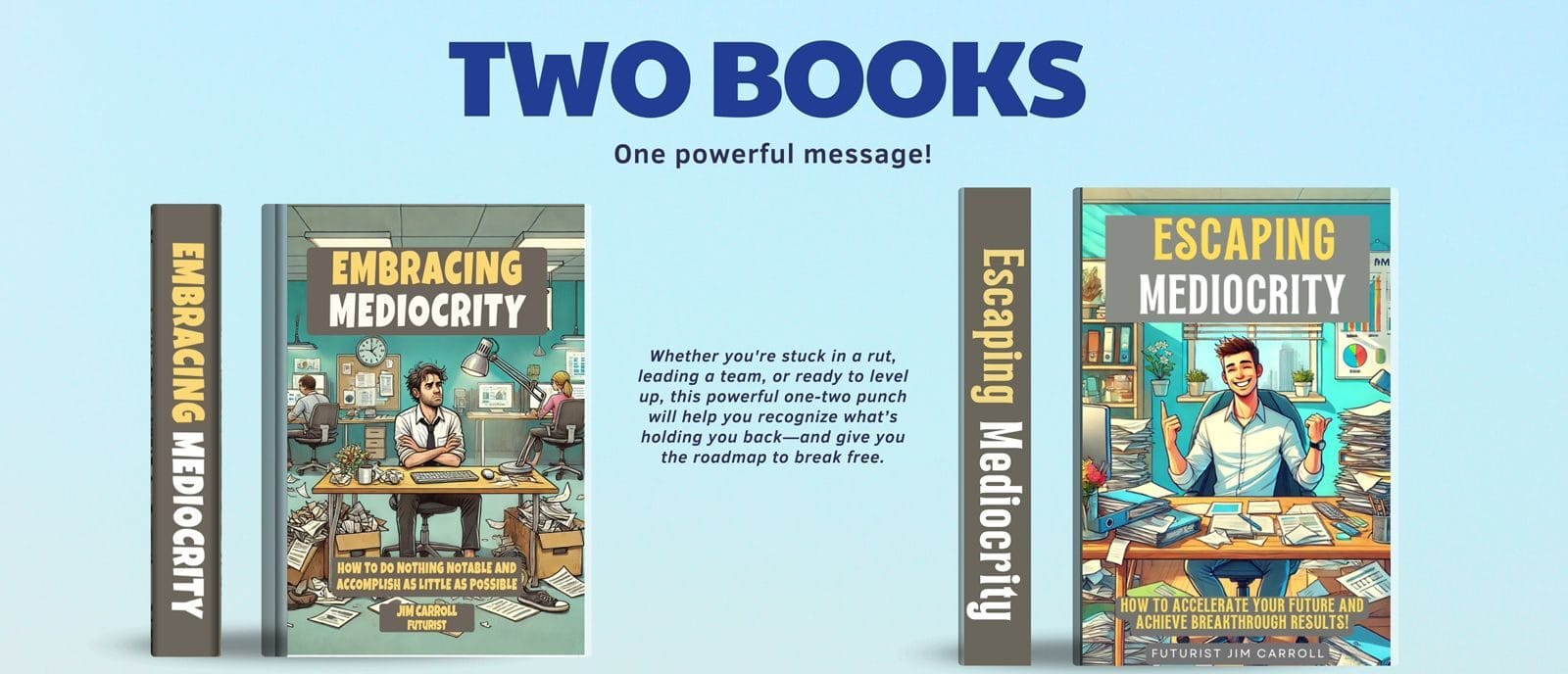
You are mediocre when you keep doing what everyone else does. You'll escape it through uniqueness! Buy the books at mediocrity.jimcarroll.com
Let's close with this paragraph from the book. where I summarize the power in that Steve Jobs quote:
This quote by Steve Jobs captures the essence of innovation and creative thinking - and why and how to be different. When you take it apart, you realize that it’s a celebration of those who dare to think and act differently, and a reminder that these are often the people who drive the most significant changes in our world. Jobs' message encourages embracing unconventional thinking and the pursuit of bold ideas, which is fundamental for advancement in any field.
These are the people who drive some of the most significant changes in the world.
You need to decide to be one of them.
Be unapologetically unique!
The story of Oblio has defined much of Futurist Jim Carroll’s approach to life.