
“Don't fear the chaos. Feed on it.” - Futurist Jim Carroll
Futurist Jim Carroll is writing his end-of-2025 / introduction-to-2026 series, 26 Principles for 2026. You can follow along at 2026.jimcarroll.com. He welcomes your comments.
Bouncing back is a losing strategy!
We are on Day 18. We have established that the future is scaling beyond comprehension (Day 16) and that your only defense is Unapologetic Uniqueness (Day 17).
Now, we must address the environment in which you will operate through 2026 and beyond. It is going to be even more volatile. It is going to be chaotic. It will be characterized by sudden shocks, black swans, and "impossible" events happening at almost every single moment.
Just like 2025.
Except far more volatile.
If you think about it, the standard corporate response to this has been the idea of developing "resilience." Everyone is talking about it, listening to experts on it, finding out how to manage, heck. Heck, even I use the phrase too much - I have a website all about it, resilience.jimcarroll.com.
I've come to realize that going forward, in an exponential world, resilience is not enough.
Resilience is a linear concept. It means surviving a shock and returning to your original shape—like a rubber band. It implies that "bouncing back" to the status quo is the goal. It assumes that going back to where you were - rather than where you should be going - is good enough.
But in 2026, the status quo is death. If you just "bounce back" to where you were in 2024, you are already behind, because 2026 is wildly different from what 'was two years before. Exponential change does that.
That's why you need to stop trying to be resilient and start becoming Antifragile.
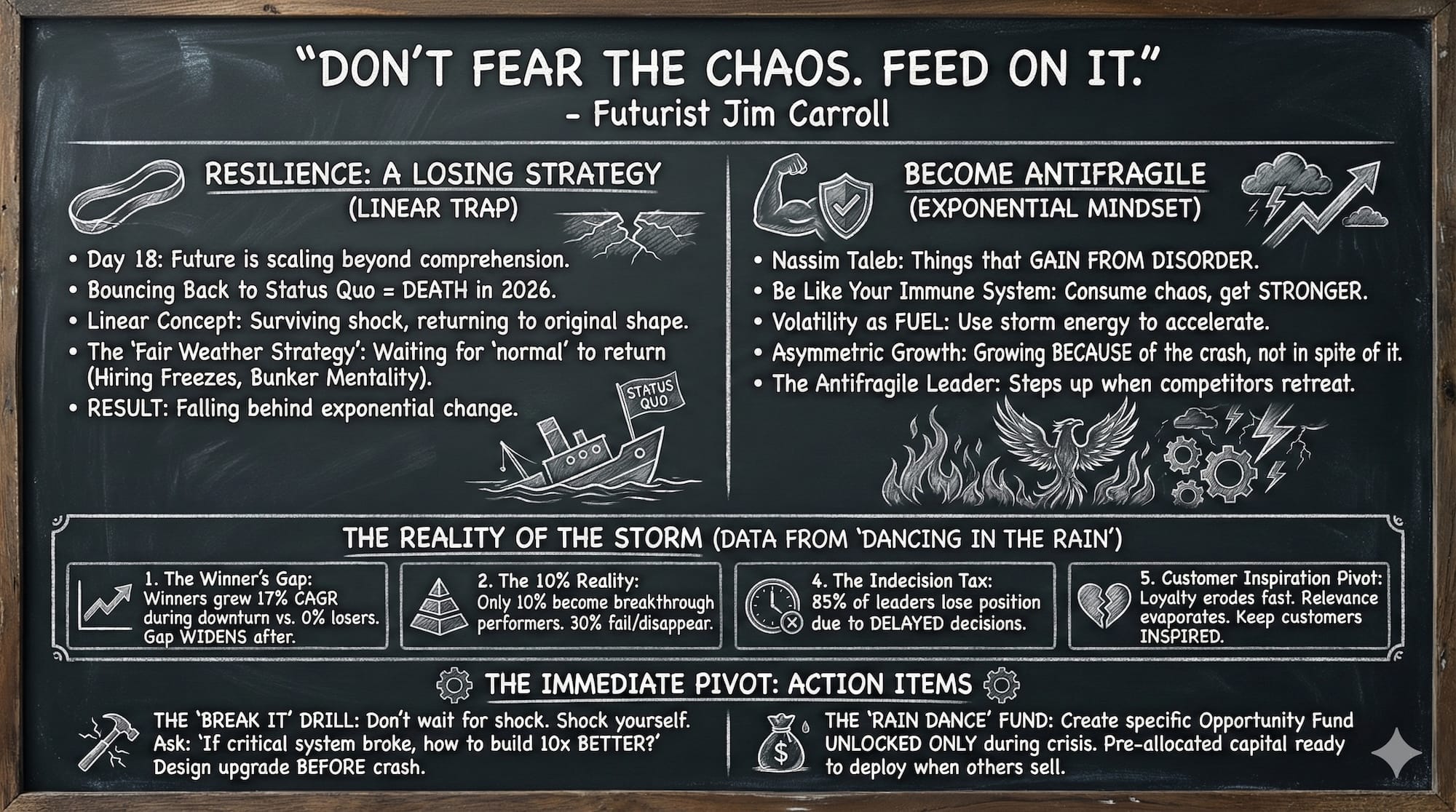
Here's your chalkboard summary!
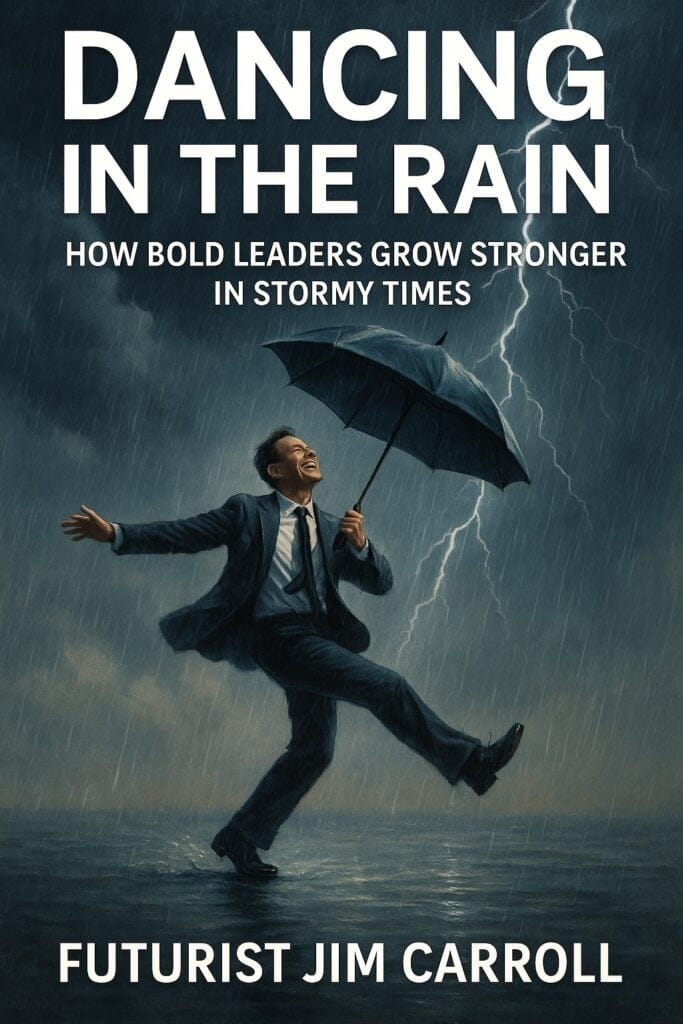
As I wrote in my book Dancing in the Rain: How Bold Leaders Grow Stronger in Stormy Times, the goal isn't to endure the storm. The goal is to use the energy of the storm to accelerate.
To understand why this shift to a mindset beyond 'resilience' is so critical, we can look at the data I compiled in the book. The research is detailed: the safety of the "middle ground" does not exist during periods of volatility. You are either accelerating away from the pack or falling behind it.
Here is the reality of the storm, with direct quotes from the book. Maybe you should buy one.
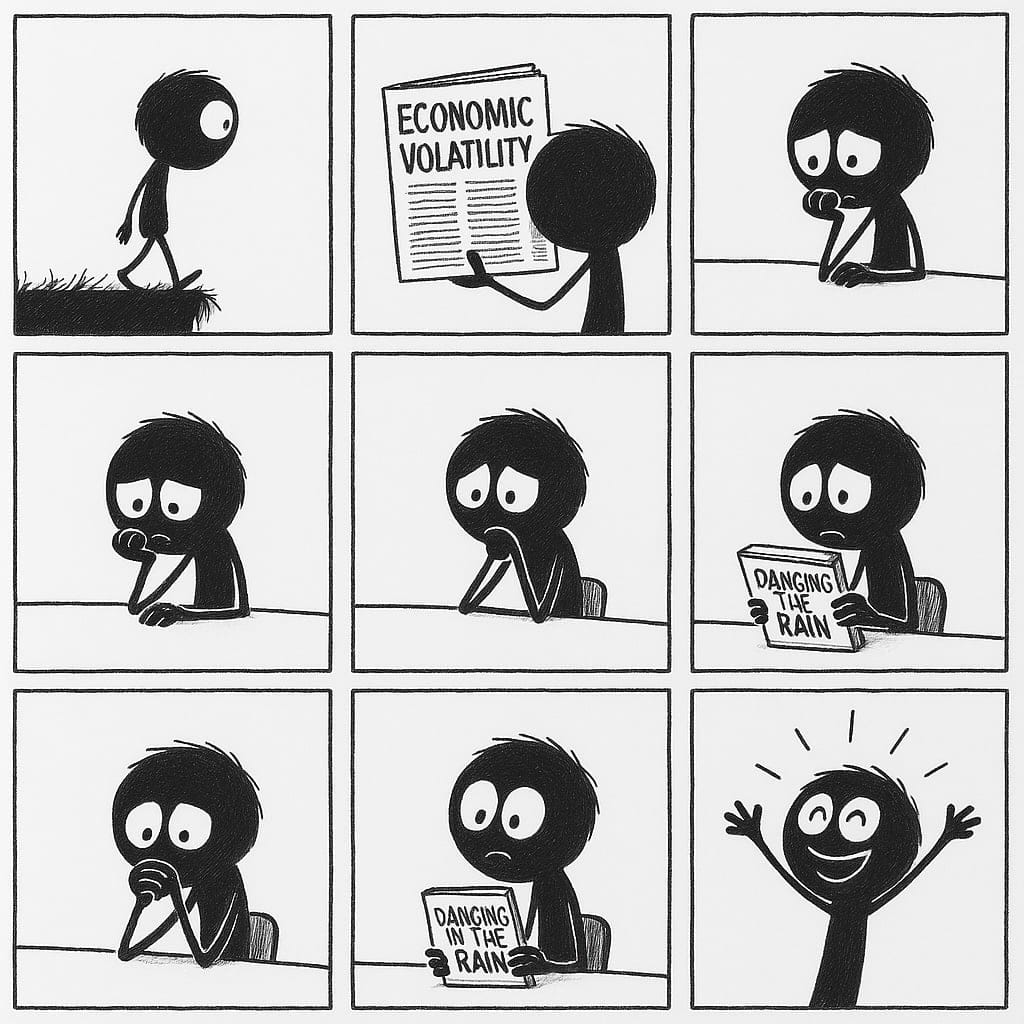
Be this guy!
I spent a ridiculous amount of time on a crazy number of stages in front of tens of thousands of people who were shellshocked and whipsawed from 2000 to 2003 by economic volatility. I did it again after the 2008 global economic meltdown. And after that, too - every once in a while, I whip out these observations and share them from the stage, such as within this keynote in London, England, recently.
https://www.youtube.com/watch?v=3ZRrbuSvEm8
Consider the title of that video - "It's what you do right now that matters."
That being the case, here's what you need to do right now!
1. The Winner's Gap
History shows us that people who decide to move forward, not back, are the ones who win.
- Observation: History shows that during the 2008 recession, "Winners grew at a 17% CAGR (compound annual growth rate) during a downturn, compared to 0% for the losers."
- The Impact: The gap widened after the volatility ended. "After the downturn was over, those same winners achieved 13% CAGR, while losers stagnated at 1%."
- What you need to do: You must explicitly "refuse to participate in the fear." You must "choose strategic investment over reckless retreat" and "reignite your innovation engine" while your competitors are stalling.
2. The 10% Reality
History also shows us that only a small percentage of people and organizations decide to do this!
- Observation: "Only 10% of organizations become breakthrough performers during a recession."
- The Impact: The vast majority fail to adapt. "60% are simply marginal performers... The remaining 30%... do not make it—they go bankrupt, are bought out, or disappear altogether."
- What you need to do: You must decide to "double down on innovation and opportunity despite lingering and pervasive uncertainty." You need to "keep [your] idea factories running" and ensure "innovation is on full throttle" even when budgets are being cut elsewhere.
3. The "Grief" Speed-Run
Oh, and guess what! History tells us that most people and organizations don't get through the shock of volatility fast enough!
- Observation: Organizations move through "Seven Stages of Economic Grief," starting with "Shock" and "Denial."
- The Impact: "It is not the recession that breaks companies, it is how long they stay stuck in it." "You cannot build the future if you are in the shock, denial, anger, or bargaining phase."
- What you need to do: You must "move with speed through doubt and into direction." Your job is to lead your team "through the fog of the grieving process" and race to the "Acceptance" phase immediately.
4. The Indecision Tax
So what happens? They stop thinking, stop acting, stop doing. They adopt freezing as a strategy, which is just about the dumbest thing you can do.
- Observation: "85% of pre-recession growth leaders lose their position during downturns."
- The Impact: They lost their lead "primarily due to delayed decision-making rather than poor choices." "Waiting too long weakens the company."
- What you need to do: You must focus on "accelerating the decision processes." You need to "simplify approval chains, establish clear decision thresholds, and enable action at all levels."
5. The Customer Inspiration Pivot
The worst thing to do is to freeze, particularly when it comes to customer relationships, because during volatility, those relationships undergo a significant change.
- Observation: "Customer behaviour is changing faster than your business model." "Loyalty erodes faster as one in three highly loyal customers now typically switch in less than one year."
- The Impact: "You... render a brand new product instantly obsolete if it does not match their expectations." Organizations that fail to innovate become invisible because "relevance evaporates."
- What you need to do: You must change what you do. "Do not focus on keeping your business alive; focus on keeping your customers inspired." You must "tune in, not tune out" and "adapt faster."
6. The "Bunker" Fallacy
They retreat to bunkers, seeking shelter from the storm, rather than existing within it.
- Observation: When volatility hits, mindsets change. When "most companies believe a recession is coming," theyprioritize controlling expenses, rather than investing for the other side.
- The Impact: Those who failed to thrive "performed heavy cost-cutting" and "scaled back R&D." "Decisions made for short-term survival rarely reward the bold."
- What you need to do: You must balance the ledger. Companies that "win the downturn" combine discipline with "a matching vision to align ongoing investment with strategy and opportunity."
The discipline you must master to do all these things is what I call Antifragility.
Did I mention you should buy the book? You can do that via the Website - dancing.jimcarroll.com!
1. The Exponential Mindset
Nassim Taleb, who came up with the theory of the 'black swan,' coined the term "antifragile" to describe things that gain from disorder. A package is fragile; if you drop it, it breaks. A rubber band is resilient; if you stretch it, it returns. Your immune system is antifragile; if you expose it to germs, it gets stronger.
You need to be like your immune system!
Consume the chaos! Thrive on it! Turn it into a lever to move forward faster!
The exponential mindset treats volatility as fuel. As the data above shows, heavy weather scares away the "tourists." When the market gets scary, your competitors retreat. They cut innovation. They hunker down. That is the moment the Antifragile leader steps onto the floor. The storm clears the field for you to capture market share cheaply.
2. The Linear Trap
Do you retreat into a "bunker mentality" when times get tough?
When the clouds gather, linear leaders instinctively seek shelter. They initiate "hiring freezes" and "travel bans." They pause their boldest projects to "wait and see." They put barriers in place instead of opening doors. They instill fear to keep control.
Is that what you'd do?
If you think about it, this is a strategy you might pursue when the sun is shining.
It assumes that the storm is a temporary aberration and that "normal" will return. But in an exponential world, volatility is the new normal.
Under that phrase. Imprint it in your mind. Make it a sticker on your desk - and know this: if you pause every time there is uncertainty, you will be paused forever. While you are hiding in the bunker waiting for clarity, the Antifragile player is out in the rain, rewriting the rules of the industry.
3. The Exponential Edge
When you stop fearing the storm and start dancing in it, you gain leverage.
That's why I gave the book the title "Dancing in the Rain." It gets you into a mindset that while conditions might not be perfect, you might as well make the most of it and flip the traditional thinking on its head. But here's what you also need to know about what you can learn once you accept exponential change as your new reality.
Here are some key facts:
- There is a hidden opportunity in the stress! So do a stress test! A storm reveals the cracks in your organization that fair weather hides. It shows you exactly where your supply chain is weak or your team is slow. The antifragile leader uses the crisis to fix the structural flaws, emerging with a harder, faster machine than before.
- There is growth hidden in the volatility: During the 2008 crisis and the 2020 pandemic, while most companies were trying to survive, the winners were making their biggest acquisitions and launching their boldest products. They bought assets for pennies on the dollar. They grew because of the crash, not despite it.
4. The Immediate Pivot
What are you doing right now to turn the wild world that is 2025 - which is likely only going to be more challenging through 2026 - into opportunity?
The first thing you need to do is move from "resistance" to "antifragility" (or adaptation). Here are your immediate actions:
- The "Break It" Drill: Don't wait for the market or scary economic headlines to shock you. Shock yourself. Make them your new normal. Look at a critical system (e.g., your cloud infrastructure or your supply chain). Ask: "If this broke tomorrow, how would we not just fix it, but build something 10x better in its place?" Design the upgrade before the crash.
- Put in place a "rain dance" fund: Most budgets are designed for the good times. What's your budget for the bad? Create a specific "Opportunity Fund" that is only unlocked during a crisis. When the market tanks or a competitor stumbles, you shouldn't need a committee meeting to act. You should have pre-allocated capital ready to deploy when everyone else is selling!
I wrote Dancing in the Rain because I saw too many talented leaders freeze up the moment things got scary.
Everyone seemed to think the best strategy was to hide and wait for "normal" to return, but I knew that waiting was the most dangerous thing they could do. I wanted to prove that you don't have to be a victim of the chaos. I wrote this book to show you that the storm isn't something to fear—it's an opportunity to grow stronger, move faster, and build your future while everyone else is running for shelter.
Did I mention you should buy it?
Like, now.
Futurist Jim Carroll really thinks you should buy his book, and wants to let you know that you can do that at dancing.jicmarroll.com