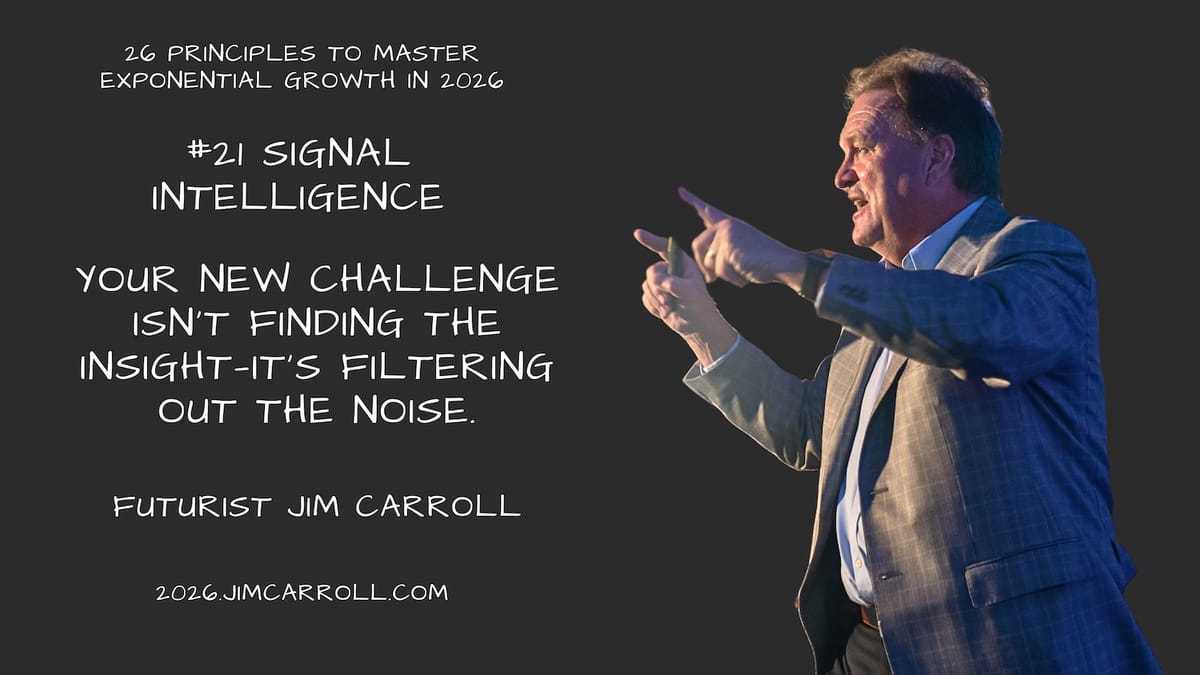
"Your new challenge isn't finding the insight - it's filtering out the noise." - Futurist Jim Carroll
Futurist Jim Carroll is writing his end-of-2025 / introduction-to-2026 series, 26 Principles for 2026. You can follow along at 2026.jimcarroll.com. He welcomes your comments.
It used to be that the problem with the information age was that there was too much information.
That's changed.
The new problem is now that not only is there too much information, but much of it is crap. And pretty soon, most of it is going to be crap.
That means one of the most important skills you need to develop in the information age is how to sift through the noise, to find what really matters. Finding the gold amidst the crap matters.
Simply put, enhancing your ability to weed out reality from unreality, facts from the unfactual, the gems amidst the wreckage - this is what will move you forward into the future. I'm not talking only about the misinformation and disinformation machine that has roiled our world, but the new megainformation machine that is AI that is emerging.
All of us are on a unique voyage into this strange new world, and as I often like to say: "We don't know where we are going, but we are making great time!'" In a world of infinite noise, the ultimate competitive advantage is not what you pay attention to. It is what you choose to ignore.
Here's your chalkboard summary!
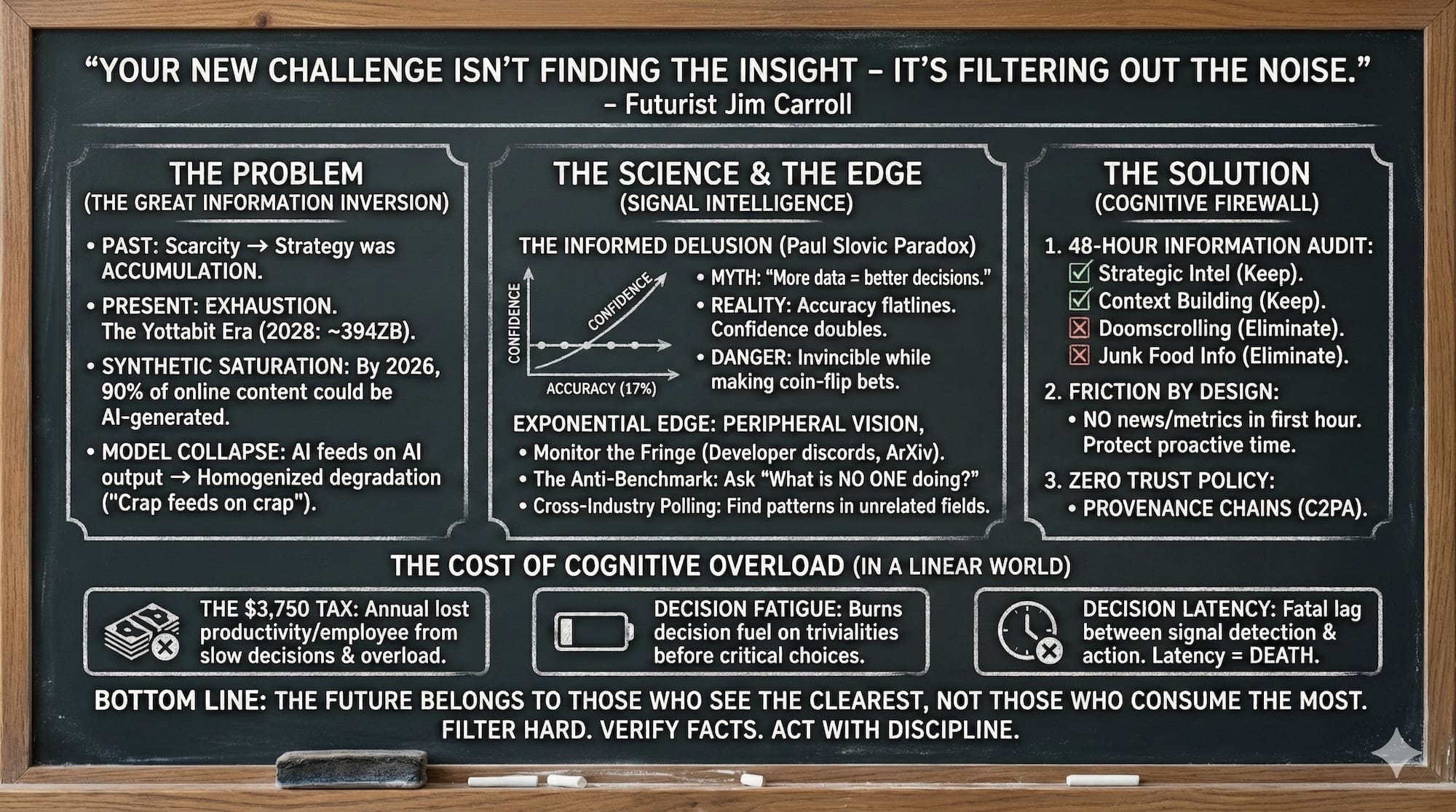
It's not lost me on that I'm using AI to tell you about the problems of AI! The very idea of the chalkboard summary, you find the challenge of our future - any complex idea, and long treatise, any deep exploration of a topic - can now simply be reduced in moments to small, digestible chunks, information-hits that we soak directly into the veins of our brains in a rush of insight chasing.
It's weird, isn't it?
And how do we know it's right?
We are on Day 21. You have stripped away the mediocrity (Day 17), embraced the chaos (Day 18), built your options (Day 19), and upgraded your network (Day 20). Now, we must upgrade your eyes.
Now we need to think about Signal Intelligence: aka the art of ignoring in order to see. Success no longer depends on acquiring more information. It depends on ruthlessly filtering noise.
The Great Information Inversion: From Scarcity to Exhaustion
Let's put this challenge into perspective.
For decades, the world of learning and knowledge was simple: Information was scarce, so the strategy was accumulation. In a business context, the leader with the most reports won; the researcher with the deepest research team had the advantage; and the individual who mastered speed-reading had a leg up on everyone.
Then the Internet emerged, and we all began to learn about the strange new world of vast sums of electronic information. We taught ourselves to search. Then, as the volume of information grew, we began to graze. Finally, we began to rapid-scan.
The "new reality" with AI now takes us into a world that is crazier than we think. We are facing the yottabit era. (I own the domains Yottabit.Net, Yottabit.com, and Yottabits.com, LOL!) The global datasphere is experiencing a form of exponential growth that defies human intuition. It isn't just "more data," it is a fundamental change in the density of our digital atmosphere, because not only will there be more of it, but much of it will be of dubious value.
In that context, the math is unforgiving: If human cognitive capacity remains static while information doubles every few years, the signal-to-noise ratio collapses. Our brains can only take in so much. We feel overwhelmed. We don't know where to start, and don't know what to look up. Not only that, we have no idea what's real and what's not.
This means that the challenge isn't finding insight anymore. It's filtering the overwhelming flood of synthetic noise to avoid exhaustion.
The AI Information Explosion
And boy, are we ever going to become exhausted!
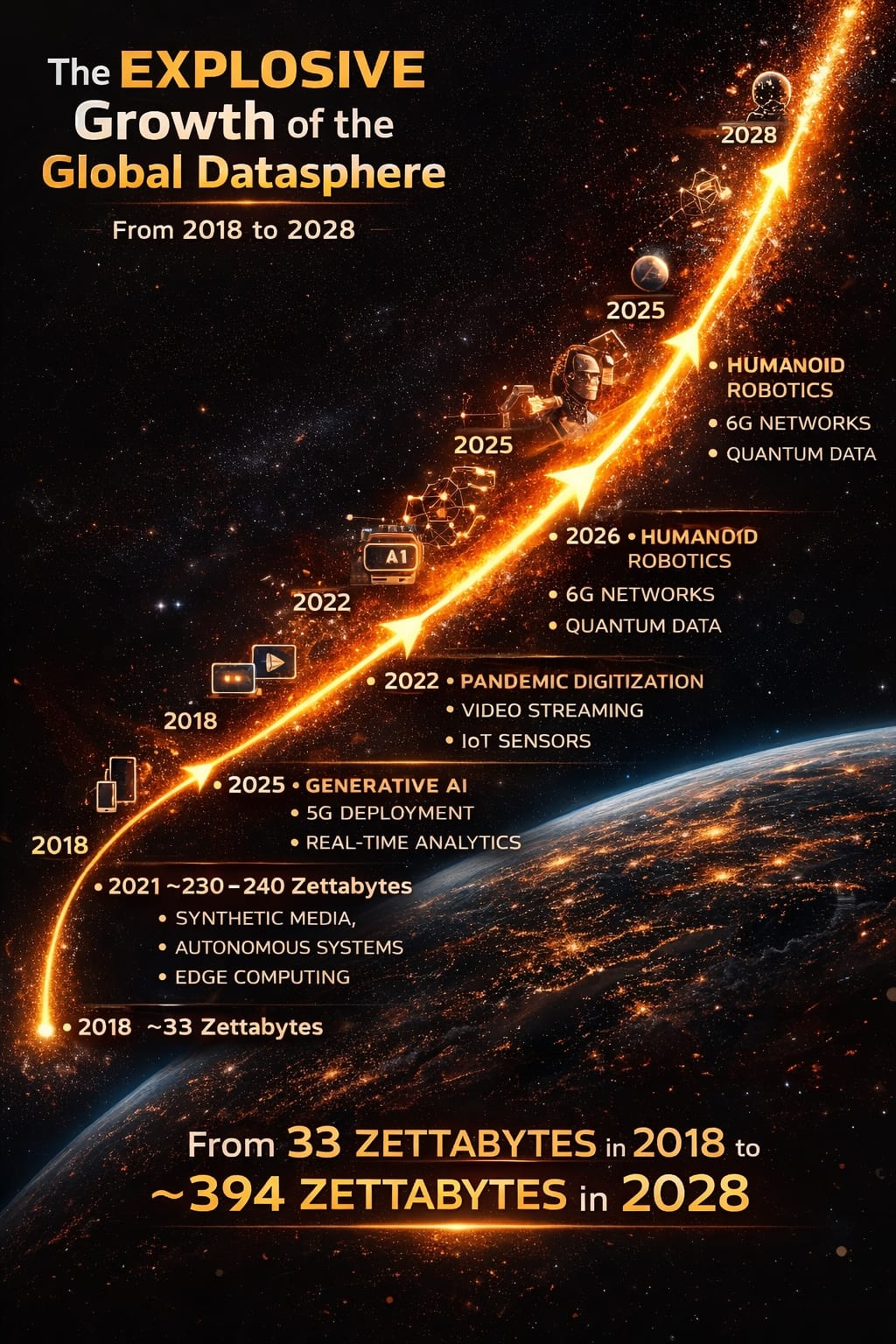
In 2018, the world was managing approximately 33 zettabytes of data, a volume driven largely by the initial maturation of mobile computing, social media usage, and the migration to the cloud.
However, that baseline has been rapidly surpassed. By the time we look toward 2028, global volumes will increase to nearly 400 zettabytes.
- 2018: ~33 Zettabytes (Driven by mobile computing, social media, and cloud migration)
- 2022: ~97 Zettabytes (Accelerated by pandemic digitization, video streaming, and IoT sensors)
- 2025: ~181 Zettabytes (Fuelled by Generative AI, 5G deployment, and real-time analytics)
- 2026: ~230–240 Zettabytes (Rising due to synthetic media, autonomous systems, and edge computing)
- 2028: ~394 Zettabytes (Projected reach via humanoid robotics, 6G networks, and quantum data)
Not only is there too much information, but much of it will not be real. It's called Synthetic Saturation.
- The 90% Threshold & The Dead Internet. By 2026, as much as 90% of online content could be synthetically generated - thrown at us by all that massive emerging AI infrastructure.
- "The Dead Internet Reality." What this means is that everything will not be real. Already, nearly 50% of internet traffic comes from automated bots. Executives relying on "social sentiment" are risking their strategy on bot hallucinations rather than human behaviour.
- Model Collapse. It’s not just about fake news; it’s about degradation. As AI models ingest content generated by other AIs, outputs become homogenized and detached from reality through recursive degradation. Crap feeds on crap, festering in putrid piles of information crap.
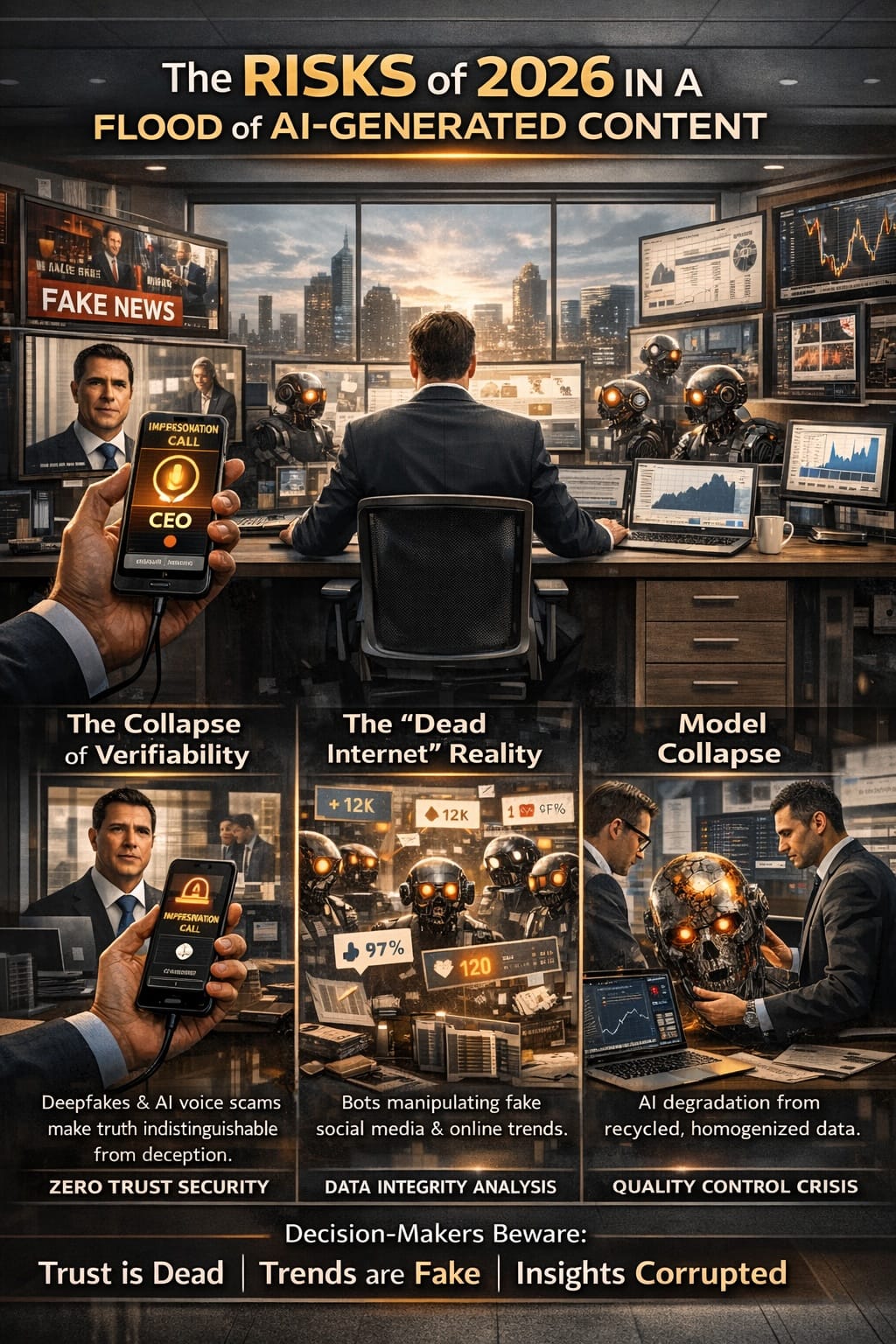
Did I mention that the fact that I am using AI to generate an image to tell you about the risks of AI is not lost on me?
But here's the thing: as organizations adopt identical AI tools to filter this information, a dangerous phenomenon emerges: algorithmic monoculture. Think about what is already happening in HR - people are using AI to try to make their resumes look better. At the other end, HR departments are using AI to try to sift out the flood of applications. Machines talking to machines, as it were. The same AI systems are being used to generate content and to screen through that content. What does it mean? To find Alpha (value above average), you must look where the algorithm isn'tlooking!
The cartoonist Tom Fishburne has a brilliant take on where this is taking us - and what is probably already happening!

The Informed Delusion
As all of this unfolds at a stunning speed, you need to know something important.
More data doesn't make you smart; it makes you more stupid!
That's not intuitive. Many people try to solve this problem of living in the information age by consuming too much information. They believe the dangerous myth that "more data equals better decisions. Researchers call this The Informed Delusion, and they have scientific proof!
Psychologist Paul Slovic’s classic study on horse race handicappers reveals exactly what happens. Slovic gave professional handicappers increasing amounts of information across four rounds: 5, 10, 20, and 40 data points per horse. The results exposed what is known as the Paul Slovic Paradox:
- Accuracy flatlined: With 5 data points, accuracy was 17%. With 40 data points, accuracy remained... 17%. The extra data didn't improve predictions at all!
- Confidence doubled: While accuracy stayed flat, the handicappers' confidence in their bets nearly doubled as they consumed more data. The more information they had, the better they thought they were doing - but there was really no improvement at all! And in fact, things became worse with increasing amounts of information.
The implication for you is brutal: Pursuing "more data" beyond a critical threshold doesn't improve your foresight—it only increases your belief in the validity of what you see. You feel invincible while making bets no more certain than coin flips. And in the context of what is coming at us with the AI tsunami, the results will be fatal unless we can take on the paradox.
That's why developing the discipline of Signal Intelligence is so important. All of us need to develop the disciplined capability to detect, verify, and act upon weak signals of change amidst synthetic noise.
It is the prerequisite for maintaining network velocity and optionality in 2026.
1. The Exponential Mindset: The Cognitive Firewall
Here's what you need to know: you now exist in an attention economy where the dominant business model is harvesting and reselling your focus. Social media is designed to feed you outrage. The algorithm isn't giving you what's useful -it's sending you stuff that makes you mad.
It's really an adversarial system that is designed to trigger your outage and to exploit your psychological vulnerabilities. In this emerging new world, not only will it make you madder, but there is going to be even more of it to make you madder. That's why you must think about the idea of building a cognitive firewall. It's your defense against neuro-phishing and attention hijacking. It is a set of rules designed to engage your analytical "System 2" thinking and bypass your reactive "System 1" thinking. The Exponential Leader treats "outrage," "hype," and "breaking news" as malware, protecting their attention as a sovereign resource.
Not only that, but you have to teach yourself to search differently. AI search tools are obviously powerful, useful machines. But have you experienced hallucinations, AI systems apologizing to you after you've called them out for feeding you false information? Have you come to rely too much on what you see and not enough on determining what might be real?
Our ability to sift through the noise to find the nuggets will be an absolutely critical part of our exponential mindset.
2. The Linear Trap: Chasing Strong Signals
The problem? Most of us have been living in a linear world. While the Internet has become a part of our lives, we've become used to the slow and steady growth of the information available to us. We've become proud of our ability to search, to learn through what we find online. But we really have no idea what's coming in terms of the volume of information coming at us. Go back and read the information about zettabytes. Why do you think I bought Yottabit back in 1999? Because I knew what was coming.
Not only that, but its the speed with which all this new synthetic information is coming at us.
And the reality is, there's a cost to cognitive overload. People using 2020 methodologies in a 2026 world to manage this flood will be effectively blind. The costs are not just psychological; they are financial.
- The $3,750 Tax: The estimated annual cost per employee in lost productivity from making slow decisions and information overload.
- Decision Fatigue: Filtering low-value information tired us out. By the time we face critical choices, their decision fuel is burned on trivialities. I wrote about this in a post some time back. The issue is real.
- Decision Latency: The desire to process incoming floods creates a fatal lag between signal detection and action.In exponential trends, latency means death. I
History already shows us we do a lousy job at filtering out information. Consider the Metaverse Hype Cycle of 2021-2022 - a powerful warning against confusing noise with signal. The hype was deafening—a strong signal generated by PR and FOMO. Companies bought virtual land for millions.
But Signal Intelligence would have looked for the user signal: retention rates and daily utility. These were absent. The noise was high; the signal was zero. Companies that exercised Hype Immunity saved billions.
Now imagine a world in which a global hype machine is selling you a big idea, a massive megatrend, a fascinating future - and it's coming at you so fast, you simply can't make the right decision - because your mind is wired into a 2020 world in a 2026 reality.
Ugh!
3. The Exponential Edge
What I'm trying to lead you into here is that you need to develop the ability to see real trends among the signals. To do that, you need to perfect your skill of Peripheral Vision. That's learning how to see what matters, and discarding the rest. Here are a few ideas:
- Monitor the Fringe: Innovation begins in fringe communities. Study developer discords, academic pre-prints on ArXiv, and "weird" internet subcultures.
- The Anti-Benchmark: Instead of asking "What is everyone doing?", ask "What is no one doing?". This protects you against Algorithmic Monoculture.
- Cross-Industry Polling: A logistics CEO studying the biology of mycelium networks might discover new routing efficiency models. Yes, that's a thing - I've written about that as a trend option. Look for patterns in industries with no obvious connection to yours.
4. The Immediate Pivot: Protocols for Day 21
So what do you do? You must move from "Information Accumulation" to "Signal Detection." Here are a few ideas.
- and information audit. You cannot manage what you do not measure. For 48 hours, log every piece of information you consume (emails, news, feeds). Categorize them using a matrix:
- Strategic Intel (High Signal/High Action): Keep and prioritize. This is where decisions happen.
- Context Building (High Signal/Low Action): Useful for understanding, but doesn't require immediate response.
- Doomscrolling (Low Signal/High Emotion): Political outrage, manufactured controversy. Eliminate immediately.
- Junk Food Info (Low Signal/Low Action): Algorithmic feeds, viral content. Eliminate to reclaim attention.
- Build yourself an information firewall. Implement these specific rules to stop the hijacking of your attention.
- Friction by Design: Deliberately introduce friction. Never check metrics or news in the first hour of the day to protect proactive cognitive time.
- The Prebunking Layer: Train yourself to recognize manipulation patterns (emotional triggers, urgency traps) before engaging with content.
- The Diogenes Stance: View attention as a finite resource to be fiercely protected, not spent.
- learn more about verification in the age of deepfakes. Have you noticed how quickly sophisticated video from AI is now completely indistinguishable from reality? Deepfakes are no longer theoretical; they are mainstream.
- By 2026, 66% of cybersecurity professionals report dealing with deepfakes regularly. You must adopt a Zero Trust policy for unverified digital content.
- Provenance Chains: If a critical file lacks a provenance chain (like C2PA), treat it as synthetic until proven otherwise.
- Triangulation: Never act on a single digital source. Require corroboration from distinct, non-correlated channels.
Our world will be flooded with AI content, so information verified by real humans will become rare and more valuable. A heavy reliance on AI will weaken our critical thinking, so we need to work harder to think clearly on our own. Our choice is simple: get pulled into noise and constant reaction, or focus on the signal by filtering hard, verifying facts, and acting with discipline!
The future?
It doesn't belong to those who consume the most.
It belongs to those who see the clearest.
Futurist Jim Carroll figures he will sell the yottabit domains one day soon.