
"Don't stay in your lane. The future is happening in the blur between the lines." - Futurist Jim Carroll
Futurist Jim Carroll is writing his end-of-2025 / introduction-to-2026 series, 26 Principles for 2026. You can follow along at 2026.jimcarroll.com. He welcomes your comments.
We are on Day 22. You have built the engine (Day 17), fuelled it with an anti-fragile mindset (Day 18), mapped your portfolio of options (Day 19), and opened your eyes to the road ahead (Day 21).
But here is the problem: You are still driving as if the old road signs exist!
This trend is easy to understand but difficult to comprehend.
Here's what's going on. In a linear world, we had "industries." Banks were banks. Car companies built cars. Hospitals treated patients.
Competitors were the people who sold exactly what you sold.
In an exponential world, these definitions are disappearing - because the boundaries that define an industry are disappearing. Why is that? Because the things that defined an industry were some very strict barriers, and a lot of 'friction' was involved to try to do anything. Today, with faster trends, technology, and AI, those barriers are disappearing because 'friction' is being eliminated.
Technology is not just speeding things up; it is melting the walls between sectors. If you define yourself by your "industry," you are already obsolete, because your biggest threat - and your biggest opportunity - is coming from outside of what you define it to be. From a personal career perspective, this has pretty profound implications - because if you are an 'expert' in a certain industry, what happens to you when the industry begins to blur?
The discipline you must master in 2026 and beyond is Boundary Dissolution.
Here's your chalkboard summary!
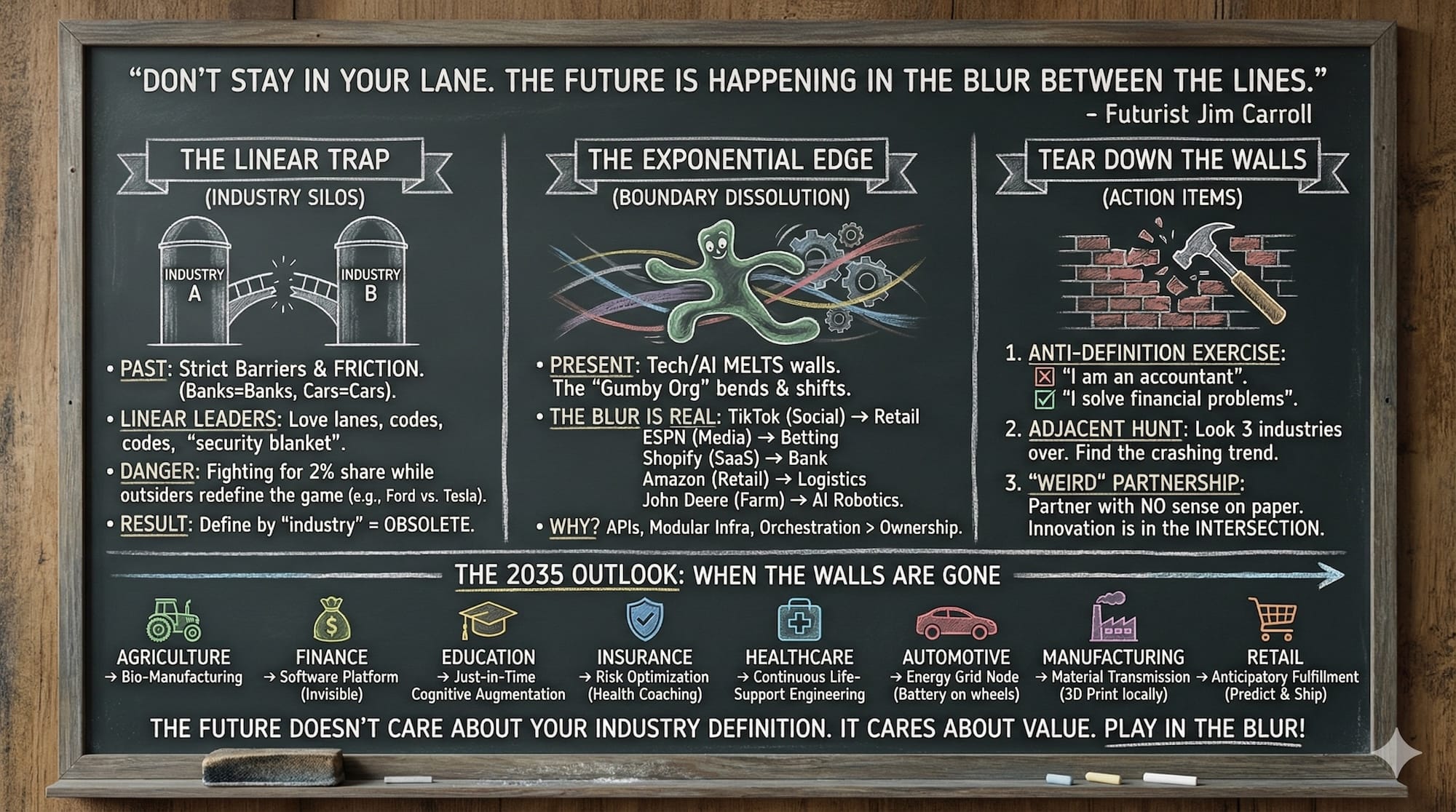
Why are the walls between industries crashing down?
It goes back to the "Tomorrow's Company Won't Have Walls" idea - the new corporate structure allows companies to bend and shape, mold and modify, shift and change. We are moving from firms as closed, industry-defined “things” to firms as cross-sector systems that route data, payments, identity, logistics, and care across different partners at high speed.
To do a lot of these, they are hiring the people who are experts at the career pivot - people who bring a broad range of skills across a vast number of different knowledge areas who have worked and can work in multiple different industries.
The new leader of the future is Gumby!
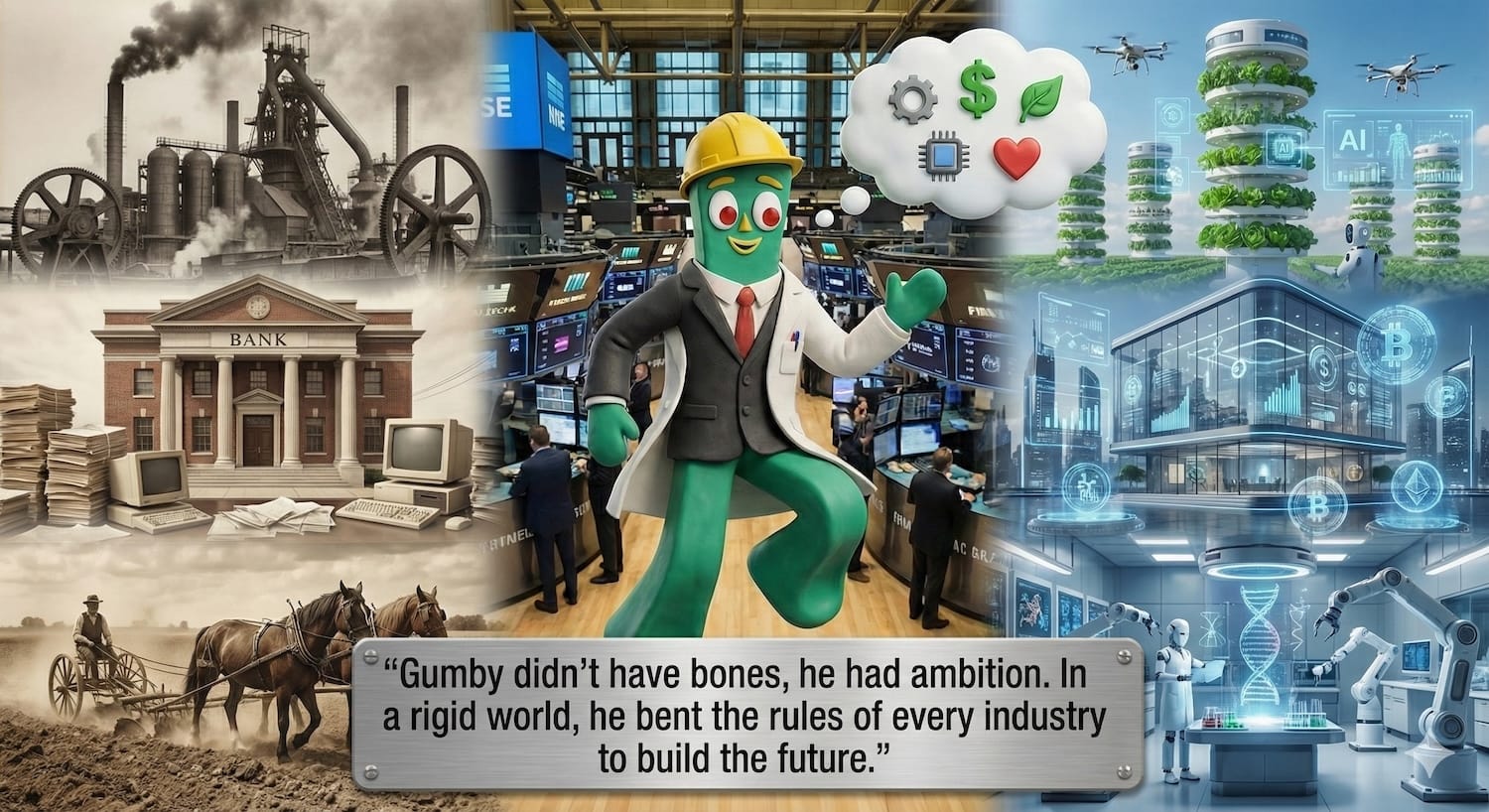
He or she doesn't have bones, but they have ambition. And in a rigid world, they bend the rules of every industry to build the future.
The Evidence: The Blur is Real!
Don't take my word for it. Look at what is happening right now among the world's biggest players.
- A social platform has become a retailer. With TikTok Shop, TikTok isn't just a media feed anymore; it's a marketplace with in-app checkout and logistics. They dissolved the boundary between a social media network or a "marketing channel" and a "storefront."
- A sports network became a wagering infrastructure: ESPN is moving betting from a separate app toward direct integration. That’s "broadcast" merging into "transactional entertainment."
- A software company became a bank: Shopify Balance is a financial account embedded inside the merchant OS. That’s "SaaS" merging into "business banking."
- An online retailer became a logistics hub: Amazon is the ultimate Gumby. 'Buy with Prime' lets merchants outside Amazon use Prime-style fulfillment. Retail distribution has become a service layer for the broader internet.
- An industrial automation firm became an AI 'stack': Siemens is expanding a partnership with Nvidia to create "industrial AI,l" providing sophisticated new industrial, smart equipment for the manufacturing sector that isn't just hardware, but a full industrial operation system."
- A farm equipment manufacturer became an AI robotics company: John Deere bought a technology company called Blue River. A business model that involved pretty basic “see and spray” technology is now quickly pivoting into a real-time machine vision tech company.
Why is this happening now?
Technology, AI, and bold thinking
- APIs provided an opening. "Application programming interfaces" allow the tech of one company to 'talk' to the tech of another company. This allows companies to plug into each other, which smooths the way for straying out of one's lane. Want to be a life insurance company that offers real-time healthcare underwriting? Use an API to plug into the real-time health data of an online, real-time health care platform that someone uses to monitor their vitals. You don't need a five-year merger strategy; you need an API key.
- Modular infrastructure makes "buying" cheaper than "building." Embedded finance, “Prime-like” fulfillment, and industrial AI partnerships all exist because the underlying methodologies and API's are now buyable, composable services. Want a sophisticated real-time delivery and logistics system? Fill out a form online, and implement some code. Boom!
- Online defines interaction. TikTok turns interaction and attention into a checkout process. ESPN turns fandom - people watching live sports - into instant bets. The interface is the marketplace.
- The winning design is "orchestration, not ownership. Orchestration is a pretty fancy word for coordination. The future belongs to those who know how to plug into all this new, fast-emerging infrastructure and make the most of it!
The 2035 Outlook
What happens when the walls are gone?
Crazy stuff!
The "industries" we know today don't just evolve. They evaporate! They disappear! They turn into entirely new things! You'll find your business opportunity and your new career in the opportunities that come about as the lines dissolve.
Here is where the blur takes us:
- Agriculture: It’s no longer "farming"; it’s biological manufacturing. By 2035, the boundary between the field and the factory is gone. With vertical farming, precision gene editing, and autonomous robotics, food production becomes a predictable software process - a "factory without walls." It becomes an industry managed by data scientists, not just farmers.
- Banking & Finance: It’s no longer a "place"; it’s a software platform. Money ceases to be a distinct product and becomes an invisible part of everything else. Your car pays for its own charging; your fridge negotiates grocery prices, and your home thermostat finds the best energy grid arbitrage. Banking dissolves into the operating system of the economy.
- Education: It’s no longer "school"; it’s "Just-in-Time Cognitive Augmentation." Yes, I made up that phrase! The idea of a four-year degree followed by work dies. AI agents deliver the exact knowledge you need, the second you need it, dissolving the line between "learning" and "doing."
- Insurance: It’s no longer "risk protection"; it’s risk optimization. Insurers stop paying for bad things that happen and start managing your life to ensure they don't. The policy becomes a real-time health and safety coaching platform, merging entirely with the wellness and IoT that surround your body.
- Healthcare: It’s no longer "medicine"; it’s continuous life-support engineering. (Yes, I made that one up, too!) The boundary between the "hospital" and the "home" vanishes. With wearables and ambient sensing, care is continuous, proactive, and delivered by consumer tech companies (like Amazon or Apple) rather than traditional medical clinics.
- Automotive & Transport: It’s no longer just "mobility"; it’s become an energy grid - at least in much of the rest of the world outside of the US. The vehicle loses its identity as just a car and becomes a big battery with wheels - and with that, a mobile node in an energy grid. Transportation and energy utilities fuse into a single infrastructure.
- Manufacturing: It’s no longer just "making things"; it becomes material transmission. With advanced 3D printing and AI, we stop shipping finished goods and start shipping digital files to be printed locally. The boundary between "digital information" and "physical product" disappears.
- Retail: It’s no longer "buying"; it’s anticipatory fulfillment. The boundary between "wanting" and "having" collapses. AI predicts your needs so accurately that products are shipped before you order them. Retail becomes a logistics utility that runs in the background of your life.
Crazy ideas?
Maybe.
But remember one of my core innovation themes - when people say 'that's the dumbest thing I ever heard,' it usually eventually becomes real!
1. The Exponential Mindset
Companies used to own their position in an industry through what they made. They will now own a future depending on how well they can orchestrate divergence into different industries - how well they can morph and merge into new ideas.
Why are industries merging? Because physical industries (selling groceries, cars) often have low margins (2-10%), while digital industries (ads, software) have high margins (60-80%). A grocery store must become an ad agency because selling milk has almost no profit, but selling ads on the milk shelf is highly profitable.
With that, the Exponential Leader stops asking, "How do I win in my industry?" and starts asking, "What value can I create if I ignore the rules of my sector?
2. The Linear Trap
Linear leaders love lanes. They love NAICS industry codes, trade associations, and conferences all about their industry because they provide a false sense of order. It provides comfort - it's a silo" security blanket. The result is that they focus 100% of their strategic energy on competing against their traditional rivals for a 2% market share gain.
In the meantime, exponential leaders ignore them and do something different altogether. Need an example? While Ford and GM were busy fighting each other in the marketplace, a software company (Tesla) and a data company (Uber) redefined the idea of mobility. While hotels were fighting over room rates, a software company (Airbnb) redefined hospitality.
If you define yourself by your "industry," you are already obsolete.
3. The Exponential Edge
When you embrace Boundary Dissolution, you unlock the velocity of Gumby!:
- Speed is inherent. You don't need to build a bank to offer banking; you plug in an API. A coffee shop can become a bank (Starbucks) because the banking infrastructure is just a software plug-in. Did you know Starbucks has over a $1 billion in deposits with its gift cards? They're a bank!
- The Trojan Horse Strategy: Because you don't look like a traditional competitor, the incumbents ignore you until it is too late. You enter a new market not as a rival, but as an "enabler," and then slowly create a new industry, leaving the other one behind.
- GenAI provides a new universal "glue" going forward: Previously, merging two industries (e.g., biology and software) required humans to learn two different "languages." Generative AI acts as a universal translator, allowing a biology firm to "speak" code without building massive new departments.
4. The Immediate Pivot
Tear down the mental walls that define your business!
- The "Anti-Definition" Exercise: Write down your current "industry" definition (e.g., "I am an accountant"). Now, cross it out. Re-define your value based on the problem you solve, not the method you use (e.g., "I provide financial certainty and algorithmic compliance").
- The Adjacent Hunt: Look at the three industries next to yours. If you are in insurance, look at health tech. Identify one exponential trend in their world that will inevitably crash into your world.
- The "Weird" Partnership: Reach out to a potential partner this week who makes no sense on paper. If you sell coffee, talk to a blockchain developer. The innovation is in the intersection.
The future doesn't care about your org chart or your industry definition.
It only cares about value.
And in 2026, value flows to those who can cross the lines, who play in the blur, and find the future in the fog!
Futurist Jim Carroll came up with the "Gumby" analogy while writing this post, and promises to use it a lot going forward!