
“Don't ‘learn’ AI. Redesign your personal productivity around it.” - Futurist Jim Carroll
Futurist Jim Carroll is writing his end-of-2025 / introduction-to-2026 series, 26 Principles for 2026. You can follow along at 2026.jimcarroll.com. He welcomes your comments.
Like it or not, you will have to learn to live with "The Machine."
We are on Day 24. You have the radar (Day 21), the open road (Day 22), and many principles I've shared before that. Now, we must address the elephant in the room: The Machine.
For the last three years, the narrative has been “Man vs. Machine.” People are going to lose their jobs! We will all be working 2 hours a day, 3 days a week, because AI will do all the work. Stuff like that.
In 2026, that line of thinking is obsolete. You need to get beyond the hype and hysteria. The competition isn’t between you and the AI. The competition is between “You + AI” and “You Alone.”
The Linear Leader tries to outwork the algorithm. The Exponential Leader learns to partner with it.
Don't fear having to compete with AI. Learn to conduct it. The discipline you must master is Algorithmic Partnership.
Here's your chalkboard summary - generated, of course, by AI!
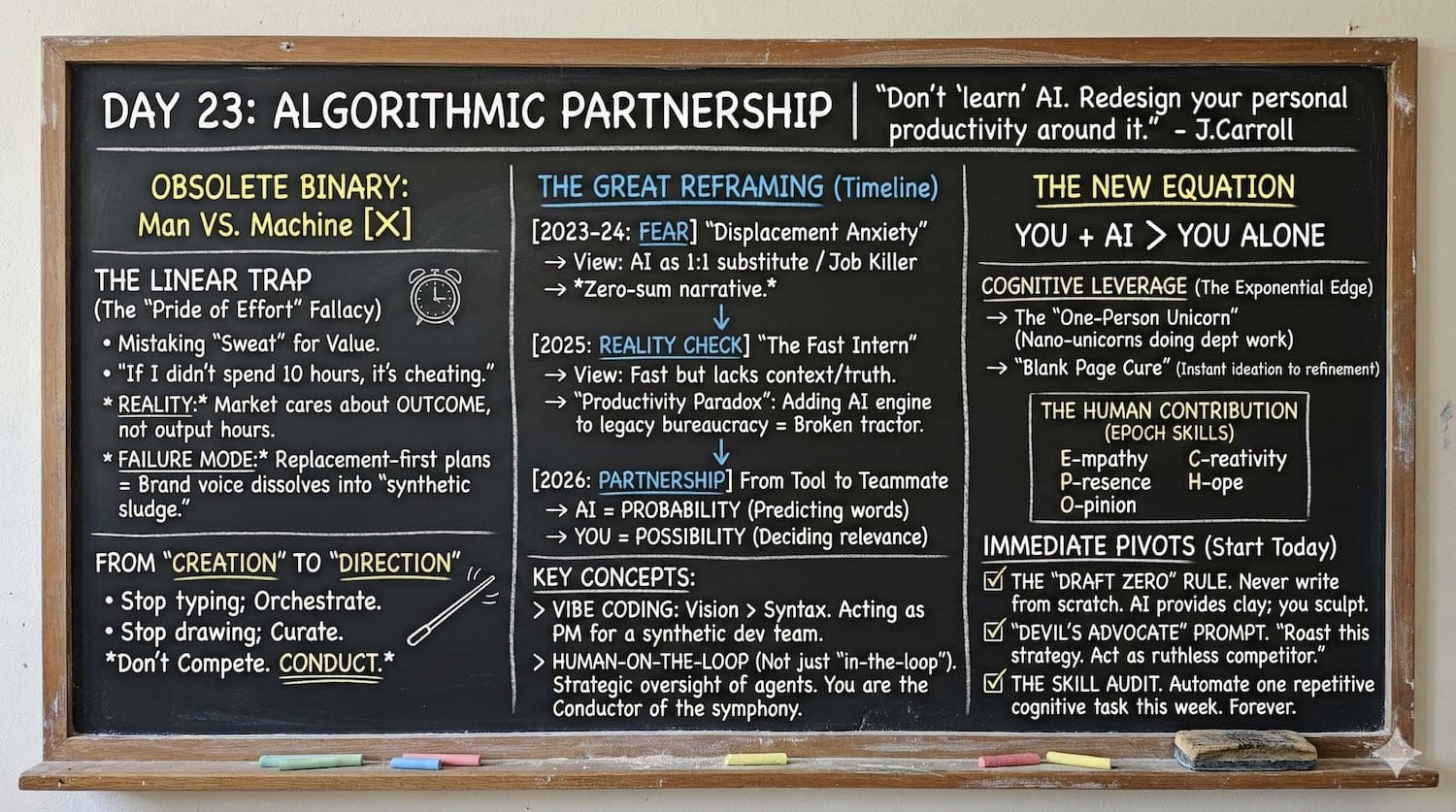
The Great Reframing: From Displacement to Orchestration
To master this partnership, you first have to understand the emotional and economic rollercoaster we have just ridden. The narrative of “AI as a job killer” didn’t just appear; it evolved, crashed, and reformed into something far more interesting.
And the voyage has caused a lot of grief!
The Era of Fear (2023–2024)
When ChatGPT and its peers first arrived, the world suffered from what we might call “Displacement Anxiety.” The logic was linear and terrifying: If an AI can write a report in 10 seconds that takes me 10 hours, I am obsolete.
That fear wasn’t abstract. Major forecasts poured gasoline on it. The World Economic Forum’s 2020 estimates talked about 85 million jobs potentially displaced by 2025, alongside 97 million new roles emerging. That headline shaped how people felt, even though it was always a projection, not a verdict.
Then there were grand pronouncements by all kinds of tech CEOs and other leaders about the magic productivity benefits of AI, with one suggesting that they wouldn't have to hire any new people in the future since AI would do all the work! Folks nodded their heads in some sort of weird agreement, buying into the narrative. People were getting drunk on Kool-Aid!
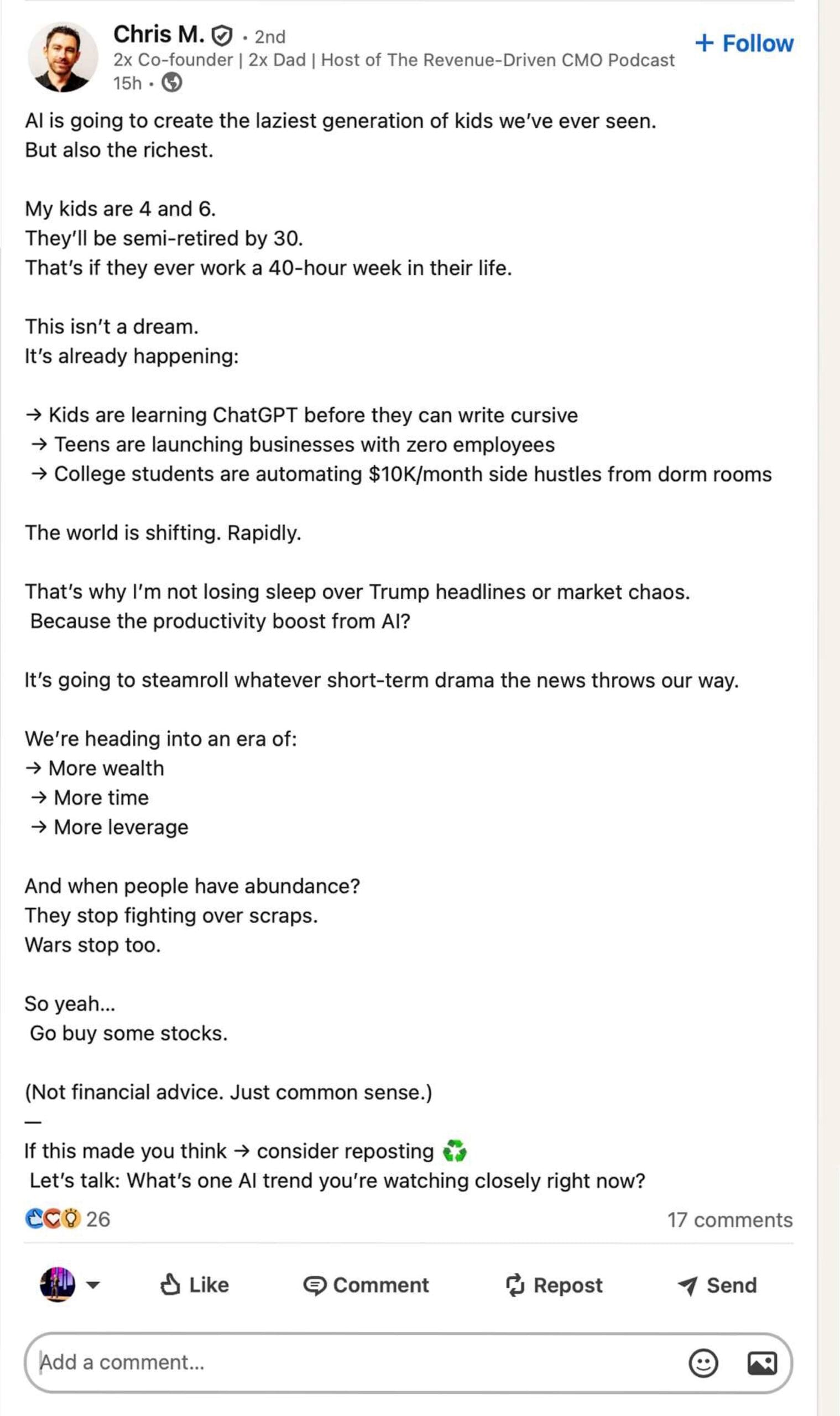
It's going to end wars. Right. Got it. I rest my case.
I've been here before. In the 1940s, Popular Mechanics magazine was predicting that the machine era would see us with unlimited leisure time!
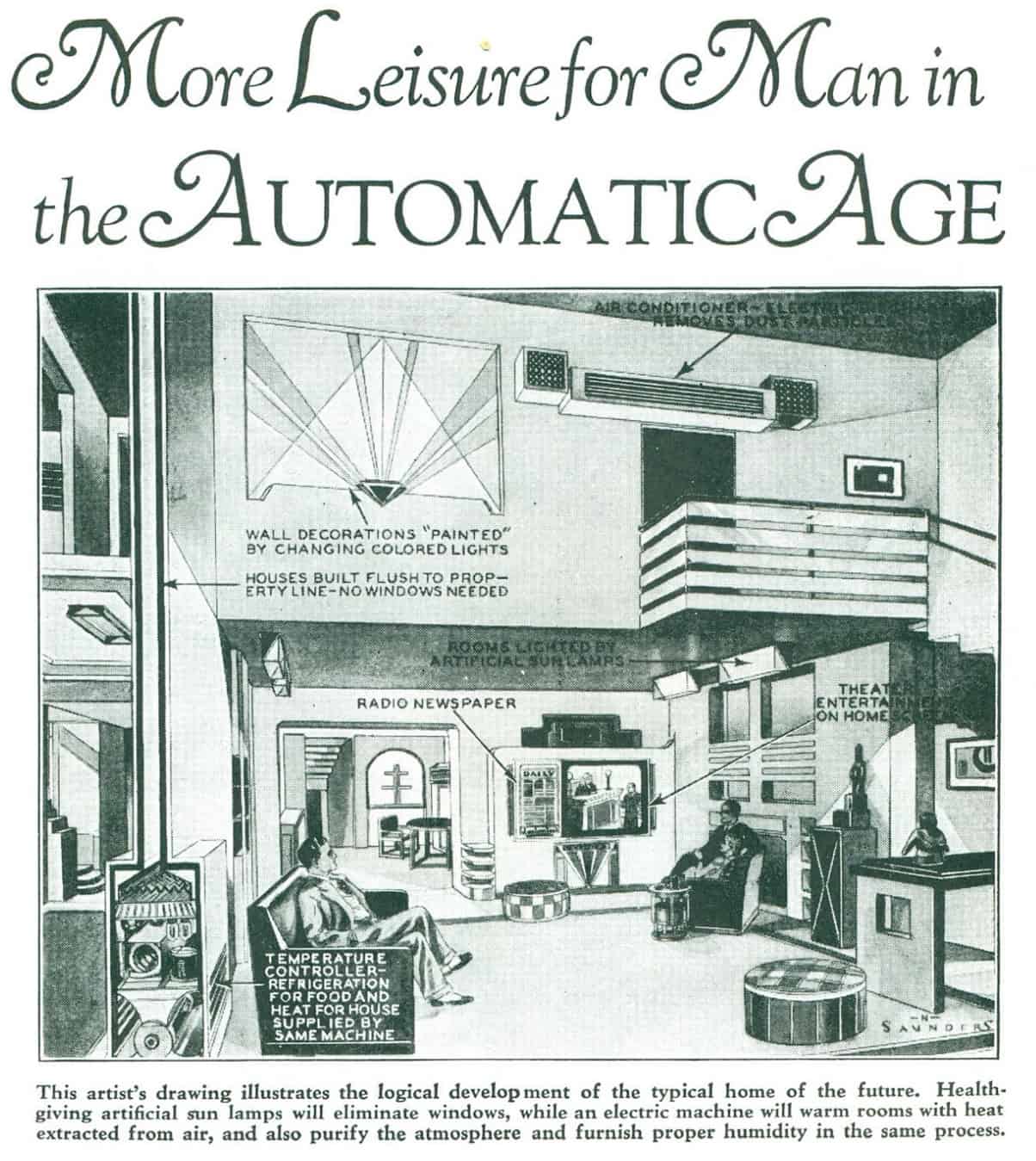
Today. Oh, well, apparently we are going to have 3-day work weeks!

Sigh.
One impact of this hype, though, as CEOs themselves not only drank the Kool-Aid but also injected it straight into their veins. They got high on the hype and made 'bold decisions.' We saw a wave of tech layoffs often attributed to “AI efficiency,” fuelling this zero-sum narrative. The reality? More likely that companies were using AI as an excuse to do the cost-cutting that they had planned in the face of spending uncertainty.
But with all of this, the fear became implanted in our minds - AI was a 1:1 substitute for human intellect, and because of that, we were all going to lose our jobs. We were doomed!
The “Fast Intern” Reality Check (2025)
Then came the reality.
By 2026, we will hit what Gartner calls the “Trough of Disillusionment” on the Gartner Hype Cycle.
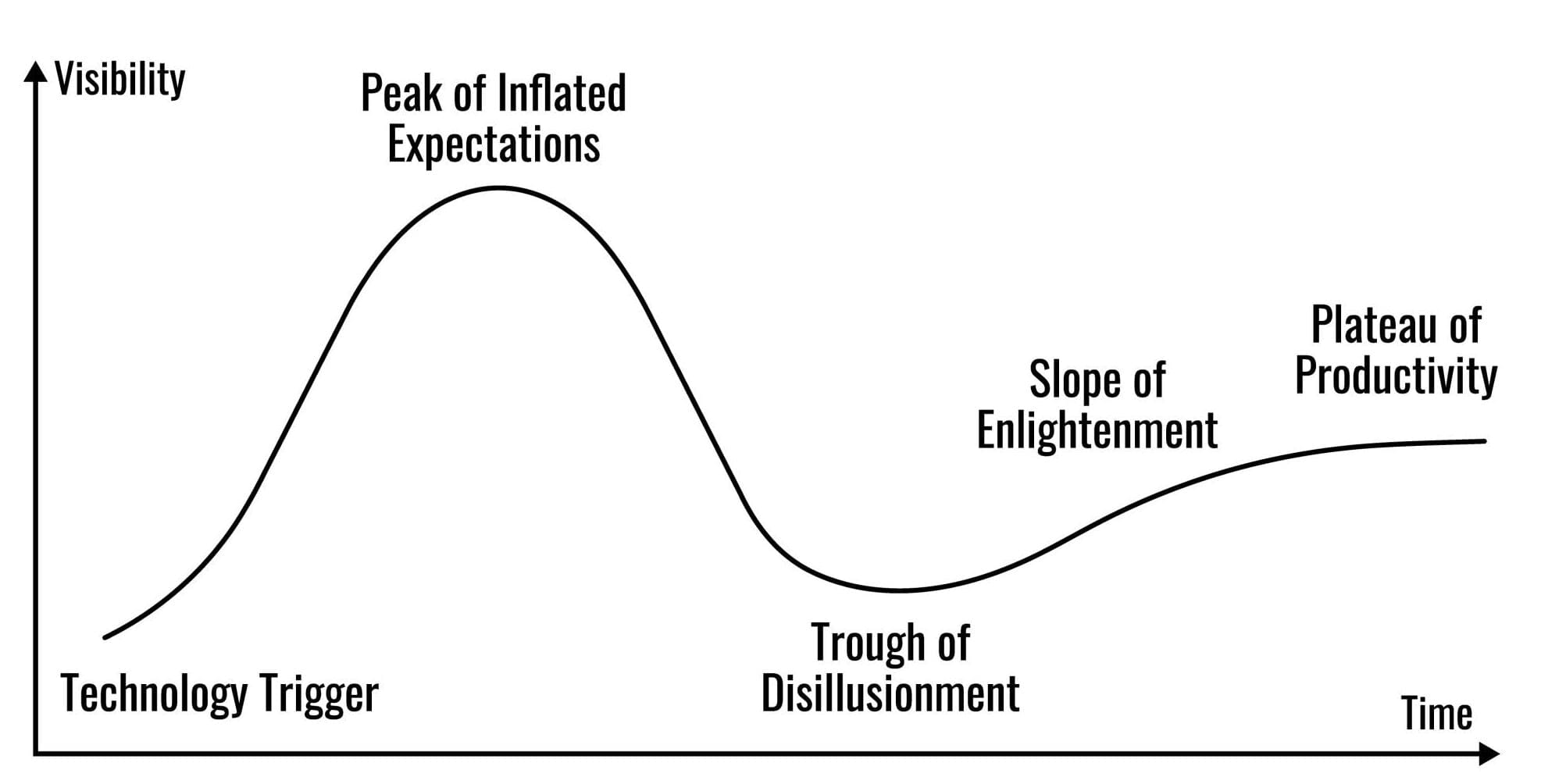
No wonder I had to share the idea, learning to deal with excessive hype as Principle #14 of this series was one of the most important things we could do.
Through 2025, many came to realize that while AI could generate content at infinite speed, it often lacked context, nuance, and truth. It made stuff up. It was often full of eras. We started to explain that it was 'hallucinating.' All while it continued to improve at a staggering speed, our understanding of its limitations, weaknesses, and faults also began to grow.
And with that, the narrative began to change. It wasn’t to be our master; it was more an immature and fast "intern” that required constant supervision. Rather than replacing us, we had to monitor it, watch it, and carefully assess its work.
- The Failure of Replacement: A landmark MIT study revealed that 95% of corporate AI projects failed to deliver ROI when they simply tried to swap humans for bots without changing the workflow. The pattern is consistent: replacement-first programs underperform because they don’t redesign the work. C
- The Productivity Paradox: We learned that adding a Ferrari engine (AI) to a tractor (legacy bureaucracy) didn’t make the tractor fast; it just shook it to pieces. (I'm coming to love tractor analogies!)
With this came two of the most brilliant observations of our short affair with AI so far, as the floodgate of spending opened up in the face of massive strategic uncertainty:
"AI: It's among the most expensive keeping-up-with-the-Joneses games in corporate history" - Korn Ferry Report, 2025
"Step one: we're going to use LLMs. Step two: What should we use them for?" - IBM Report, 2025
Productivity? If you think about it, we ended up doing more work because of it, not less!
But at the same time, for those of us who learned to tame it, our productivity soared, all while it continued to get better and better. (Or, as some would say, more productive with more sophisticated errors!) So as we close out 2025, there’s also a second reality check hiding in plain sight: most of what seems to be happening is that we are interrupting specific tasks, but not deleting jobs. Goldman Sachs, for example, has said that even if current AI use cases scaled broadly, only a small slice of total employment would be at risk of full displacement, while a much bigger slice of daily tasks would be reshaped.
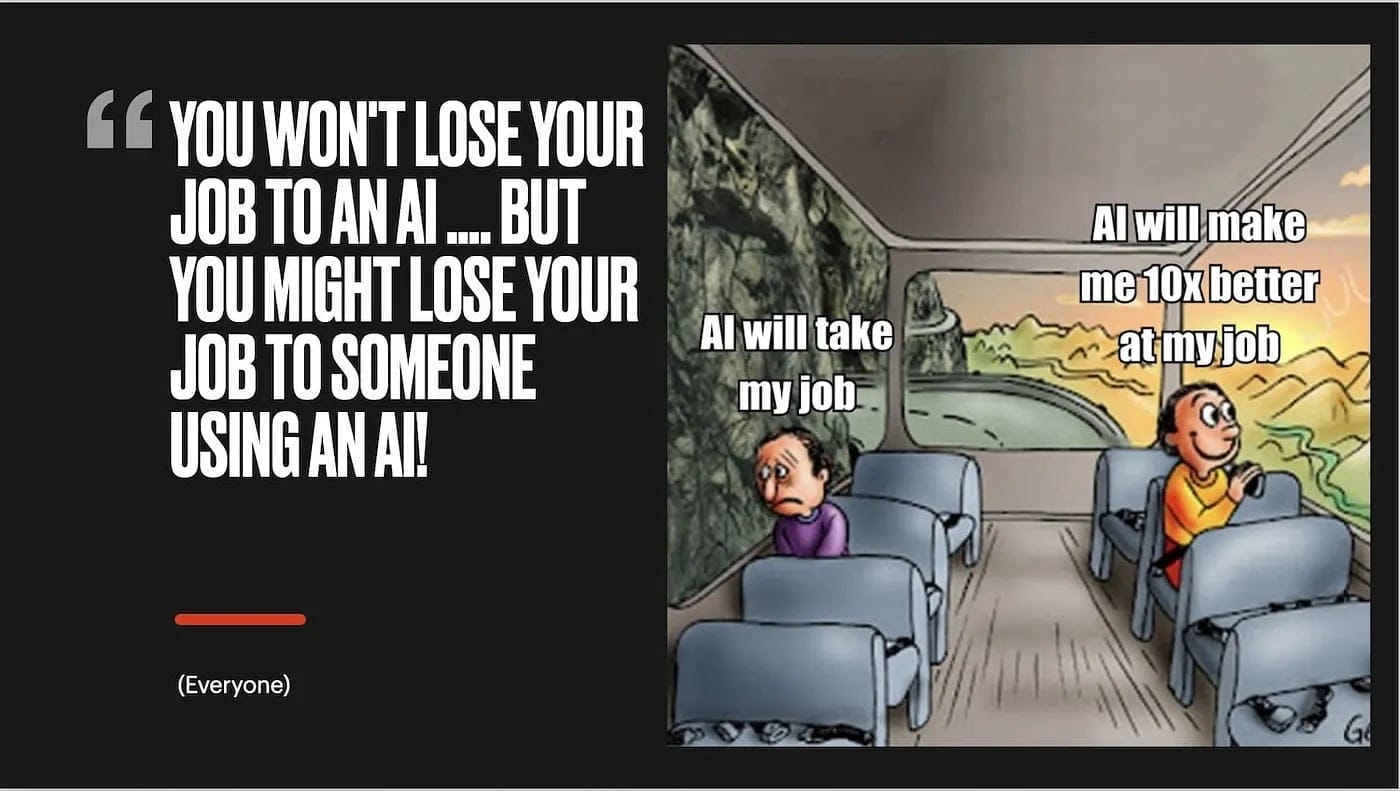
This is a pretty significant change in the narrative! We moved to this - an image I've often shared.
The Pivot to Partnership (2026)
Think about what this means.
The World Economic Forum now predicts that while 92 million jobs might be displaced by the shift between humans and machines, 170 million new roles are emerging, roles that didn’t exist three years ago.
Many of these new roles seem to be exactly what the image implies - they are actually old jobs and careers, enhanced by the impact of AI. With that, it seems pretty clear that the winners of 2026 and beyond aren’t those who automated their workforce into oblivion. We aren't about to all lose our jobs.
Instead, we will continue to see wild chaos as jobs and careers undergo dramatic change, and as corporations try to figure out what all this 'AI stuff' actually means, and where the opportunities, productivity, and efficiencies really lie.
It's “jobs chaos,” rather than a “jobs apocalypse.”
1. The Exponential Mindset
What seems to be happening is that AI is moving from a "tool" to a "teammate."
If that's the case, you've got to stop thinking about AI as a search engine like Google, a generator of text, or a creator of images and video.
Start thinking of it like your partner. It's going to be here, and will be a big part of your working life, whether you like it or not. That's why you need to place the phrase Algorithmic Partnership.
What is it? It's realizing that AI is a force multiplier for your intellect, an enhancement of your knowledge, an enabler of new skills. In this partnership, you don’t type; you orchestrate. You don’t just draw; you 'imaginate' (my word, I made it up!) You don’t just code; you architect. Your value shifts from “creation” to “direction." That's a big mindset shift.
In my case, it's certainly happening. I am doing a lot of what people have come to call “Vibe Coding.” I'm doing a lot of highly technical work, building very complex apps or solving deep technology support issues, simply by describing the vibe and functionality to an AI. In that way, I've developed entirely new skills - managing and orchestrating my own highly specialized tech development and support team.
The barrier to entry to get fully into this world? It's not the words we choose to describe what we are doing - it's adjusting our vision of what we can accomplish.
2. The Linear Trap
In the face of this opportunity, many people are struggling with the uniqueness of "AI guilt."
Think about it: one of the more interesting aspects of this AI voyage is that many people came to believe that if they used AI, they were cheating. Why is that? Linear leaders take pride in the sweat. We've come to believe that if we didn’t spend 10 hours writing the report manually, it wouldn’t be valuable. We resist AI because it feels like we are 'bending the rules.'
In 2026, the market does not care how hard you worked. It cares about the output; it cares about what you produce; it cares about what you can do. That being the case, clinging to manual effort in an automated world isn’t integrity; it’s inefficiency. And the simple fact seems to be this: we are shifting from "output" (hours worked, lines of code written) to "outcome" (business impact, customer value).
So while you are proud of your 10-hour draft, your competitor’s Algorithmic Partnership has produced 10 variations in 10 minutes and is already executing the best one. You can't compete against that - and if you remain stuck in the old mindset, you'll fall way, way behind.
3. The Exponential Edge
When you master Algorithmic Partnership, you unlock the very unique leverage this strange new world provides us:
- The “One-Person Unicorn”: We are entering the era where a single individual, powered by a stack of AI agents, can do the work of a traditional department. We are already seeing “nano-unicorns,” startups reaching massive valuations with fewer than 10 employees. You can be the writer, the coder, the designer, and the strategist simultaneously because your partner handles the execution.
- The Blank Page Cure: You never start from zero. Your algorithmic partner provides the clay, the raw draft, the basic code, and the initial list. You provide the sculpting, the judgment, the empathy, the strategy. You move instantly from ideation to refinement.
And the productivity evidence is getting harder to ignore. In controlled and field experiments, human-AI teams and AI-assisted workers often move materially faster, sometimes dramatically, while quality becomes a management choice instead of a guarantee. According to Microsoft, GitHub Copilot experiments, for example, found large speed gains on defined coding tasks. xArciv reports that in a large marketing experiment pairing humans with AI agents, researchers observed major productivity lifts per worker, alongside a reminder that the partnership still needs tuning, especially when moving beyond text into multimodal work.
Different frameworks label this change bucket differently, but the core observation is the same: while AI can do a lot of work, the power and role of human judgment and orchestration are the missing link. With that, entirely new roles are appearing that are basically “partnership operators,” people paid to make the human-AI system reliable, useful, and aligned to outcomes.
Algorithmic orchestrators, as it were.
4. The Immediate Pivot
So here's what it all means - you need to stop using AI as a tool and start treating it as a partner! How do you do that? Try a few ideas:
- The “Draft Zero” Rule: Commit to never writing a first draft from scratch again. Use your partner to generate the skeleton, the Draft Zero, and then use your human expertise to add the muscle and soul. Save your energy for the elevation of the idea, not the generation of it.
- The “Devil’s Advocate” Prompt: Before making any strategic decision, feed your plan into your AI partner and ask: “Roast this strategy. Act as a ruthless competitor and tell me three reasons why this will fail.” Use the machine to challenge any built-in bias that you might have and that you might not be aware of!
- The Skill Audit: Identify the one low-value, repetitive cognitive task that consumes your week (for example, summarizing meetings, sorting emails). Spend one hour this week building a simple AI workflow to kill it forever. Vibe the code!
The principle for 2026? Like it or not, you’re going to live with the machine, so stop treating AI like a new subject to study and start treating it like the operating system for how you get work done.
The old “man vs. machine” panic is fading because the real contest is “you plus AI” versus “you alone.” We’ve learned that replacement thinking fails when you bolt AI onto old workflows, but partnership thinking wins when you redesign the work itself.
In that model, your value shifts from grinding out first drafts and doing 'busywork' to orchestrating.
That' directing, judging, and refining the things you do, using AI to generate momentum while you provide context, truth, and strategy.
It's not Man vs. Machine.
It's You.
With The Machine.
Futurist Jim Carroll predicts that in 10 years, we will all look back and have a good laugh at the AI hysteria of 2022-2025.