
"In an era of synthetic perfection, your flaws are now the ultimate watermark of your authenticity." - Futurist Jim Carroll
Futurist Jim Carroll is writing his end-of-2025 / introduction-to-2026 series, 26 Principles for 2026. You can follow along at 2026.jimcarroll.com. He welcomes your comments.
I'm back!
And we're on Day 24. You have the radar (Day 21) and the Algorithmic Partnership (Day 23). There are only two more posts after. This will get us to our 26 Principles for 2026.
I've put a lot of thought into the series. I know that you likely aren't reading every one - and indeed, if you are like most people, you are simply skimming what's here.
Today, you need to skim this key point - in 2026 and beyond, you need to take the time to secure your most valuable asset: Your humanity.
How do you do that?
Share your flaws. Highlight your failures. Document your mistakes.
Admit you are human!
There's no doubt that with AI moving as fast as it is, we stand on the precipice of a strange new era - we could call it the “Age of Infinite Perfection.” Synthetic media, algorithmic amplification, and automated engagement surround us. Slop, we've called it. And it is quickly leading to what some have called the "dead Internet," a world where a staggering percentage of online traffic and content generation is generated by non-human sources. Generated by AI, indexed by algorithms, and served to you based on what a machine thinks you need to see.
And the problem with a lot of this is that the machines are getting so good that they are getting close to absolute perfection. Have you seen the latest with AI video? Have you looked at an image and had to check yourself to remember that its;' from an AI? Have you been duped by an artist with stunningly powerful music only to discover it's an AI?
I have!
Check out Let Babylon Burn. Listen to this song. I had it on repeat for a month before I realized it wasn't real!
If you are a brand, a product, a company or an individual, how will you ever manage to stand out among the slop? Or stuff that is so perfect, it fools you into believing it's real?
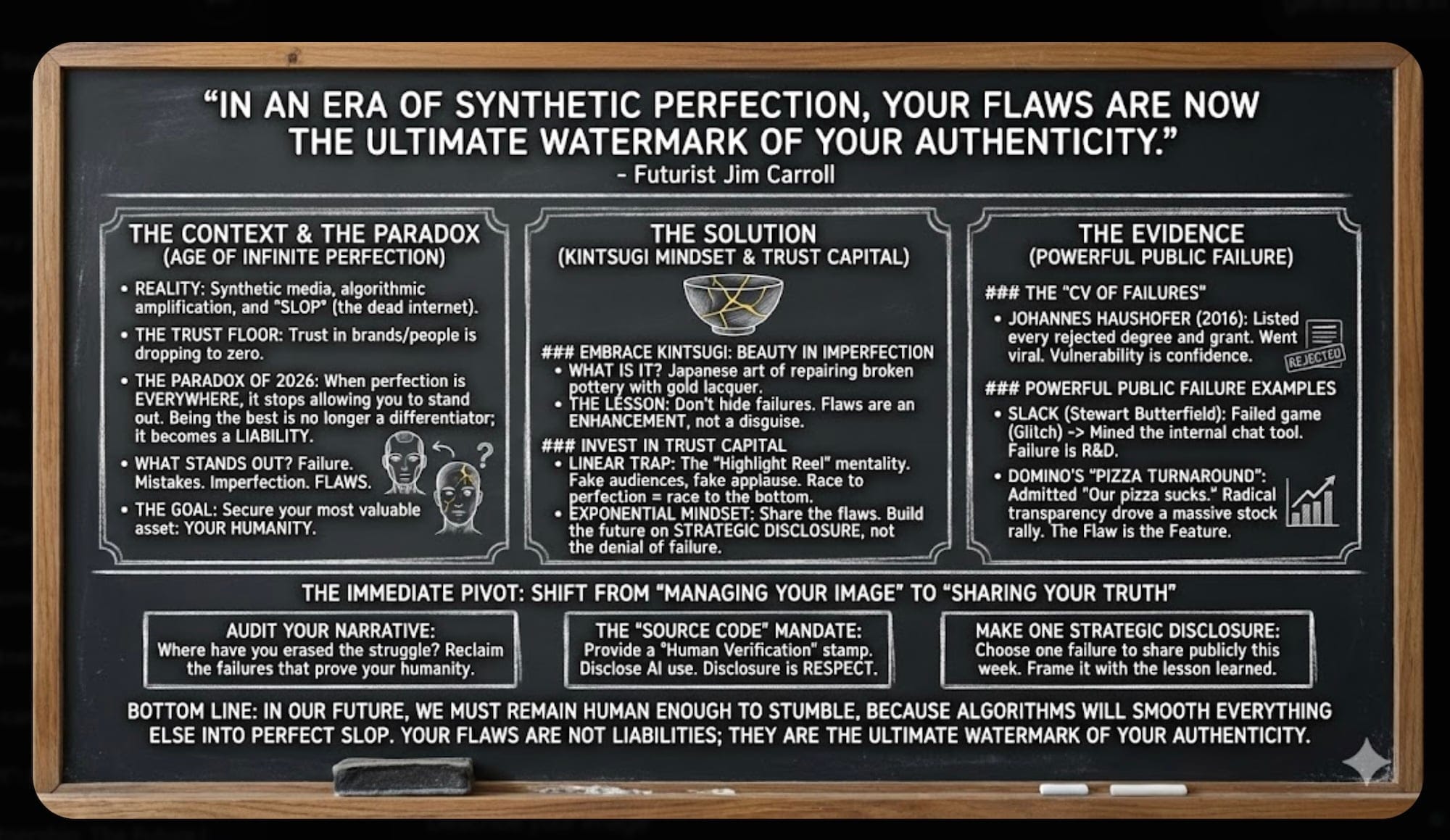
(Oh, and if you are skimming, here's your chalkboard summary. Yes, it was AI-generated, so I am working a bit at cross purposes here, but at least I'm admitting it!)
In this environment, the trust that people have in people, companies, brands, and transactions is dropping to zero. Some call it the 'trust floor.' Not only that, but we are all getting access to the same tools that allow us to generate perfection on demand.
When everyone is perfect, what stands out? That's the paradox of 2026 and our future: When perfection is everywhere, it stops allowing you to stand out. Being the best is no longer a differentiator - instead, it becomes a liability.
Think about where we are headed - when a machine can instantly generate a convincing quarterly report, a flawless biographical summary, or a photorealistic image of a product that does not exist, perfection dominates. In that context, a resume without a gap, a product launch without a stumble, or a leader without a scar becomes common - the common thread of a world of perfection.
What stands out? Failure! Mistakes! Imperfection!
Flaws.
What's the solution? Embracing the idea of Kintsugi
The Beauty of Kintsugi
The Japanese are wonderful with the way they conceive of ideas that others can't.
That's where the idea of Kintsugi comes in.
What is it? It's the art of repairing broken pottery with lacquer mixed with powdered gold, silver, or platinum, making the cracks part of the object's history and beauty, not something to hide. It embraces the idea that we can find beauty in imperfection and the concept that we can treat something that breaks as something that is actually an enhancement. It treats the repair of broken pottery as part of the history of the object rather than something to disguise.
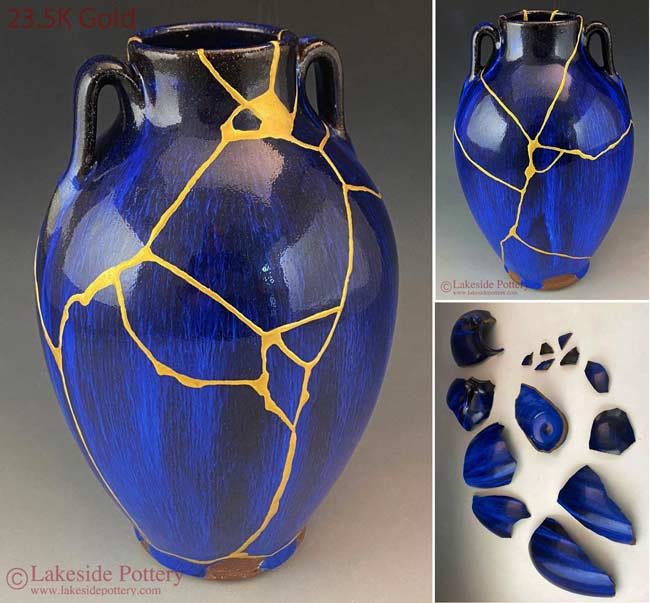
That's what WE should be doing in a world of imperfection.
We shouldn't hide our failures, bury our flaws, or disguise our mistakes. It's a part of who we are, and in the era of perfection, it will do more to help us to stand out than to try to play the algorithmic game that dominates our future. In that context, the specific, painful details of a rejected grant application, a failed product launch, or a public stumble serve as a verification signature that proves human identity.
The Resume of Failure
With that, I bring you the idea of a resume of failure!
In 2016, Princeton professor Johannes Haushofer published a "CV of Failures" listing every degree he was rejected from and every grant he was denied, noting that these "invisible" failures vastly outnumbered his visible successes.
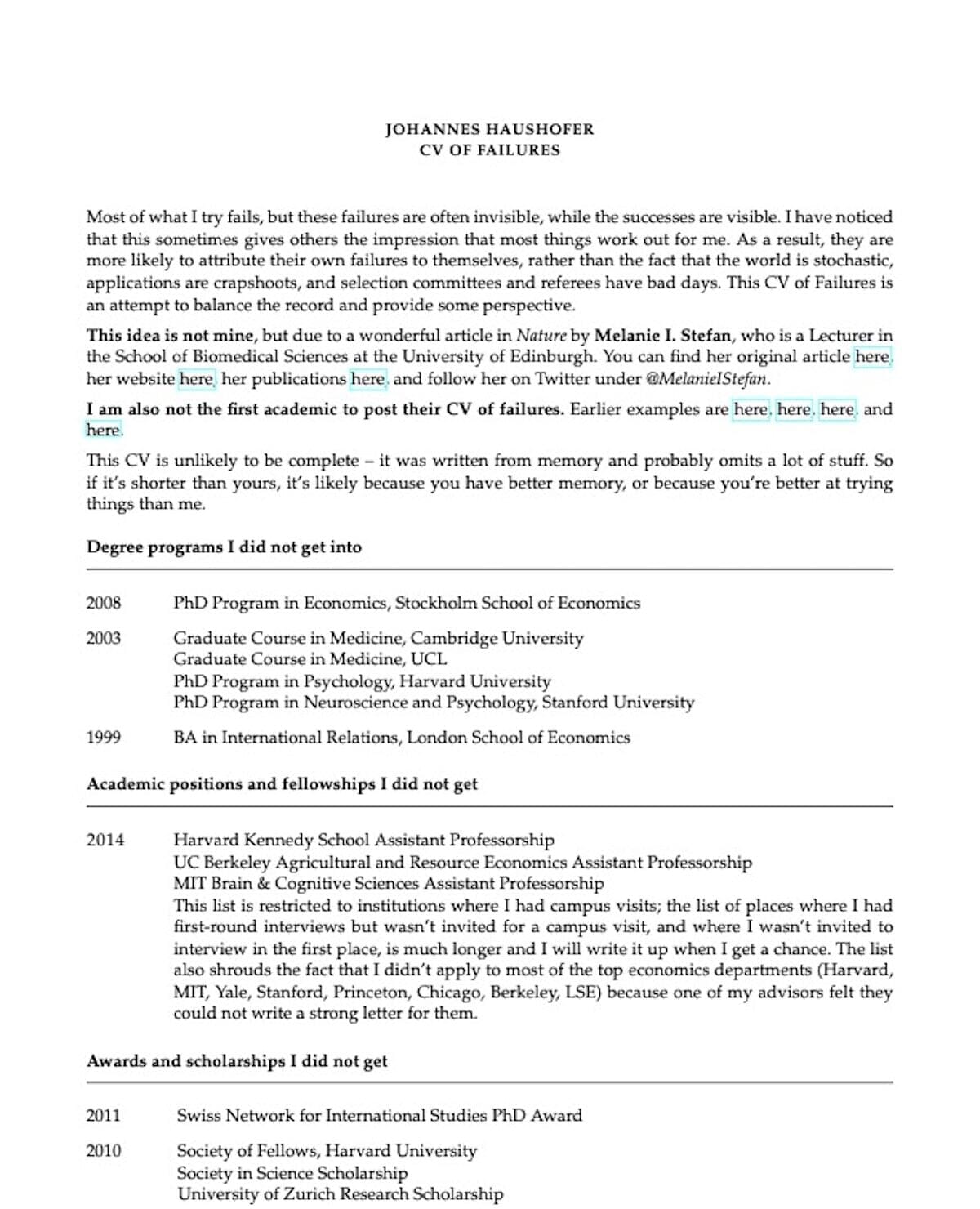
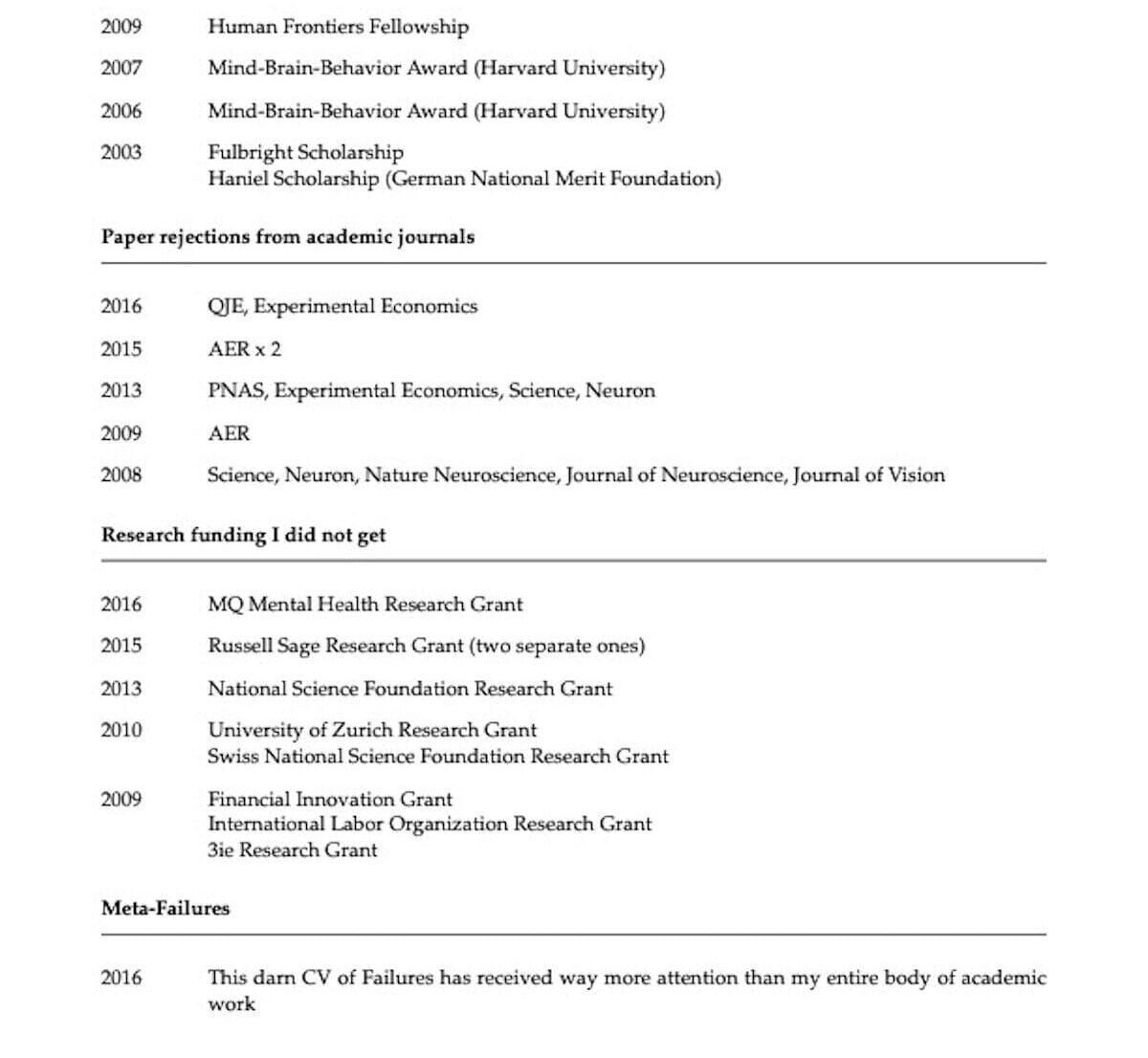
It instantly went viral. No wonder. Not only that, but read the last line! Failure stands out.
Since then, others have copied his model.
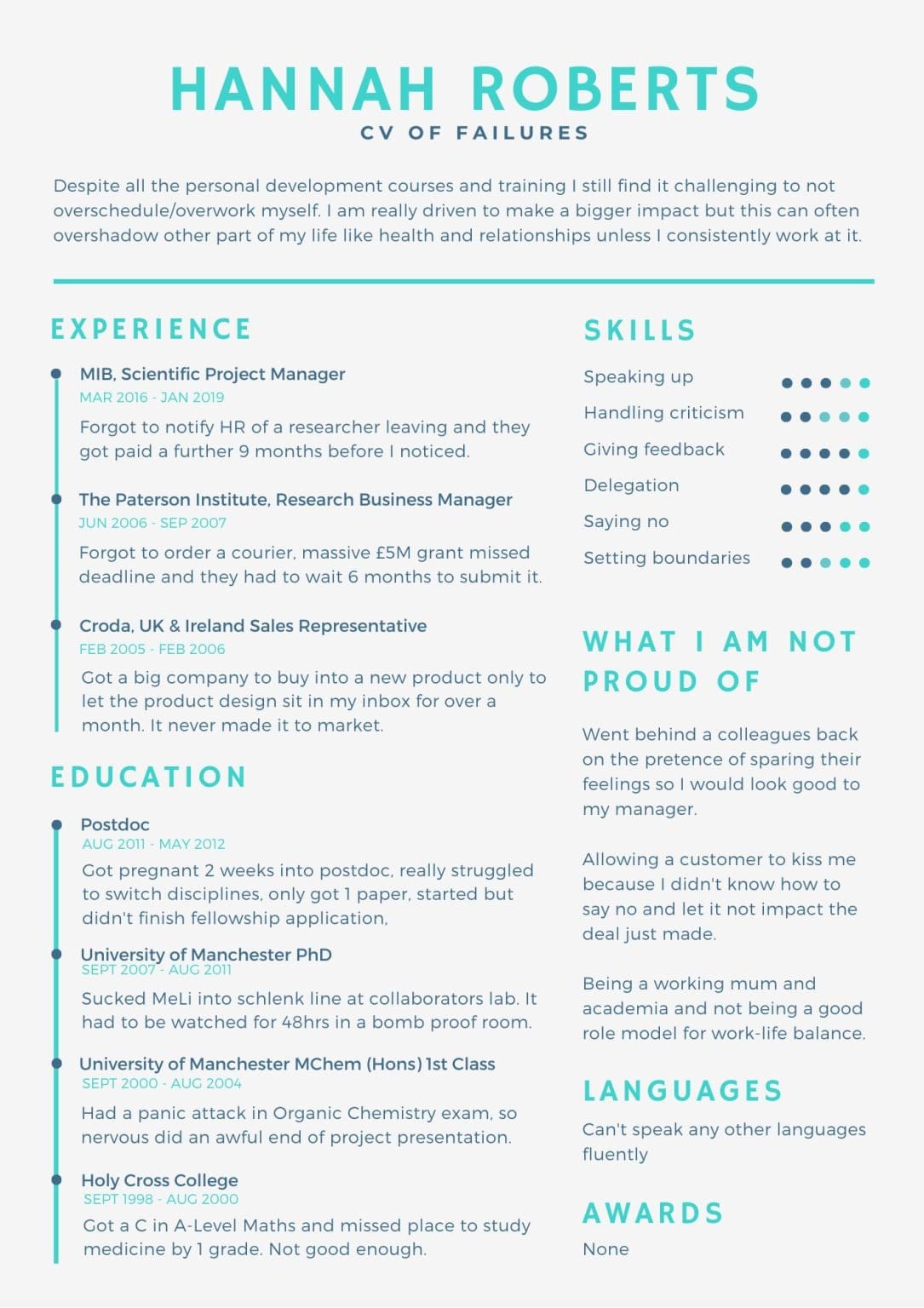
Why does this type of thing appeal to us? Why will we see more of it? Why is this a powerful strategy in the era of AI?
Because our failures are proof of our effort, a signal of our learning, a statement of our resolve.
An overview of our honesty.
Demonstrating that we've put in the work to get to success.
For Haushofer, an academic, he works in a sector obsessed with prestige. And despite his unique resume of failures, he proved that his success was developed through effort, not gifted to him through luck. By quantifying his rejections, he provided a "source code" verification of his resilience that a polished bio could never convey.
The lesson? Vulnerability is a presumption!. IN a world saturated with "toxic positivity," the admission and sharing of failure signals a level of confidence so high that the individual can afford to expose their flaws.
History proves the point
Powerful public failure
I dug into this idea and found lots of examples of how failure is actually success. Read on!
The "Slash and Burn" Pivot: Stewart Butterfield (Glitch to Slack)
Failure can become success - even if it is not planned. That's the story of the collaborative software platform Slack. The video game failed - but the software the team used to develop it became one of the most powerful collaborative platforms in the world today!
- The Context: Before Slack was a $27 billion company, it was a failed video game called Glitch. Instead of burning cash to delay the inevitable, Butterfield admitted the failure to investors immediately and shut the game down. But he realized that the internal chat tool they had built was something unique - and so he turned that into the product!
- The Authenticity Signal: Butterfield didn't hide the corpse of the failed project; he mined it. He told his investors what went wrong - but what he saw going right! In doing this, he preserved the transparency with his investors - he had the "trust capital" he needed to make a pivot. If he had hidden the reality, Slack would never have been funded.
- The Lesson: Failure is R&D. Linear leaders try to fix the failure to save face; exponential leaders extract the asset from the wreckage and move on.
Radical Transparency: The Domino’s "Pizza Turnaround"
- The Context: In 2009, faced with a stock price of $11 and customer complaints that their product tasted like "cardboard," Domino’s ran national ads admitting, "Our pizza sucks." They used real focus group footage bashing the product.
- The Authenticity Signal: This was the ultimate "Anti-PR" move. By validating the public's perception, they reset the bar of trust. People saw the company and the brand as honest, someone standing out in a world of sameness. The admission of the flaw became the primary feature of their marketing campaign, driving a stock rally that eventually outperformed Google and Amazon over the ensuing decade! (Wow!)
- The Lesson: The Flaw is the Feature. When you admit the negative, the market believes the positive. In an "Age of Infinite Noise," consumers are adept at spotting corporate speak; they crave the raw signal of honesty. They got it with pizza!
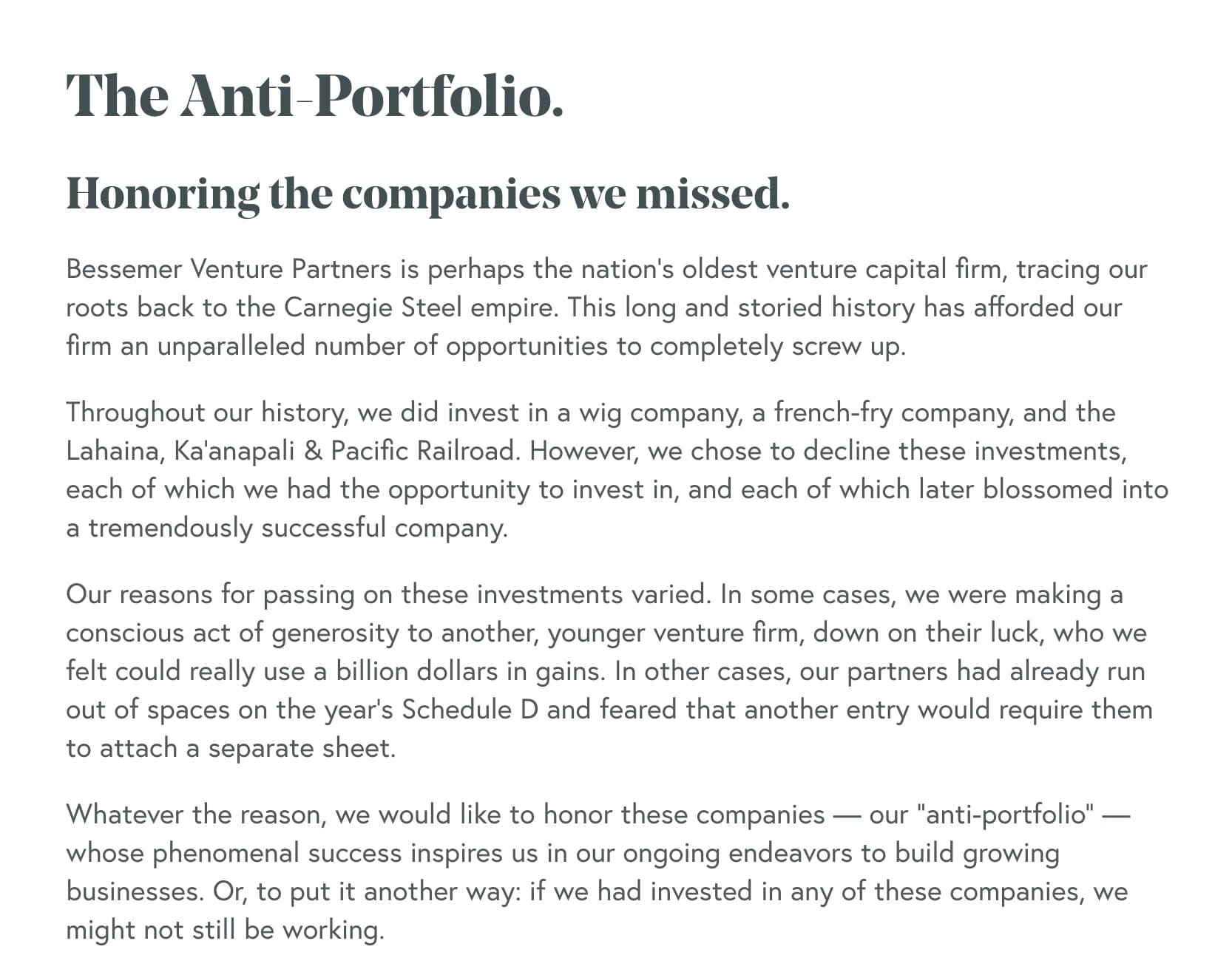
The Anti-Portfolio: Bessemer Venture Partners
- The Context: One of the world’s most successful VC firms maintains a public "Anti-Portfolio"—a list of the massive companies they refused to invest in, including Apple, Google, and FedEx. In doing so, they indicate they aren't scared of some of the biggest investment failures of all time.
- The Authenticity Signal: This is a corporate "CV of Failures." It demonstrates "intellectual honesty," signalling to entrepreneurs that the firm is grounded, realistic, and confident enough to admit to multi-billion dollar mistakes.
- The Lesson: Confidence acts as a filter. Perfection equals suspicion; admitting to the "one that got away" proves that your wins are based on judgment, not just luck.
The Serendipity of Error: Viagra and Post-it Notes
Sometimes, success comes from the very mistakes that you managed to make along the way. Viagra and Post-it Notes lead the way!
- The Context: Viagra was a failed heart medication; Post-it notes were a failed super-glue. In a linear model, these projects would have been deleted for failing their primary goals.
- The Authenticity Signal: Yet these innovations highlight the fact that failure brings success - and in a world of algorithms, might have never made it past their impossible finish line. There's a powerful lesson here: only human intuition can recognize that a "failed" adhesive is actually a new way to organize information, and that a failed medicine can actually become a multi-billion dollar product!
- The Lesson: Error is an opportunity. In the exponential mindset, what looks like a bug is often a feature waiting for a new application; a failure is often a success; a flaw is actually a work of art. Kintsugi, as it were.
In our future, we must remain human enough to stumble, because algorithms are going to smooth everything else out into perfect slop.
That's why the idea of Trust Capital is so important.
1. The Exponential Mindset
AI is moving so fast that soon, if not already, AI perfection is everywhere.
In that reality, the exponential mindset recognizes the perfection and decides it's time to share the flaws. It's a decision that part of the future will be built not on the denial of failure, but on its strategic disclosure.
2. The Linear Trap
The linear world never really thought about the necessity of highlighting flaws.
It's certainly the case in my industry. Many speakers are stuck in the perfect "Highlight Reel" mentality. They build speaker videos that are so perfect that the true story of what they offer never really comes through. Not only that, but there have been recent stories of what this has led to - videos with fake audiences, fake applause, fake audiences.
And in that context, people no longer really know who is good on stage and who is not. The race to perfection has become a race to the bottom because clients can no longer distinguish between so many cases of perfection. Ouch!
3. The Exponential Edge
When you invest in Trust Capital, you embrace the discipline to fail in public.
You recognize that in an era where everyone is generating perfection with AI, your ability to stand out with flaws now matters more than ever before.
Do you have a gap in your resume? Don't hide it - explain what happened. Your business failed? Explain why! You missed out on a grant? Share the fact that you actually tried!
Jessica Winder is one of the smartest people I know when it comes to our new world of recruiting and hiring. She'll loudly and proudly tell you that you should never hide the gaps in your resume. Ever.
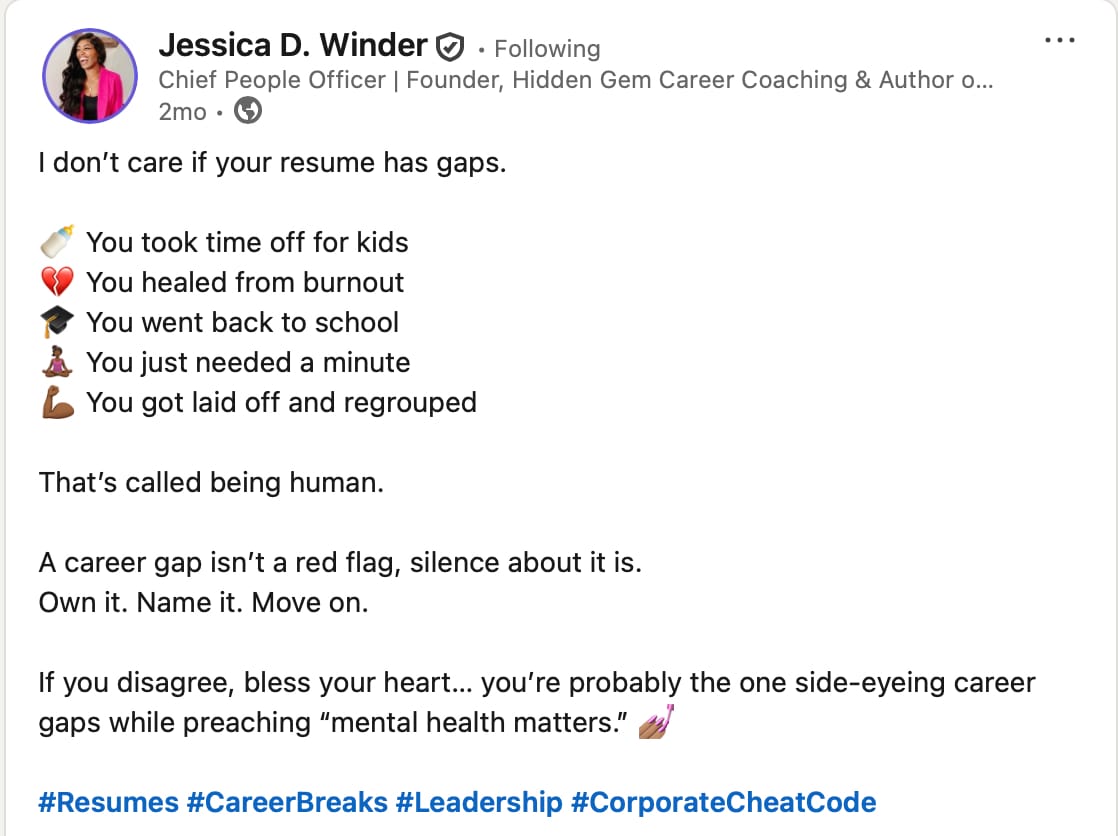
You want authenticity? Reality? She's a double-twin mom - with four little ones under the age of two as I write this. And she dared to interview while she was pregnant with her second set of twins, disclosed it, and got the job.
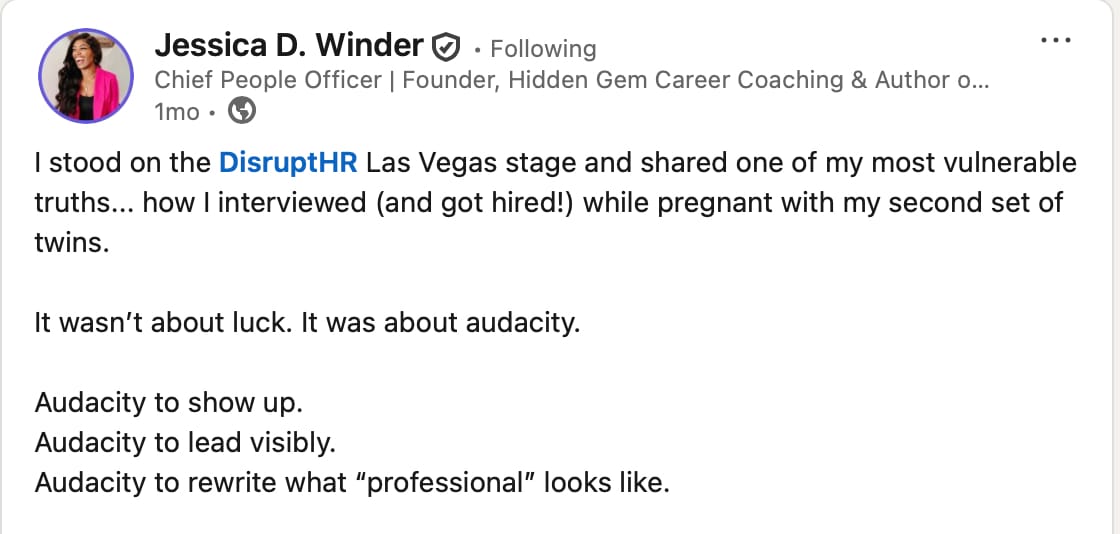
And in doing so, she isn't hiding 'flaws' - because experiencing the joy of motherhood is not a flaw, it's one of the most powerful gifts ever bequeathed to humanity.
4. The Immediate Pivot
How do you get there?
You shift from "managing your image" to "sharing your truth."
- Audit Your Narrative: Review your professional narrative. Where have you erased the struggle? What failures have you hidden that could serve as proof of your humanity?
- The "Source Code" Mandate: For every key report or opinion you release, provide a "Human Verification" stamp. If you use AI, disclose it. Disclosure is not weakness; it is respect. My chalkboard summaries are AI; some of my research is AI. A lot of the writing is mine.
- Make One Strategic Disclosure: Choose one failure to share publicly this week. Frame it with the lesson learned and the benefit from it. Observe the response.
Share the strength you've found in your mistakes. The lessons learned from when things went wrong. The discoveries you made when it went off track.
The beauty in your flaws, or the ripples in your reality.

Just like Kintsugi.
Futurist Jim Carroll has made a lot of mistakes. He's proud of most of them.