
"The moment between having an idea and executing it is gone" - Futurist Jim Carroll
Futurist Jim Carroll is writing his end-of-2025 / introduction-to-2026 series, 26 Principles for 2026. You can follow along at 2026.jimcarroll.com. He welcomes your comments.
Get ready for the reality that the distance between ‘imagination’ and ‘reality’ is collapsing
We are on Day 25. We are one day away from the finish line!
Today, you need to think about speed, velocity, and acceleration.
Yes, I've covered a lot about the issue of speed (Day 1) and scale (Day 16). However, before we conclude this series, it is essential to understand the actual physics, science, and technology behind the phenomena unfolding in our exponential world.
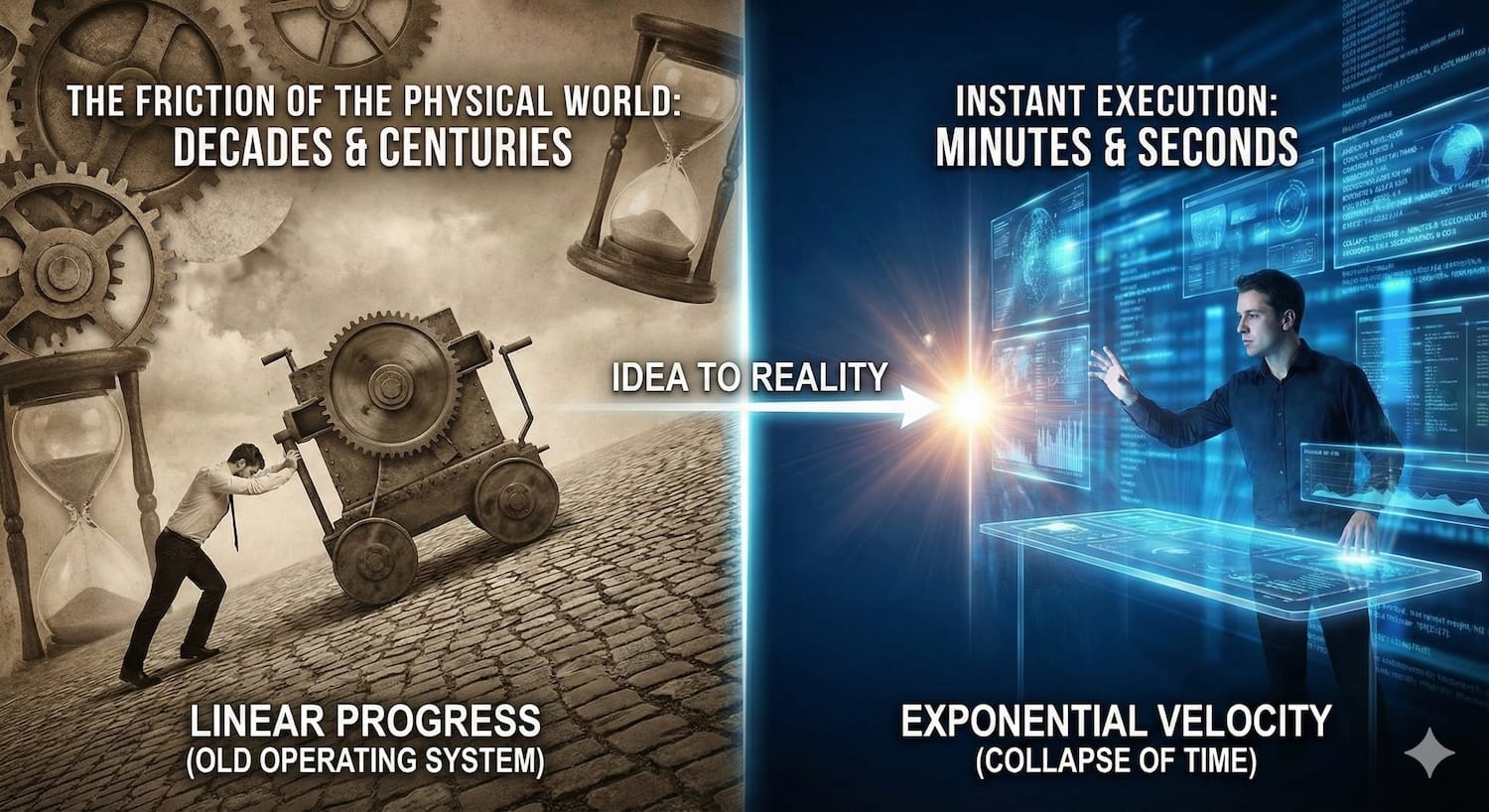
Here's the core issue: for the vast majority of human history, the relationship between your imagination and the realization of what you could achieve was governed by the "friction" of the physical world. It took time to do things. If a civilization wanted to build a cathedral, it measured the project in centuries. If a pharmaceutical company sought to cure a disease, it measured the timeline in decades.
Time was the constant barrier to progress, something that was not easily broken. In that way, you could think of it as a tax levied on progress.,
In 2025, that tax was repealed.
We have entered the era of the "Collapse of Time."
The old "operating system" that has governed progress, where step B had to patiently wait for step A to finish before it could move forward, is being overwritten by an exponential new world in which many things happen all at once.
This is not just a theoretical idea - over the last 24 months, we have witnessed the compression of timelines across every sector.
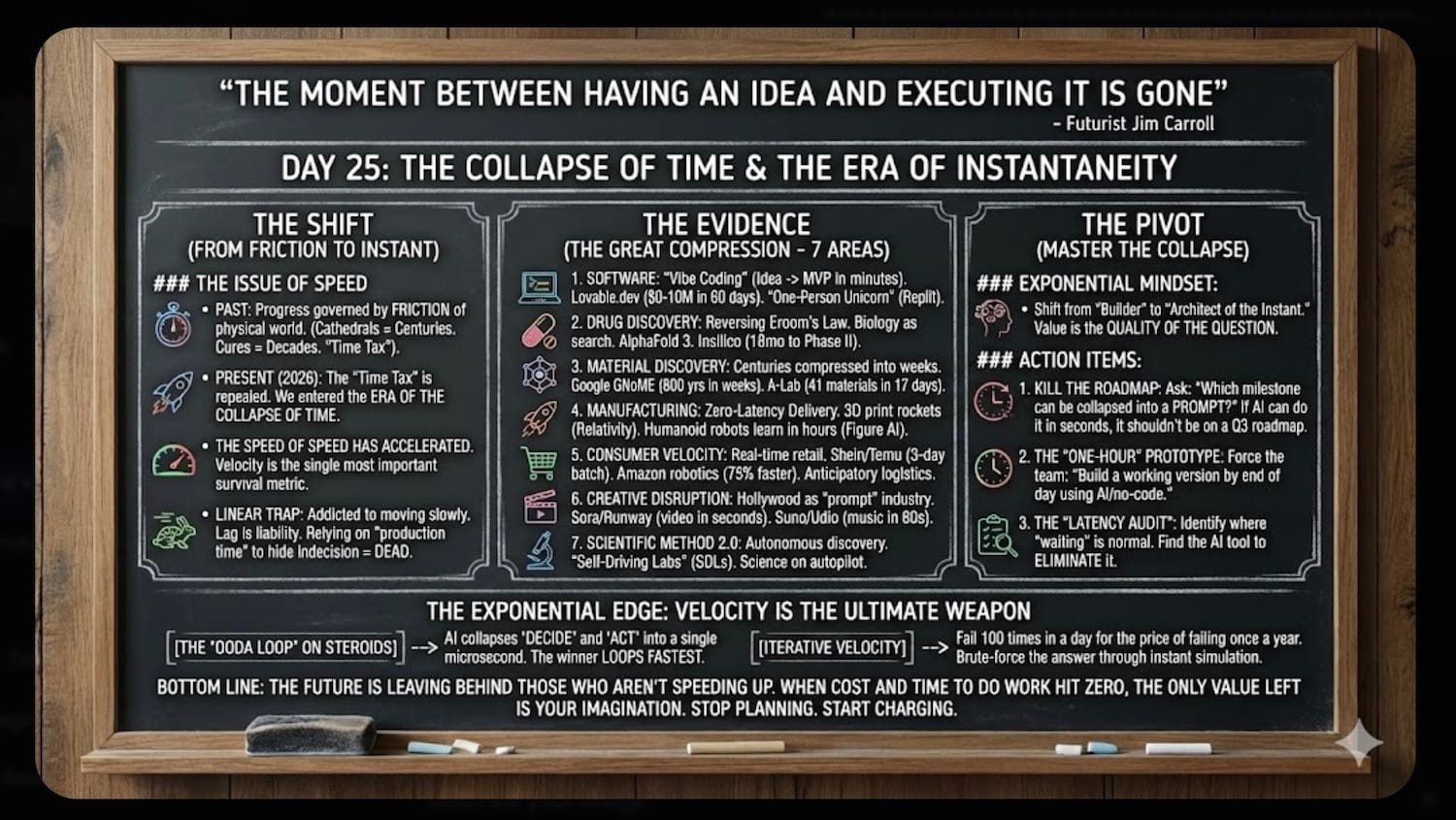
Here's your chalkboard summary!
The Issue of Speed
The issue of speed is not a new one for me and those who follow me. What's new is that the speed of the speed has accelerated to a degree that was unimaginable just a few years ago.
Let's revisit - if you look back at my writing over the last few decades, you will see a consistent thread. I have spent my career warning leaders that the luxury of "time" is disappearing, and that the window for action is closing faster than ever before. Countless global organizations engaged me to come in and speak to their teams on the importance of this topic - for many CEOs, speed of change has been the defining trend of our time.
With that, I framed the idea in multiple books.
- The Future Belongs to Those Who Are Fast
- The Speed Theme: This book argued that size no longer guarantees success. The old rule was that "the big eat the small," but in the modern economy, "the fast eat the slow." It was established that velocity is the single most important metric for survival.
- Ready, Set, Done: How to Innovate When Faster is the New Fast
- The Speed Theme: Here, the focus shifted to agility. It wasn't just about moving fast; it was about the "zero-latency" reality where you must execute a solution almost before you realize you have a problem. It introduced the idea that we are racing against a timeline that is constantly accelerating.
- Think Big, Start Small, Scale Fast
- The Speed Theme: This book provided the operational framework for speed. It made the case that you don't need a perfect plan to start—you just need momentum. It emphasized that waiting for clarity is a death sentence; you must start small and then explode into growth at high velocity.
For thirty years, I have been telling you that the future is speeding up. The message is still powerfully relevant.
But now, we have reached a new reality - we are no longer just "going faster."
The timeline isn't just compressing.
It is disappearing entirely.
Here's why.
The Great Compression: Evidence of the Collapse
If we look back at what happened over the last two years, with the arrival of AI and the maturing of many other trends, the issue of acceleration is everywhere.
1. Software Development
Some folks suggest that the phrase of the year should be "vibe coding," which describes what happens when the traditional human role of computer programming is augmented by AI. I've certainly been doing a lot of it! The phrase makes sense: you describe the desired outcome, aka the "vibe," and AI works with you to do the implementation, debugging, and deployment.
- The Impact: The path from idea to what people call a "Minimum Viable Product (MVP)" has compressed from months to minutes. The "setup tax" of coding has been abolished.
- The Example: The industry is taking to the idea with speed. Lovable.dev evolved from an open-source project to a platform that allows users to generate apps via prompts. In early 2025, they scaled from $0 to $10 million in revenue in just 60 days—defying all historical gravity for growth. Replit Agent is sharing the idea of the "One-Person Unicorn," allowing founders to build complex platforms like LinkedIn clones in under two weeks. Think about that - two weeks.
- What it Means Going Forward: The barrier to entry to create sophisticated applications and IT infrastructure is no longer technical skill; it is imagination. Over time, everyone becomes a coder, and applications proliferate at a speed that is unimaginable today.
2. Drug Discovery
We are talking about a new trend that involves biology at Silicon Valley speed. We are reversing "Eroom's Law" (which stated drug discovery gets slower and more expensive over time) by applying generative AI to lab discovery.
- The Impact: The timeline for identification of new potential target molecules - the key to drug development - is collapsing from years to seconds.
- The Example: AlphaFold 3 can now predict the structure and interactions of all life's molecules with unprecedented accuracy. Insilico Medicine brought the first fully AI-discovered drug to Phase II trials in just 18 months (which traditionally takes 4-6 years). Unlearn.AI is using "Digital Twins" to reduce the number of human subjects needed in clinical trials, shrinking enrolment times by months.
- What it Means Going Forward: Biology has evolved into becoming a search problem. We are moving toward a future where biological therapeutics can be generated on-demand for new diseases and risks, reducing pandemic response times from months to days.
3. Material Discovery
We are now discovering new chemicals and materials at the speed of light. Traditionally, materials science was a serendipitous process of trial and error - the type of thing that happened in centuries before and has stayed with us. Now, AI has transformed it into a high-speed prediction engine.
- The Impact: We are compressing centuries of experimental knowledge into weeks.
- The Example: Google DeepMind's GNoME tool discovered 2.2 million new crystals, including 380,000 stable materials—equivalent to 800 years of human experimental knowledge. The A-Lab at Berkeley operated 24/7 without humans to autonomously synthesize 41 new materials in just 17 days. Microsoft and PNNL used AI to screen 32 million battery materials and synthesize a working prototype in less than nine months.
- What it Means Going Forward: All of this is leading to transformative new materials that continue to change entire industries. The transition to a sustainable energy future (batteries, solar panels) will happen faster than predicted because the materials required are being invented faster than we can regulate them!
4. Manufacturing & Logistics
The time from design to delivery is collapsing - I've been speaking about the idea of 'faster time to market,' and the collapse of product lifecycles, for quite some time. But now, the trend is accelerating, driven by additive manufacturing, humanoid robotics, and digital twins.
- The Impact: Design is now an instant software/AI process. Not only that, once we conceive the product, we might not need to tool a factory; we print the part on demand on a big 3D printer.
- The Example: Relativity Space is 3D printing vast sections of rockets, reducing part counts by 100x and iterating designs in months rather than years. Czinger Vehicles uses generative AI design to print chassis structures, allowing them to change the design and print a new version immediately. Figure AI and Agility Robotics are deploying humanoid robots that learn tasks in hours rather than weeks, solving labor shortages instantly.
- What it Means Going Forward: We are entering the era of Zero-Latency Delivery. The bottleneck is no longer design and execution; it is imagination.
5. Consumer Velocity. The gap between a consumer's desire and its fulfillment is vanishing, driven by AI-optimized supply chains and "anticipatory logistics." It's a world of real-time retail - an influencer wears a product, and the product is shipped to stores worldwide in less than 24 hours.
- The Impact: Supply chains are shifting from "forecasting" (guessing what people want) to "reacting" (making what they just clicked on).
- The Example: Both Shein and Temu operate on a "real-time fashion" model, testing small batches and reordering in 3 days (compared to Zara's 3 weeks - and Zara used to be the role model for speed!) Amazon Sequoia robotics have sped up inventory identification by 75%, while Zipline is using autonomous drones to deliver packages up to 10 miles in just 10 minutes.
- What it Means Going Forward: The concept of "ordering" creates friction. We are moving toward a world where AI anticipates needs and goods arrive before the customer even fully articulates the desire.
6. Creative Disruption
Hollywood is becoming a 'prompt' industry. The time required to visualize a scene through your imagination has dropped from weeks to seconds. The role of AI in filmmaking and music going forward will be recognized as a massive disruptor in 2026 - expect the first full-length motion pictures and TV shows generated entirely by AI this year.
- The Impact: The cost of pre-visualization and concept art has collapsed to near zero. Filmmakers can now "storyboard" in AI full motion video with a few prompts. This is bigger than the shift to CGI years ago - indeed, a whole new generation of AI-enabled directors and producers is set to take over.
- The Example: Sora and Runway Gen-3 allow creators to generate photorealistic video clips in seconds, a process that used to require weeks of animation. Suno and Udio are generating radio-quality music in under 60 seconds. Tyler Perry famously paused an $800 million studio expansion after seeing these capabilities, realizing physical infrastructure was becoming obsolete.
- What it Means Going Forward: Content creation is no longer constrained by budget or technical skill, but purely by the quality of the idea, the sophistication of the model, and the skill of the prompter.
7. The Scientific Method 2.0
We are moving to the era of 'autonomous discovery - a world in which we discover new science through a hypothesis-driven model to a data-driven, self-driving model.
- The Impact: People are thinking about and developing "Self-Driving Labs" (SDLs). These integrate AI, robotics, and advanced computing to design and execute experiments without human intervention. Science, all by itself, on autopilot
- The Example: The University of Toronto's Acceleration Consortium and NC State are building labs that can reduce the time to bring advanced materials to market from 20 years to as little as one year. Moderna and IBM are using quantum computing to model mRNA, optimizing vaccines at a molecular level previously impossible.
- What it Means Going Forward: We are industrializing the process of discovery itself. The rate of scientific breakthrough is about to decouple from the limitations of human labor.
All of these developments are occurring all around you at a staggering speed. The future doesn't just belong to those who are fast anymore - it is leaving behind those who aren't speeding up. In that reality, the discipline you must master is responding to the Collapse of Time.
1. The Exponential Mindset
The Exponential Mindset understands that we have moved from the "Era of Creation" (which takes time) to the "Era of Instantaneity" (which takes the ability to use new tools to do things faster)
In this reality, when the cost of doing the work hits zero, and the time to do the work hits zero, the only value left is the quality of the question you ask. Prompting. Prompt engineering. Learning how to talk to the machine.
In that way, you are no longer a "builder." You are an "architect of the instant."
2. The Linear Trap
Linear leaders are addicted to moving slowly. They rely on long development cycles to hide their indecision. They hold meetings to build consensus. They seek reports to justify decisions. They use "production time" as an excuse to delay the strategy.
They build 5-year roadmaps for technologies that change in 5 months!
In 2026, lag is a liability; waiting is an anchor; pausing is perilous.
If you are relying on the "time it takes to build" to protect your market share, you are already dead. While you are holding committee meetings to approve the prototype, your competitor has already conceived of the final product and is selling it.
3. The Exponential Edge
When you master the Collapse of Time, you unlock the value occurring in an exponential world.
- The "OODA Loop" on Steroids: The military concept of "Observe, Orient, Decide, Act" (OODA) determines who wins a dogfight. In 2026, the AI collapses the "Decide" and "Act" phases into a single microsecond. The winner isn't the one who plans best; it's the one who loops fastest.
- Iterative Velocity: As we discussed in Day 6 (Make Better Mistakes), the Collapse of Time allows you to fail 100 times in a day for the price of failing once a year. You don't guess the future; you brute-force your way to the right answer through thousands of instant simulations. Vibing everything!
4. The Immediate Pivot
Stop planning for the future. Start charging at it with the idea of instantaneity in mind!
- The "One-Hour" Prototype: Challenge your team: "If we had to build a working version of this new product by the end of the day, how would we do it?" Force them to use AI, digital twins, and no-code tools to collapse the timeline.
- Kill the Roadmap: Take your 12-month product roadmap and ask: "Which of these milestones can be collapsed into a prompt?" If an AI can do it in seconds, it shouldn't be on a roadmap for Q3.
- The "Latency Audit": Identify the one process in your business where "waiting" is considered normal (e.g., waiting for legal review, waiting for code compilation, waiting for supply chain). Find the AI tool that eliminates that wait.
Think of it this way: the old rules of waiting and long-term planning are officially broken.
We are living in a world where the only thing standing between you and a breakthrough is your willingness to act! To imagine! To do! To move forward.
In this reality, you can no longer afford to pause, because the tools to build the future are already in your hands.
Stop staring at the calendar and start building your future today.
Get ready, because tomorrow we cross the finish line with Day 26.
Futurist Jim Carroll is done with writing books about the issue of speed, because it seems everybody is finally getting it.