
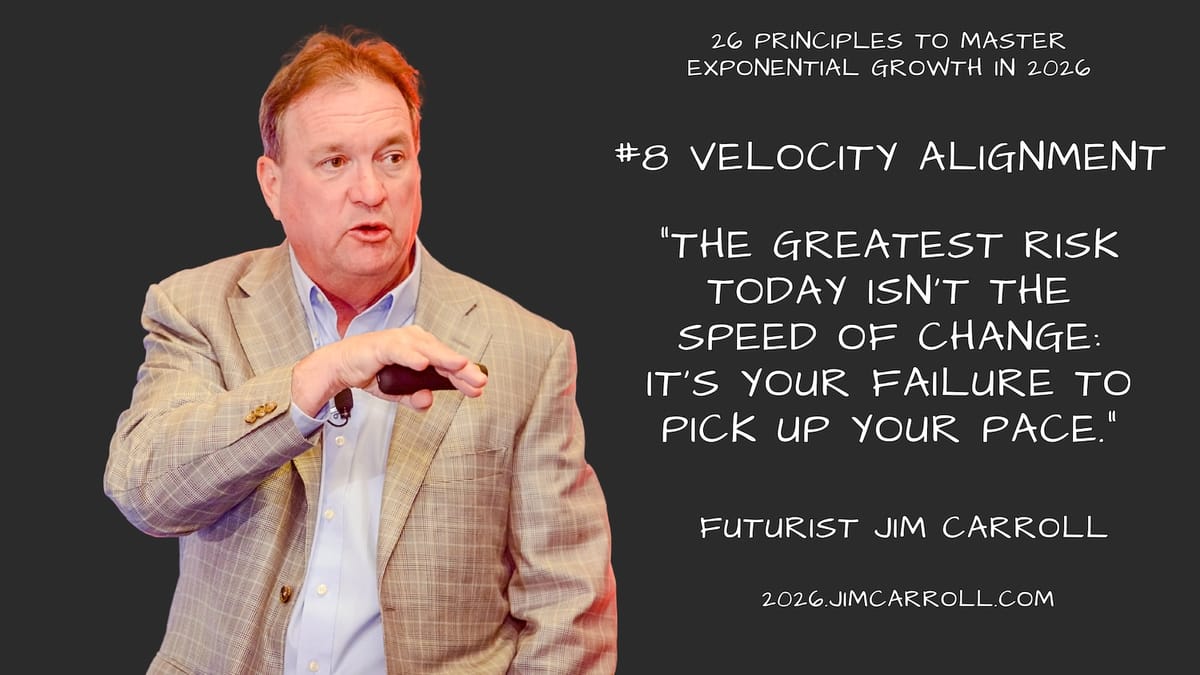
"The greatest risk today isn't the speed of change: it's your failure to pick up your pace." - Futurist Jim Carroll
Futurist Jim Carroll is writing his end-of-2025 / introduction-to-2026 series, 26 Principles for 2026. You can follow along at 2026.jimcarroll.com. He welcomes your comments.
We are on Day 8. You've committed to the pivot (Day 7). Now, you have to run.
That's why the principle you need to align to is "Velocity Alignment."
What is it? Matching your internal pace with external reality. Here's your chalkboard summary!

In a linear world, speed was a differentiator - the future belonged to the fast! Being faster than your competitor was a real advantage - if you mastered speed, you had what you needed to stay out in front in a competitive world. Speed wasn't a mad rush, though - you had the luxury of "measured paces," long development cycles, and five-year roadmaps.

Five-year roadmaps! As they say, LOL to that! In our faster world, you can barely plan for next month!
The sad truth is that in our new exponential world, speed is no longer a differentiator; it is the baseline requirement for existence. The external environment is accelerating so rapidly that if you don't do the minimum to keep up, you are guaranteed to not just fall behind, but perhaps, become rapidly irrelevant. our personal workflow, your team's processes, your organisational cadence—are still running on linear time, you are falling behind every single hour.
The interesting thing for me, as we head into 2026 in the context of the issue of speed, is that perhaps my book of 2012 is now out of date. The future no longer belongs to those who are fast - it belongs to those who are fluid!
Here's the key thing you need to ponder - the disconnect between external velocity and internal friction is where companies die, and careers stall.
The Evidence: 10 Ways Speed is the New Currency
Throughout my blog posts and keynotes, I have documented how the fundamental metrics of success have shifted toward velocity. CEOs have brought me in to talk to their teams to help them understand the reality of speed and the necessity for corporate velocity. The things I talk and write about aren't theoretical; they are the new operating reality across every sector.
Here are 10 examples from my analysis of how speed is now the primary metric:
- Shrinking product lifecycles: Everything is becoming something from the 'olden days' faster, and it often happens before our very eyes. The example I share most often goes back years 60% of Apple’s revenue comes from products that didn’t exist four years ago. The window to earn back R&D investment is collapsing. Apple's edge case is becoming the baseline.
- R&D compression: The automotive industry has moved from 5-to-7-year development cycles to a software-defined reality where features are deployed instantly over-the-air. My Tesla isn't a car - it's an iPad with wheels that gets constant updates that add new features.
- The collapse of adoption curves: It took radio 38 years to reach 50 million users. It took ChatGPT two months to reach 100 million. New competitors achieve scale almost instantly. You have no time to plan - only time to act.
- Knowledge velocity: As Buckminster Fuller suggested and modern data confirms, human knowledge is now doubling every 12 hours. Your ability to ingest new information must match this pace. It's all about just-in-time knowledge - it's no longer about what you know, but what you can come to know.
- Skill obsolescence: The half-life of professional skills has dropped from 15 years to 5 years or less. Speed of re-skilling is now more important than existing expertise. College degrees are becoming obsolete by the time someone graduates.
- Manufacturing speed (digital twins): We have moved from physical prototyping of products, which can take months and years, to AI-driven "digital twins" prototyping. Combined with 3d printing and other sophisticated methodologies, it allows for thousands of design iterations in hours rather than months.
- Supply chain agility: It's no longer about just-in-time inventory - in our world of crazy volatility, it's about just-in-case. The metric has shifted from lowest-cost routing to fastest reconfiguration speed in the face of disruption (tariffs, weather, pandemics).
- Rapid competitor emergence: Traditional industry barriers have dissolved. A tech company can become a major automotive player (Tesla, BYD) in a fraction of the time it took legacy players to build their dominance.
- Customer expectation for immediacy: Customers expect everyone to operate at the same level of excellence as the world's best. The "Amazon Effect" has retrained B2B and B2C customers to expect instant gratification, compressing service-level-agreement timelines. If you don't have world-class customer infrastructure, you can no longer compete.
- Pharma/biotech acceleration: The COVID-19 vaccine development proved that 10-year timelines could be compressed into 10 months through parallel processing and new tech (mRNA), resetting expectations for all drug development. That's but one industry - most other industries are seeing similar increases in velocity.
If the world is moving at this speed, you cannot afford to move at yours.
The discipline you need to master is Velocity Alignment.
1. The Exponential Mindset
Velocity Alignment?
It's not just about "working harder" or "rushing", or deciding to be faster.
It is aligning your internal operational tempo with the external speed of the world around you. It involves personal habits that default to action, minimise delay, and move at or ahead of the speed of change, rather than falling behind. It's coming to understand that time is the most perishable resource in an exponential environment, and that a good execution today is exponentially better than a perfect execution next month!
2. The Linear Trap
Ask yourself what is slowing you down. It’s usually clinging to linear processes in an exponential world.
Think about these things - is this your mindset?
- The trap of the slow pace. You are defined by an outdated belief that "slow and steady wins the race." In an exponential world, those who are slow and steady get lapped before they even realise the race has started.
- A waterfall mentality. Do you get into a mindset where step B cannot start until step A is perfectly complete? This creates massive bottlenecks compared to living, acting and thinking faster - and acting.
- Believing that quality trumps speed. Do you have a mistaken belief that moving fast inherently means that you have to sacrifice quality? You can break that link - exponential leaders use technology (like AI and automation) to increase speed and quality simultaneously.
- You worship at the altar of routine. You are chained to a world in which you follow procedures because "that's how we've always done it," even when the process takes longer than the actual work itself. You are still being killed by the innovation killers I defined many years ago.
I could go on, but you get the point. You are stuck in a slow pace in an extremely fast world!
3. The Exponential Edge
So what happens when you change your thinking and master velocity alignment?
You stop chasing the future and instead become a part of it. In effect, here's what you gain:
- Tempo control: By executing faster, you force competitors to react to your moves, putting them permanently on the defensive. From a career and personal perspective, you've got a leg up on those competing for a new job or new contract position, because you clearly demonstrate that you can bring the core skill of agility to the table.
- More chances "at-bat": Remember the previous core principle - iterative thinking! Because you've learned to pick up the pace, you get to run more experiments, launch more iterations, and learn more lessons in the same amount of time as a slower competitor.
- Getting in front of the future: if you really do things right, you can 'get ahead of the curve' instead of always falling behind. You see the trends at the sme time that others do - but you've learned to act on them without delay!
To do all these things, you need to act now.
4. The Immediate Pivot
To increase your velocity, you must attack the friction points in your daily work. Here are some ideas to get you going.
- Conduct a "friction audit": Identify one thing you do every day that, in the context of what I am writing about here, feels devastatingly slow. Do what you can to kill that single biggest bottleneck today!
- Learn to race a sprint, not a marathon: Stop planning in quarters or years. Break your current major project into two-week sprints with clear deliverables at the end of each. Force yourself to be faster. Learn from what you are doing.
- Get into sunset thinking! For any task that takes less than an hour, institute a rule: if it hits your desk before noon, it must be finished before the sun sets today. Stop the pile-up.
- Start to learn how to use AI to speed things up. Like it or not, it's here to stay. Careers are changing, knowledge is evolving, and structures are collapsing. AI is having a profound impact on the whole issue of speed, and learning how to master it is no longer optional - it's rapidly becoming a baseline.
In an exponential world, speed is no longer just an advantage but the absolute baseline for survival.
You must immediately align your personal pace with this accelerating reality to avoid falling behind. That's the essence of Principle #8 - velocity alignment!
Futurist Jim Carroll identified 'speed' as being the core metric for future success over 25 years ago.