
"Know this: if your goals feel 'realistic,' you are thinking too small." - Futurist Jim Carroll

We are on Day 9. You've committed to the pivot (Day 7), and you are increasing your execution velocity (Day 8). You are moving faster.
But are you aiming high enough?
In an exponential world, you can’t just think big - you need to think bigger!
And so day 9 is all about aiming higher and achieving the moonshot mentality. Here's your key thought: in 2026 and beyond, the idea of being just 10% better is dead, and being 10x better is critical.
Here's your chalkboard summary!
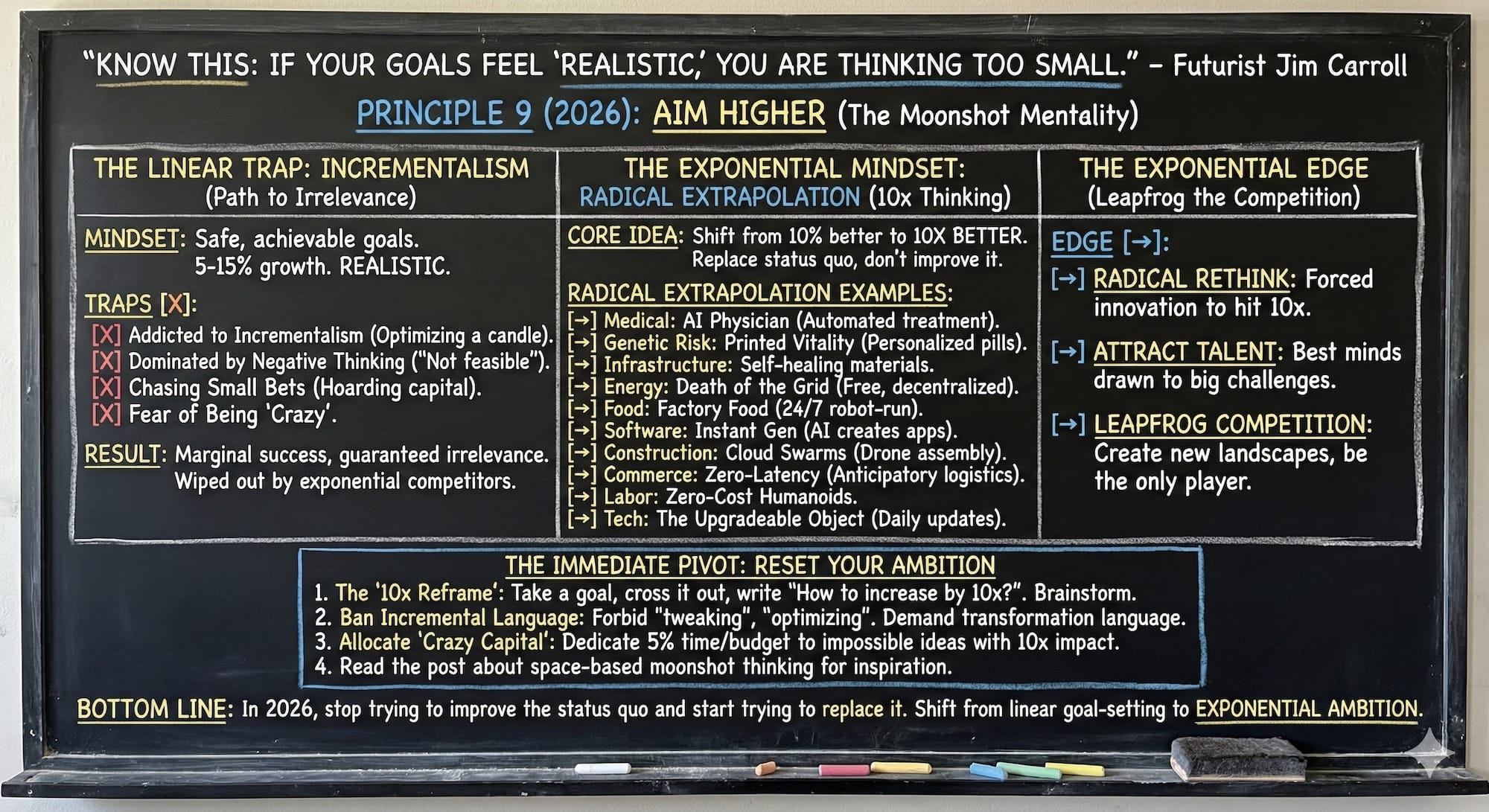
Think about it: in a linear world, success was defined by incrementalism. Growing sales by 5%, cutting costs by 10%, or improving efficiency by 15% year-over-year was considered a victory. You achieved this by working a little harder, squeezing a little more out of things, and making safe, small, "feasible" bets.
Realistic things.
Things you know you could accomplish.
In an exponential world, incrementalism is the path to irrelevance. Small steps won't work. Thinking small is a guarantee for marginal success. While you are striving for 10% growth, an exponential competitor - maybe someone leveraging AI, developing a new business model, or developing new skills - is aiming for 10x growth and will wipe you out before your five-year plan is halfway done.
To survive in 2026, you must stop trying to improve the status quo and start trying to replace it. You need to shift from linear goal-setting to exponential ambition.
Moonshot thinking!

The discipline is Aiming Higher!
As Sly and the Family Stone said - I want to take you higher! To understand the scale of ambition required for 2026, you first need to see where the trends are actually going. You cannot plan for 2030 using 2025 thinking. If you take today's shifts and extrapolate them to their 10x conclusion, the future looks radically different.
So let me take you into my world of "Radical Extrapolation" - I'll take some trends I've covered and take them higher. I'm Sly. You're the family. Let's get high!
From "Information Overload" to "The AI Physician"
Trend: Medical knowledge doubling every 78 days.
The Moonshot: By 2035, human doctors cease to be the primary diagnostic engine. The sheer volume of data means only AI can track the billions of variables. Your "checkup" becomes a continuous, real-time data stream from wearables, and treatment is automated before you even feel a symptom. Your iPhone data has already given the doctor much of what they need to know about your situation.
From "Genetic Risk" to "Printed Vitality"
Trend: Genomic sequencing costs are collapsing below $200.
The Moonshot: Medicine shifts from "generalized" to "hyper-personalized." We stop treating the average human - we treat a patient of one. You wake up, a sensor reads your blood biomarkers, and a 3D printer on your counter presses a pill with the exact molecular mix your body needs for that specific day. Crazy? Not at all!
From "New Materials" to "Immortal Infrastructure"
Trend: Material discovery is compressing from 20 years to 2 years.
The Moonshot: We stop fixing potholes and rust. Instead, concrete, asphalt, and steel are all engineered with biological properties to heal themselves. Infrastructure becomes "living," repairing its own cracks and adapting to weather stresses without human intervention. I wrote about this very trend in my recent Megatrends series.
From "Electric Cars" to "The Death of the Grid"
Trend: Battery costs dropping below $100/kWh.
The Moonshot: Energy becomes so cheap and storage so dense that the centralized utility grid becomes obsolete. Homes and businesses disconnect entirely, relying on painted-on solar skins and localized storage. Energy becomes a "free" resource like air. Your car is now a key part of the electrical grid, storing and sharing energy from its battery as needed.
From "Ag-Tech" to "Factory Food"
Trend: Autonomous farming and robotic harvesting.
The Moonshot: The idea of farming only when the sun is up is gone, as agricultural robots come to dominate production. Agriculture decouples from nature. Farming moves entirely indoors to vertical, sterile, 24/7 robot-run factories located in city centers. Weather, pests, seasons, and transport costs are eliminated from the food supply equation.
From "Coding Tools" to "Instant Software Generation"
Trend: AI training costs dropping 99%.
The Moonshot: The "App Store" model dies. You don't download apps; you describe a problem to your AI, and it generates a custom software solution or app for you in seconds. Every individual has the power of a 100-person dev team in their pocket. Imagine your world without your iPhone as it was in 2006, and compare it to today. Now imagine what happens with 'AI apps.'
From "Drones" to "Construction by Cloud"
Trend: Micro-autonomous swarms.
The Moonshot: Rapid assembly, modular construction, new methodologies. We retire the crane and the bulldozer. Swarms of thousands of coordinated drones 3D print and assemble skyscrapers in days, moving like a fluid rather than machinery. Construction becomes a 24-hour, silent, autonomous process.
From "Fast Shipping" to "Zero-Latency Commerce"
Trend: Anticipatory logistics.
The Moonshot: The concept of "ordering" a product disappears. Predictive AI calculates that you need detergent, a replacement part, or fresh produce before you know it. The supply chain becomes a synchronized pulse where goods arrive at your door exactly as the need arises. Ya, this idea has been shared since the late 90s as e-commerce invaded our lives, but some components of it will become real.
From "Helpful Robots" to "Zero-Cost Labor"
Trend: Humanoid robots dropping to the price of a motorcycle ($16k).
The Moonshot: They'll be all around us. Manual labor costs collapse to near zero. General-purpose humanoids handle all stocking, cleaning, and basic assembly. "Labor shortage" ceases to be a phrase in business; the workforce is infinite, scalable, and downloadable. (Humanoid robots are perhaps one of the most far-fetched ideas for us to accept, but the technology in 2025 started moving crazy fast. We'll see what happens now that it has hit exponential velocity.)
From "Obsolete Tech" to "The Upgradeable Object"
Trend: Product lifecycles are collapsing to near zero.
The Moonshot: Everything we buy has some element of tech in it. It's upgradeable, changeable, and feature addition capable. Take a look at my 11 Rules of IoT Architecture, and ask yourself what happens when every device is unlocked, changed, or completely repurposed purely by software updates, or physical goods are designed to be dissolved and reprinted annually. The idea of the "model year" is replaced by the "daily update."
If those examples felt "unrealistic" to you, you are trapped in a linear world, dominated by your linear thinking.
For 2026 and beyond, you need to break free of marginal thinking.
1. The Exponential Mindset
It's all about a shift in your goal-setting.
Aim higher! Think bigger! Be bold. Those sound like generic motivational pap, but they're not. Check the article I share at the end of the post - a fellow in the nascent, small Canadian space industry, with a brilliant post that captures the whole idea of thinking bigger.
Take this thinking, and apply it to your world. That's what it's all about!
2. Why We Fail to See It
Ask yourself if your ambition is trapped by linear thinking. Ask yourself if you are trapped in a mindset that has you thinking small, all the time, with all the things around you.
- You are addicted to incrementalism. You find the comfort of setting safe, achievable goals based on last year's performance to be seductive. You don't have to work too hard. Do the right things, and you'll get your bonus or a great score on your appraisal. Here's a question to ask: Are you merely optimizing a candle instead of inventing a lightbulb?
- You are dominated by negative thinking. You are killing bold ideas immediately because they aren't currently "feasible," cost-effective, or fit into the model "how we do things here." This shows your mind is centred on negativity rather than opportunity, and also ignores the reality that exponential tech makes the impossible feasible very quickly!
- You only chase the small bets. You keep all your innovation capital hoarded, since you always look for the safest bets. The result is that you'll never take a higher-risk, higher-reward moonshot.
- You fear being labelled as 'crazy': You hesitate to propose a 10x idea because you fear looking foolish or unrealistic to your peers, who are stuck in linear thinking. WRONG! And in fact, being crazy is one of the core themes in my upcoming book, Being Unique!
3. The Exponential Edge
When you master the idea of aiming higher, you change the fundamental trajectory of your future:
- You undergo a radical rethink: A 10x goal forces you to abandon legacy processes that are holding you back. You can't get to 10x by tweaking what you have; you are forced to innovate.
- You hang with like-minded. The best minds aren't interested in working on 5% improvements. They are drawn to big, audacious challenges. Moonshots attract exponentially better talent and energy.
- You start to leapfrog the competition: While competitors are fighting over market share points in the existing landscape, you are creating an entirely new landscape where you are the only player.
4. The Immediate Pivot
So what do you do?
First and foremost, change your goals. Challenge your thinking. Reset your ambition. Here are a few immediate actions to think about:
- The "10x Reframe" Exercise: Take one major goal currently on your plate (e.g., "increase sales by 15%"). Cross it out. Write down: "How could we increase sales by 10x?" Spend 30 minutes brainstorming only solutions that could hit the new number.
- Ban "Incremental Language": For one week, forbid phrases like "tweaking," "optimizing," "slightly improving," or "realistic growth" in your strategy meetings. Demand language focused on transformation and breakthrough. Take my Innovation Killer list, print it, and tape it to the wall.
- Allocate some "crazy capital": This is perhaps the best idea! Carve out a small percentage of your time or budget (even 5%) that is exclusively dedicated to testing ideas that seem currently impossible but would have a 10x impact if they worked.
Whatever you do, get going. Get inspired. Start thinking, and start acting.
To do that, read this post - this is EXACTLY what it's all about. I saw this on LinkedIn just as I was pulling this post together, and thought it was perfect!
Based outside Toronto, Canada, I know that our nation has suddenly been plunged into the need to Aim Higher because of some crazy global volatility. Aaron's ideas are the perfect idea of how to aim higher - and the fact that it involves some real space-based moonshot thinking is exactly the type of example I needed for this post.
Listen Up, Space Nerds: Canada’s Space Market Is About to Change
Aaron Topple
December 1, 2025
[caption id="attachment_51214" align="alignright" width="1024"]

Sc[/caption]
For decades, Canada’s space community has been a small, tight-knit circle. Everyone knows everyone. The people in it are brilliant engineers, scientists, program managers and operators. The kind of people who can launch things into orbit using nothing but math, ingenuity, and caffeine.
But here’s the truth no one wants to say out loud: Brilliance alone won’t build Canada’s space future.
And unless this community adapts quickly, it is going to be overtaken by a new wave of players who understand business, capital, and commercialization far better than they understand delta-v.
I am not in a position to criticize… It’s just a wake-up call.
The shift is already happening...
The Era of Public-Sector Space Is Ending
For most of Canada’s history in space, everything was publicly funded. It had to be. The entire world treated space the same way.
When public money drives the agenda, progress moves at the speed of government priorities which, let’s be honest, are usually things like social programs, healthcare and infrastructure.
Space exploration rank somewhere below... “fix that pothole on Main Street.”
So… innovation crawled.
But globally, the world has shifted. Space is leaving the public sector. Space is becoming private and the growth curve is no longer linear, it’s exponential.
Look at the companies driving global progress today:
- SpaceX: Privately led
- Blue Origin: Privately led
- Rocket Lab: Privately led
- Relativity: Privately led
- Firefly: Privately led
- Axiom: Privately led
These companies didn’t succeed because they were the best engineers in a government agency. They succeeded because they were the best fundraisers, storytellers, strategists, and business builders who capitalized on the opportunity to work in space.
Canada has finally acknowledged this reality.
Canada Wants “Sovereign Launch Capability,” Not Government Rockets
This is key.
The Government of Canada does not want to own a rocket. It does not want to run a rocket program. It does not want a space equivalent of the Navy or the Air Force.
What it does want is:
A responsive, domestic, private launch capability.
Meaning:
If something needs to reach orbit quickly, the government wants to pick up the phone, call a Canadian company, and say:
“We need a launch… go.”
Not in Florida. Not in Alaska. Not in New Zealand.
Here. At home. On Canadian soil.
To prepare for this, DND and DRDC have already begun the groundwork:
Inflection Point 2025
Capstone 40
DRDC’s RFP for 2-3 responsive launch companies
These aren’t theoretical strategy documents. They’re explicit signals that Canada is restructuring its defence and industrial posture toward privately operated, rapid launch capabilities.
This is the opportunity of a generation.
And not everyone is ready for it.
Canada’s Technical Talent Is World-Class; But Commercialization Is the Blind Spot
The problem is not intelligence. Canada’s space engineers, scientists, and operators are world-class.
The problem is commercialization literacy.
Most of the current space founders in Canada are technical wizards who:
- know thermodynamics
- know orbital mechanics
- know propulsion models
- know manufacturing
- know space systems
- know how to get hardware to survive vacuum, radiation, and re-entry
But they don’t know:
- how to raise capital
- how equity structures work
- how to negotiate valuation
- how to pitch a private investor
- how to structure a business model
- how to build a growth plan investors trust
- how to scale a company with real money at stake
And this is no one’s fault.
These skills were never needed in a purely government-funded space economy. But in the new era?
They are essential.
And here’s the uncomfortable truth:
Without private capital, you don’t get private launch capability. Without private launch capability, you don’t win the DRDC RFPs. And without winning those, you’re out of the game… permanently.
Some of The World’s Most Successful Space Companies Were Not Built by “Space People”
Let’s look again:
Elon Musk
Jeff Bezos
Tim Ellis
Max Haot
These people were not aerospace insiders. They weren’t “space community” people. They didn’t grow up inside government programs. They weren’t career engineers at space agencies.
They were:
- entrepreneurs
- capital allocators
- tech executives
- business builders
And because they understood capital, they could hire the people who understood space things.
This is the inversion Canada hasn’t internalized yet.
If you’re a Canadian rocket scientist or space engineer who wants to build something meaningful, you must understand:
- Your technical skill is not enough. Your passion is not enough. Your credentials are not enough.
- You need capital.
- And to get capital, you need to trade something for it.
- That “something” is equity.
Equity Is Not the Enemy, It’s the Fuel
Canadian space entrepreneurs often cling to ownership like its oxygen.
But here’s the truth: 100% of nothing is still nothing.
It is better to own:
- 30% of a launch company that gets contracts,
- 20% of a spacecraft manufacturer that flies, or
- 10% of a space systems company that scales,
,,,,than 100% of a “company” that is still a PowerPoint pitch five years later.
You cannot hold onto equity and expect to build a world-class aerospace company at the same time.
You need investors. Investors need upside. Upside requires equity.
This is the trade-off. This is the game. And this is the part of the game the Canadian space community must embrace.
The Flood Is Coming
Right now, the Canadian space community is small, brilliant, and comfortable.
But give it 12-24 months?
It will be flooded.
Flooded with:
- MBAs
- finance bros
- private equity groups
- international investors
- commercialization experts
- operators who know how to take a product to market
- “not real space people”
They will come because the opportunity is big.
They will come because DRDC and DND are signalling billions in long-term spending.
They will come because global capital is now hunting for space investments with real sovereign value.
And when they come, the ecosystem will change forever.
That tight-knit, engineer-first Canadian space club will vanish. A more competitive, commercial, capital-driven ecosystem will replace it.
You cannot stop this. You should not want to stop this. You can only get ahead of it.
This Is the Moment: Set Aside the Ego, Take the Capital, Build Something Real
If you’re a Canadian engineer, scientist, founder, or aspiring founder:
Stop worrying about dilution. Stop worrying about maintaining perfect control. Stop worrying about who is “doing it right.”
Let go of the purity test.
Take the capital. Scale the company. Build the rocket. Launch the payload. Get the contract. Create the capability Canada needs.
Your ideas deserve to fly, not sit in a lab, a binder, or a conference expo booth.
Canada is giving you the window. The market is hungry. The documents are published. The RFPs are live. The transition has begun.
Listen up, Space Nerds: the future is here.
Don’t miss your shot because you held onto your teddy bear too tight.
One of the highlights of Jim's career was the moment he was invited to keynote an event at NASA, with a room full of astronauts, mission directors, rocket engineers, and others, with the focus being on 'thinking BIG'. The second highlight was when he was invited back for a repeat performance!