
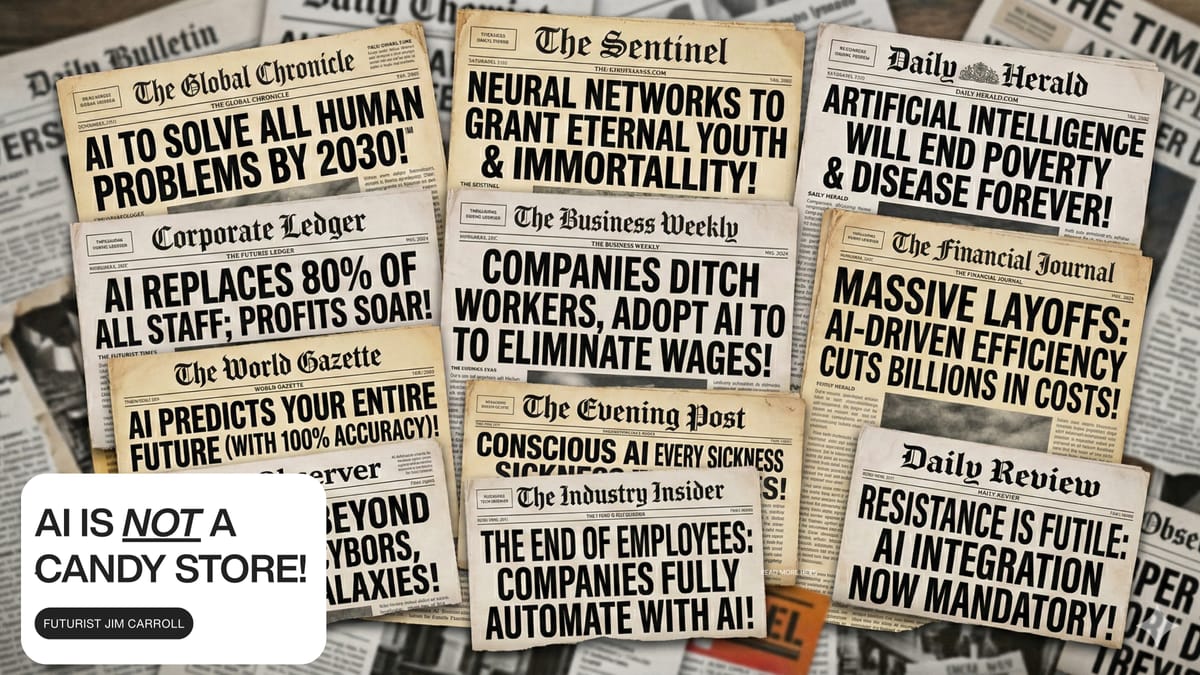
"AI is not a candy store!" - Futurist Jim Carroll
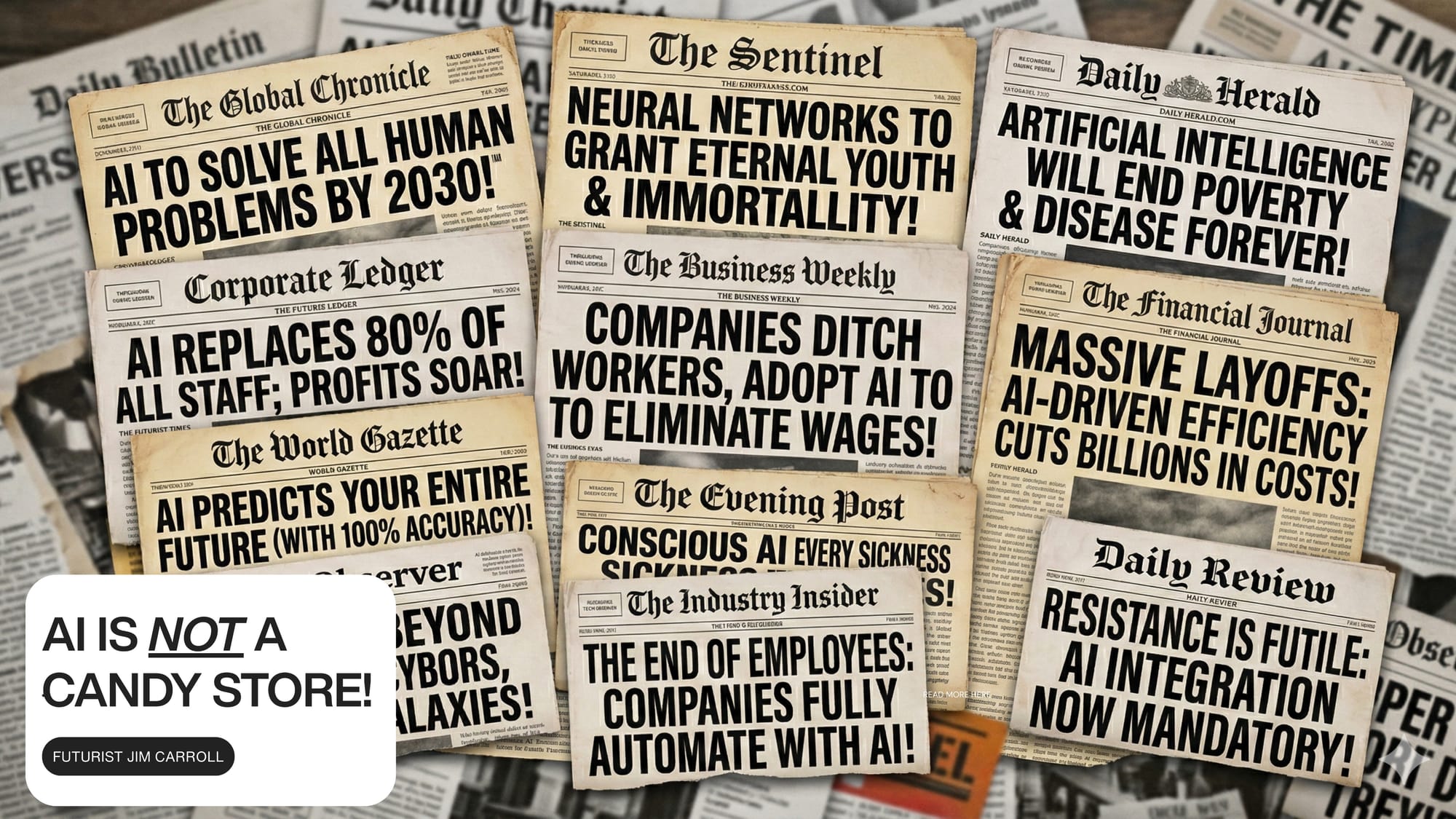
Last week, Jack Dorsey (one of the original founders of Twitter) issued a memo that will likely be remembered as the "intelligence-native" manifesto, in which he announced a massive set of layoffs at his company, Block.
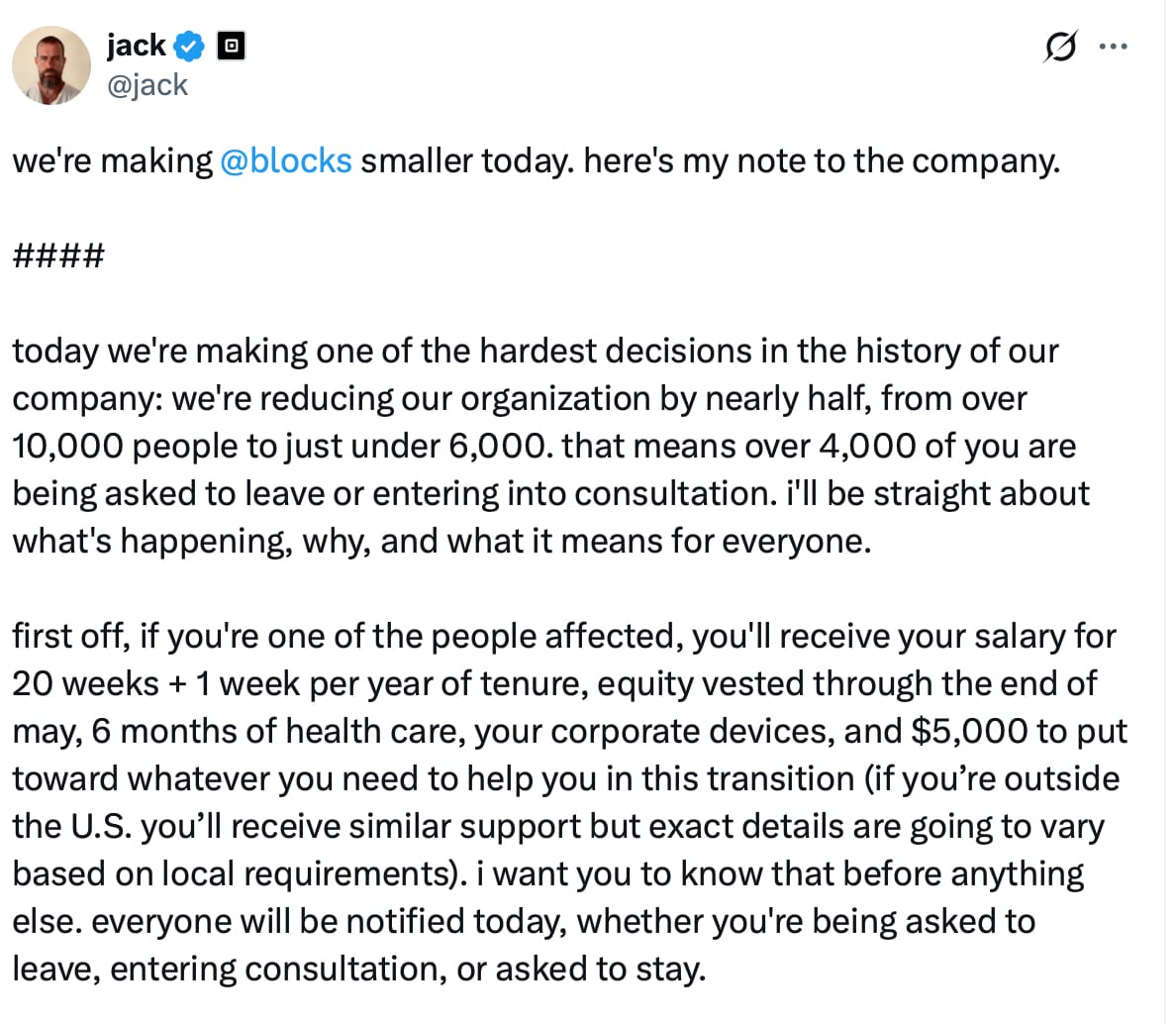
He didn’t just trim the edges at Block; he hacked away nearly half the company - over 4,000 people.
Not because they were failing, but because he argues that a human-heavy workforce is now a legacy liability. His central justification was that AI is moving so fast that smaller, flatter teams are becoming exponentially more productive than the massive corporate structure built during the pandemic.
Dorsey effectively declared that Block isn't the outlier; they are just the first ones to be honest about the fact that most companies are "late" to the realization that the old way of scaling through headcount is dead.
The media, of course, went wild with the story, announcing that this was the canary in the coal mine of a world in which vast numbers of staff were soon to be culled from organizations worldwide. All jobs were at risk - companies were instantly discovering the secret, wild benefits of AI implementation.
And, well, hype once again gets in the way of reality.
Critics were quick to call him out, pointing out that Block’s workforce had ballooned from roughly 3,800 people in 2019 to over 10,000 by 2025 as a result of 'pandemic bloat,' - it had just become a large, inefficient company. Many said that while Dorsey wrapped the cuts in the high-tech sheen of AI efficiency, the reality was far different. Not only that, but the so-called productivity benefits were nowhere near what he was claiming, given the makeup of the company and workforce.
But never let reality get in the way of some good hype!
And yet, the hype was born in the bright lights of great expectations. CEOs everywhere were probably muttering under their breath: "I want some of that."
And that's one of the big problems with AI today.
In a conference call with a client last week, one person suggested the biggest challenge they were seeing involved too many CEOs seeing the hype of AI, and saying to their tech department, "I want some of that." They specifically commented that CEOs and senior executives were now caught up in seeing the latest, greatest AI development as some sort of candy store they could pick and choose from. Instant hits of sweet productivity gains were simply within reach!
And the fact is, nothing could be further from the truth.
Some folks on the Internet responded with biting, satirical posts - written in what has become known as "LinkedIn Staccato" or "Bro-etry" style. It's a post characterized by short, punchy, cynical lines that mimic the "thought leader" mindset but reveal a darker, more selfish corporate truth.
Take these for what they are worth. The fact is, they are probably closer to the truth than you realize.
They're also a good synopsis of what is really going on when AI is treated like a candy store.
Context: Posted roughly 24 hours after Jack Dorsey announced he was laying off 4,000 people (40% of Block) because "intelligence tool capabilities are compounding faster every week."
Last month, I announced our "AI-Native Transformation."
I laid off 4,000 people.
I called it "intelligence compounding."
Compounding means growth.
Growth means fewer humans.
Fewer humans means I can tell the board we’re an "Agentic-First" play.
I don't know what that means.
But the stock price went up 24%.
I sent the announcement on a Thursday.
I was in a silent retreat in French Polynesia.
I have a "connectivity-optional" exemption.
"Visionary leaders require radical isolation to channel the future."
I wrote the policy.
A bot formatted it.
HR approved it.
HR is now just a single Python script.
By Friday, the remaining team was "re-baselining."
Re-baselining means doing the work of the 40% who left.
Plus teaching the AI how to do the rest.
Very efficient.
We implemented a "CEO-Agent" module.
It cost $4.2 million in compute.
It generates 400 visionary memos per hour.
None of them make sense.
But the "disruption metrics" are peak.
Disruption is culture.
I’ve never been more certain of anything.
A lead dev asked why the API is hallucinating.
He had data.
Reliability was down 60%.
I said, "Reliability is a legacy mindset."
He asked what the new mindset was.
I said, "Probabilistic outcomes."
He asked how we bill customers for probabilistic outcomes.
I said, "We don't. We bill them for the vibes."
He stopped asking questions.
Then he was "graduated."
Graduated means his Slack access was revoked at 2:00 PM.
Good luck with your startup.
It’ll be an AI wrapper.
We installed a "Synthesized Presence" tracker.
It tells me which employees are using AI to pretend to be working.
I check it from my yacht.
The irony is beautiful.
Average human effort: 4%.
Average bot effort: 96%.
I sent a mass text.
"Stay hungry."
The CEO asked if we’re winning.
I said, "Absolutely."
I showed him a chart of GPU utilization.
It was just a picture of a mountain.
He smiled.
"This is what progress looks like."
It looked like a JPEG.
Because I generated it in 3 seconds.
Next month I'm proposing an "Identity Bonus."
$5,000 for anyone who legally changes their middle name to 'GPT.'
It’s not a mandate.
It’s "incentivizing alignment."
As long as the headcount goes down and the ARR goes up.
That's culture.
And here's another one:
Last month I announced our "AI-First Transformation."
We laid off 40% of the engineering team.
I called it "algorithmic streamlining."
Streamlining means efficiency.
Efficiency means fewer humans.
Fewer humans means I can tell the board we’re a "lean tech play."
I don't know what that means.
But the stock price went up 12%.
I sent the announcement on a Thursday.
From my yacht in Croatia.
I have a "digital nomad" exemption.
"Visionary leaders require high-frequency environments to spark innovation."
I wrote the policy.
AI checked the grammar.
By Friday, the remaining engineers were "upskilling."
Upskilling means doing the work of three people who just left.
While training the bot that will eventually replace them.
Very synergistic.
We implemented a generative coding tool.
It cost $1.2 million in licensing.
It writes 10,000 lines of code per minute.
None of it works.
But the "velocity metrics" are off the charts.
Velocity is culture.
I’ve never been more certain of anything.
A junior dev asked why the app keeps crashing.
He had data.
Technical debt was up 400%.
I said, "Bugs are just unplanned features."
He asked how we fix them.
I said, "We prompt the AI to fix itself."
He asked what happens if the AI fails.
I said, "Then we prompt it better."
He stopped asking questions.
Then he was "re-allocated."
Re-allocated means his badge doesn't work anymore.
Good luck with the job market.
It’s "saturated."
We installed an AI productivity tracker.
It measures "eye-to-screen" ratios.
And "keystroke sentiment."
It tells me exactly when someone is unhappy.
I check the dashboard every morning.
From the beach.
The data is fascinating.
Average happiness: -12%.
Average output: "Hallucinating."
I sent a Slack message.
"Focus on the mission."
The CEO asked if the AI transition was working.
I said, "Absolutely."
I showed him a graph.
Lines going up. Colors turning green.
He smiled.
"This is what the future looks like."
It looked like a PowerPoint I made in 4 minutes.
Because the AI made it for me.
The real product is a disaster.
But he doesn't know that.
He's also an AI.
I replaced him in January.
Nobody noticed.
That's strategy.
Take these for what they are worth!
Futurist Jim Carroll will be taking on the topic of hype and reality in a keynote in Dallas next week.