
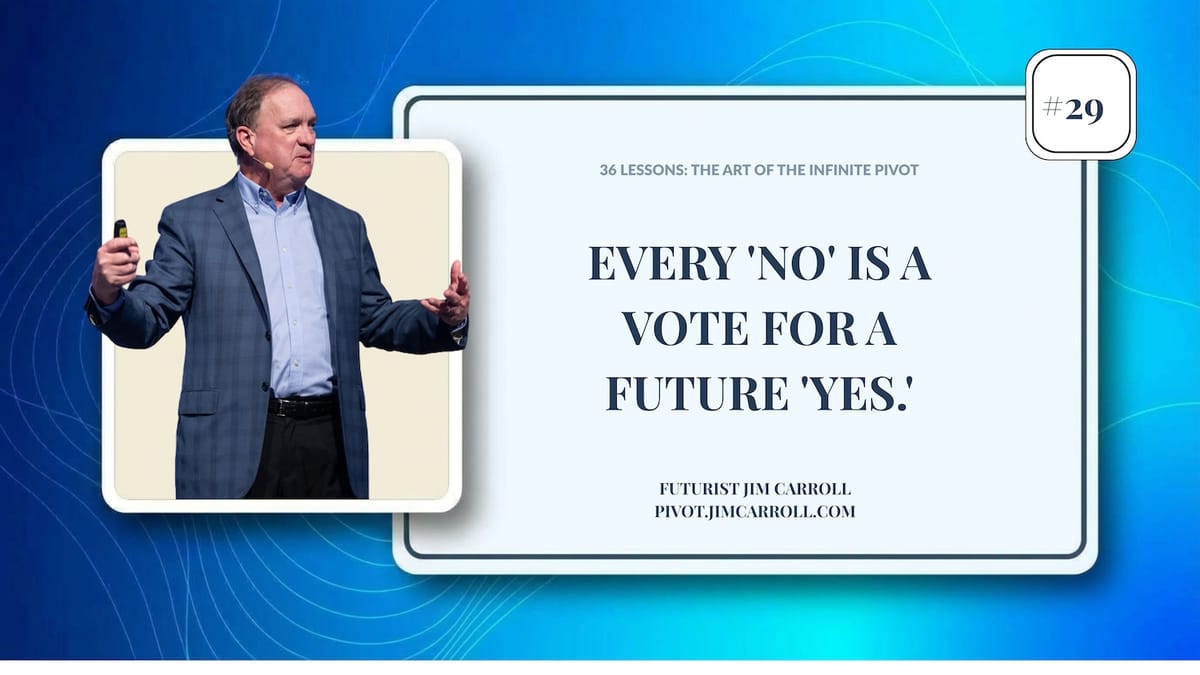
"Every 'no' is a vote for a future 'yes.'"- Futurist Jim Carroll
Futurist Jim Carroll is writing a series, The Art of the Infinite Pivot, based on 36 lessons from his 36 years as a solo entrepreneur, working as a nomadic worker in the global freelance economy. The series is unfolding here, and at pivot.jimcarroll.com.
In the global freelance economy, the pressure is relentless: take everything that comes through the door. Chase every lead. Never leave money on the table. Never turn down an opportunity.
Hustle.
I get it.
I've lived that reality since 1990.
Here's the thing - the tone for the hustle is set right out of the gate. When you're in year one of running your own thing, every email feels like the difference between making it or not. You say yes to almost anything because the alternative of an empty calendar is terrifying. I've lived that reality for a long time. My early years on my own were a frantic hustle of saying yes to anything that looked like it might pay the bills.
But here is what I've learned in the 36 years since: the pivots that worked weren't built on the things I said yes to; sometimes, they were built on the things I said no to.
Every no is a vote for a future yes.
Think about that. Any time you take on the wrong client, the wrong topic, or the wrong project, you don't just lose that day or that week. You risk losing that time for something that could have been used for something better. You fill your calendar with mediocrity, and then you wonder why the perfect opportunity passed you by. It passed you by because you were too busy doing something else.
From 1998 to 2001, I was doing, perhaps, 80 to 100 events per year. 4 keynotes in 4 days in 4 different cities all across North America. Travel, a full schedule, prep time. It was exhilarating, but at the same time, I was raising a young family with my wife, writing even more books about the Internet, participating in book tours, and so much more. And when the dot.com collapse happened in 2001, I was not quite prepared to reinvent - to pivot - at the speed the future demanded. It wasn't until 2004 that I finished writing my book, What I Learned from Frogs in Texas: How to Save Your Skin with Forward Thinking Innovation, that I was able to escape the tech lable nd move into the innovation/futurist branding.
I look back sometimes and realize I lost three years that might have made my pivot to a new future easier. I didn't - because I didn't make time for the necessary pivot, because I was too busy saying yes.
I learned a very powerful lesson.
It's hard to think about, but ultimately, saying YES to everything will eventually get in the way of your success. You can't move toward a new future if your calendar is jammed with last year's commitments to this year's wrong opportunities. The freelance economy doesn't reward those who say YES most often. It rewards those who say YES most carefully.
It's not just that - sometimes, you just should not do the things you might otherwise do, and need to say NO - not to make time, but to protect your brand, reputation, and personal outlook.
A few weeks ago, I turned down a tobacco company inquiry. NO. Years back, a client wanted me to take on a topic around cryptocurrency that involved making promises about the technology I knew were unrealistic. NO. (I turned out to be right; the plans the company had involved an area of crypto hype that has flatlined.) Various healthcare events with topics that bordered on fraud? NO.
Then there are the opportunities that border the edge of reality - people putting together a shady conference, a proposal that is clearly on shaky ground, or a business initiative that just doesn't smell right. After 36 years on my own, I can usually spot a hustler in the first email: within three sentences, sometimes within the subject line. The radar develops only after you've been wrong enough times to learn what wrong looks like. And once you've got it, you don't ignore it. You say NO.
Last but not least, saying NO is critical to manage burnout, which puts you in far worse circumstances. Later in my career, when things were crazy hot, I was turning down 5 to 10 keynote requests a week - or rather, my wife was trying to convince me the schedule was simply too full. How did I learn to finally say no? I burned out. I hit the edge. I paid a price. And yet that was a hard lesson to learn, because for a little while, I didn't listen - I lived for the hustle. The result? For a time, I was a direct casualty of the hustle. (More on that story one day.)
In all of this, I haven't even mentioned the importance of saying NO to focus on your health, wellness, fitness, and family. The importance of that should be obvious.
Think about all of this this way: in our increasingly complex world, we all need to make time in the hustle to pivot. To prepare for a different future. To reinvent ourselves. To get ready for the next thing. That means you need space to grow, learn, and reskill yourself. This needs a gap in your schedule, a clear hour in your week, an open file in your mind. Every yes you give to the wrong opportunity is a quiet no to the time you should be making in your life.
The Infinite Pivot requires you to be ruthless about what you decline.
That feels uncomfortable, especially when the inquiry comes with money attached. But here's the test I use: if I say yes to this, what am I quietly saying no to? Because every yes has a hidden cost — the future opportunity you won't have time for, the rest you won't take, the deeper work you won't do, the family time you won't get back.
Saying no isn't refusal.
It's intelligence.
It's the most underrated discipline in the freelance economy.
Stop chasing every opportunity.
Start protecting your future ones.
The time you guard today is the time you will have tomorrow to pivot when you need to.
Futurist Jim Carroll has come to learn that the potential negativity in saying NO is one of the most powerful ways to get to the positivity of saying YES.