
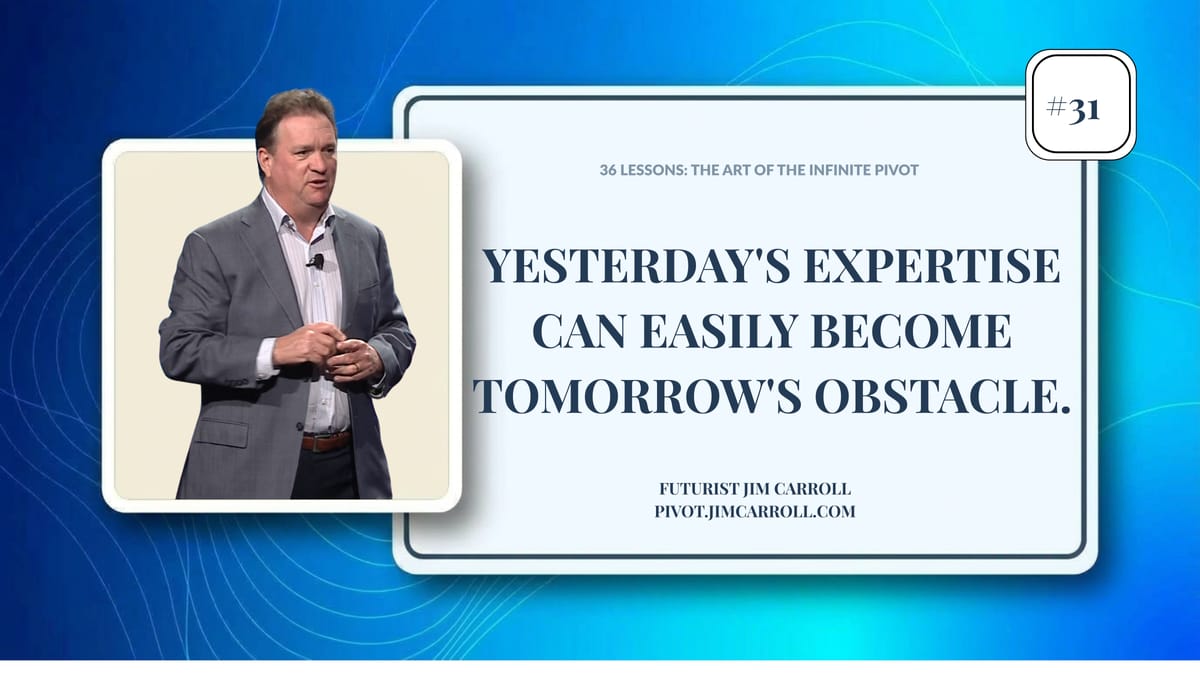
"Yesterday's expertise can easily become tomorrow's obstacle." - Futurist Jim Carroll
Futurist Jim Carroll is writing a series, The Art of the Infinite Pivot, based on 36 lessons from his 36 years as a solo entrepreneur, working as a nomadic worker in the global freelance economy. The series is unfolding here, and at pivot.jimcarroll.com.
Here's something most successful people don't want to hear: the deeper your expertise, the more it can quietly hold you back.
It's a paradox, actually. The thing that got you here is the same thing that can make you blind to what's coming next. The hard-won knowledge, the pattern recognition, the muscle memory of how things work in your industry can become the very things that buttonhole you as someone who is too narrow to take on wide challenges.
This is related to, but distinct from, two earlier ideas in this series. Lesson #2 made the case that expertise is perishable: your knowledge has a shelf life. Lesson #28 was about obsolescence: the external signals that tell you the world is about to move past you. Both are about your expertise running out.
This one is different. It's about what happens before your expertise expires: when it's still technically valid, still earning you a living, still making you the smartest person in most rooms. Why is that? Because it might lead you to become blind to the need to pivot faster.
I learned this several times by learning how to learn. I'm a huge fan of the phrase "learning is what most adults will do for a living in the 21st century," because that literally defines my career.
In the late 1980s, I was a Chartered Accountant (I still am, but now known as a CPA). Auditing, finance, and taxes. A solid, respectable career. Then I started watching what was happening with personal computers and corporate networking, and I knew the future wasn't in ledgers. So I retired the accountant idea, and taught myself enough about technology to become an IT and email consultant when most people in business hadn't yet sent their first email!
By 1991, I was going deeper. I'd been doing online research since 1984 (that's not a typo), and I realized that the skill had become a profession. I built a service offering specialized online research to companies, law firms, and private investigators. At one point, Air Canada was a client, hiring me to do detailed research related to M&A activity. The label for that work eventually emerged: "competitive intelligence professional." I was doing it before the category had a name. Full circle: in 2003, I headlined the Society of Competitive Intelligence Professionals, the very industry that emerged from what I was doing almost 20 years earlier.
By the mid-1990s, I'd retired that role too, and was going deep into the Internet itself, eventually writing the first of many books about the technology, and becoming a recognized voice on the disruptive impact of early Web trends. That earned me a healthy living as a speaker advising companies and associations on how this would change their world. I became an e-commerce expert at the nascent birth of the technology, writing a book about what it meant - and having VISA feel comfortable enough to place their logo on the cover.
Yet by the early 2000s, I retired that expertise as well. The dot-com collapse made the "Internet expert" label feel dated. So I rebuilt myself as a "Futurist, Trends and Innovation Expert," which required learning something else entirely: how to do deep, fast, industry-specific trend research. That last skill is the one I've leaned on hardest in the years since, but which went back to the skills I first started picking up in 1984. It's what allows me to walk on stage in front of an audience of manufacturers, healthcare executives, agricultural producers, automotive dealers, or insurance leaders, and tell them something useful and very specific about their future that is very specific to their industry. I'm not an expert on their industry. I'm an expert on how to rapidly become useful to it. I know how to go deep on the trends that matter.
I have also gone deep on the technical complexities of networking and infrastructure when keynoting some of the world's largest tech security conferences. You can't stand in front of a room full of cybersecurity professionals and wave your hands. You have to know what you're talking about, at a level that earns the room's respect. That comes from the fact that I have probably about a dozen computers in my home, as well as many online servers, all of which I tinker with for video production, home automation, and other activities.
Every one of these moments started with me not knowing what I was doing.
So what does all of this mean? Learn to learn. Don't let your expertise box you in. Go wide. When you're an expert, your reflex is to defend what you know. When you're a beginner, your reflex is to ask. You see the gaps. You notice the strange edges. You don't yet have a worldview to protect, so you can absorb the new one whole.
That puts you in the mindset in which you are continuously learning.
Learning to learn.
Because that's what we are all doing in the 21st century.
The ultimate compliment Jim has received in his career? One fellow came up to him after a keynote and asked how long he had been a farmer.