
"Innovation often dies in the quiet comfort of mutual delusion." - Futurist Jim Carroll
Let's talk about innovation.
I was on a Zoom with a potential client yesterday, looking into an innovation-themed leadership event they were pulling together. One thing that became obvious was that they didn't really want the session to focus on the real big issues the organization is faced with.
Sadly, this often seems to be the case - people refusing to ignore the very things that are holding them back from moving forward. And in an era of relentless disruption, that means the greatest threat to their future isn't a competitor, slow product innovation, or internal collaboration failure.
It’s the team's collective agreement to ignore reality.
When a team or an entire industry chooses comfort over truth, they enter a state of "mutual delusion."
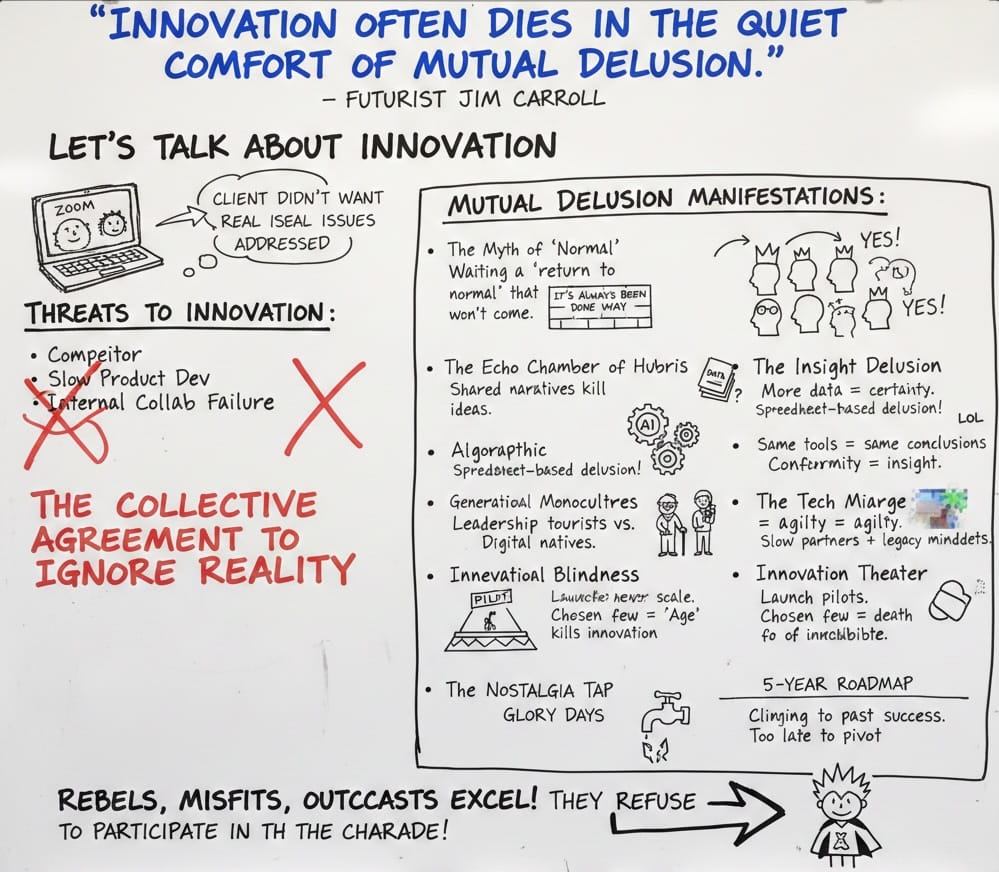
Here is how this concept manifests in the context of innovation:
- The myth of "normal": Teams often convince themselves that market volatility or massive industry disruption is a temporary phase to be endured rather than a permanent shift in the economic landscape. This delusion allows them to wait for a "return to normal" that will never come.
- Collective denial: Innovation culture is frequently killed by shared narratives. When a group reinforces the idea that "it’s always been done this way," they build a protective wall of denial that keeps new, disruptive ideas out.
- The echo chamber of hubris: Success often leads to a dangerous state of invincibility. Leaders surround themselves with voices that mirror their own confidence, creating a mutual delusion that blinds the entire organization to emerging threats.
- The insight delusion.: Organizations often believe that more data equals more certainty. As they say, LOL. In reality, teams can use massive amounts of information to build a sophisticated but false justification for a failing strategy. Call it the spreadsheet-based delusion!
- Algorithmic monocultures: Here's a new risk to think about: as more companies rely on the same AI tools and models, they risk falling into an industry-wide mutual delusion—where everyone reaches the same "average" conclusions and mistakes conformity for insight.
- Generational blindness: A gap often exists between leadership "tourists" who visit the future and digital "natives" who live in it. The delusion occurs when (an older) leadership assumes its traditional perspective is more valid than the reality seen by those on the (younger) front lines. Yes, innovation death often happens because of the 'age' thing.
- The tech mirage: It is a delusion to believe that having high-speed technology makes an organization agile. True innovation is often held back by the "distributed drag" of slow-moving partners and legacy mindsets.
- Innovation theater: Many organizations participate in a mutual delusion by launching high-profile "innovation pilots" that they never actually intend to scale, mistaking the appearance of activity for the reality of progress. As I have long explained, making innovation the responsibility of a 'chosen few' is a sure way to kill it in its tracks!
- The comfort of linear planning: In an exponential world, the five-year roadmap acts as a corporate security blanket. Relying on it is a form of collective delusion that provides a false sense of predictability in a chaotic environment.
- The nostalgia tap: Clinging to the "glory days" of past success is perhaps the most common mutual delusion. It prevents a team from recognizing a fundamental rupture in their industry until it is too late to pivot.
All of these are the very reasons why it's the rebels, misfits, and outcasts who excel at innovation - because they are the ones who refuse to participate in the charade!
Futurist Jim Carroll has a long list of detailed observations on why some organizations succeed at innovation while others fail. He's come to understand that most of it is own-goal failure.