
“If you are the fastest person in the room, you are in the wrong room.” - Futurist Jim Carroll
Futurist Jim Carroll is writing his end-of-2025 / introduction-to-2026 series, 26 Principles for 2026. You can follow along at 2026.jimcarroll.com. He welcomes your comments.
The 1987 editorial "Tomorrow's Company Won't Have Walls" stands as one of the most accurate corporate prophecies of the modern era.
And it had a profound impact on my life.
It's probably fair to say that if I hadn't read it, I wouldn't have stepped out on my own to start my own company, chase my own career, do my own thing, and become a global freelancer, a nomadic worker, a lone wolf, long before the trend became real and the idea fashionable. Like I've said - I haven't had a job for 35 years, and I work really hard to not have to get a job!
It's worth reading, because it predicted with precision the modern organization of today.
"Tomorrow's Company Won't Have Walls", New York Times, October 1987
The hub of the network organization will be small, centralized, and local. At the same time, it will be connected to an extended network that is big, decentralized, and global. People from the network and from outside the company will join the group at the hub for periods of time and then leave it.
But the network organization will also present its own set of paradoxes. For instance, how will these new organizations be able to manage the often conflicting interests of the centralized hub and the decentralized network? And how can a system that is both centralized and decentralized be unified and coordinated, and quick to respond to changes in the marketplace?
For the global organization of the future, the ability to acquire new products, services, technologies, and capital will not be the problem. The marketplace is crowded with each of these as never before.
But for exactly this reason, the challenge for each company will be to nurture its own unique culture and develop the quality of its human resources. That is because competitive advantage will rest increasingly in the way each network organization gathers and assesses information, makes its decisions, and then carries out those decisions.
The 21st century will be full of organizational surprises. The challenge of arranging cooperative efforts between companies to achieve strategic gains is beginning to emerge. Changes in the marketplace have given companies from around the world the opportunity to develop these new linkages. Advances in telecommunications technology also enable companies to bring people together for a competitive advantage. The time has now come to form new global collections of companies, and to fully utilize human relationships.
Think about where we are now: many organizations don't define themselves by the depth of their staff - they do so by the reach of their skills network.
But in 2026 and beyond, the sophisticated reach of a networked organization is not enough.
It's no longer about the reach of your skills network, but also the speed with which they operate.
If they aren't as fast as you, it will slow you down even further, stunt your progress, and ruin your ability to align with exponential trends.
Here's your chalkboard summary!
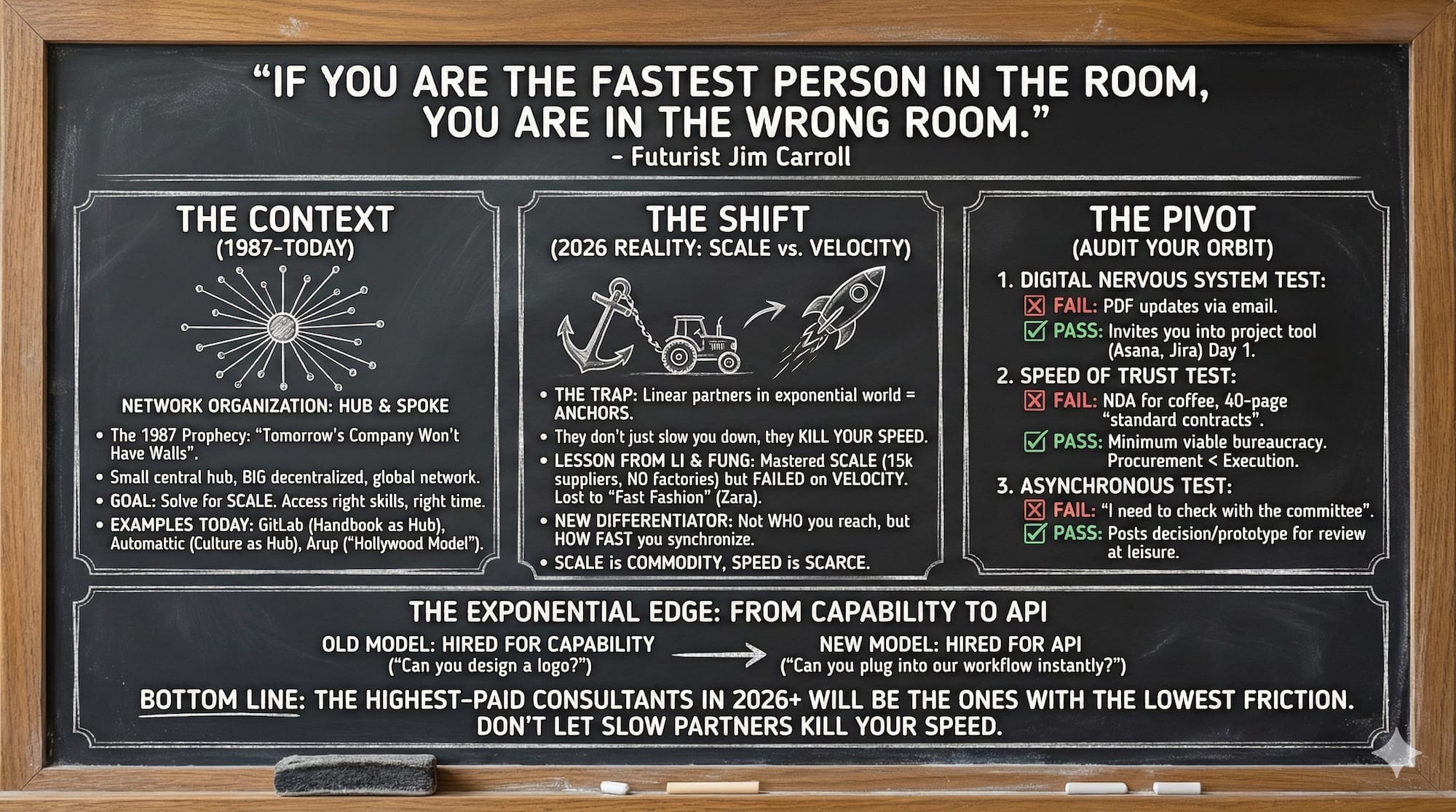
That's why, in 2026 and beyond, you have to stop letting slow partners kill your speed.
The Issue of Network Velocity
We are on Day 20. We have built your internal engine: You have the Unapologetic Uniqueness (Day 17), an Antifragile Mindset (Day 18), and Optionality Architecture (Day 19).
Do those things, and you are getting ready for our exponential world.
But as they say, "but wait, there's more!" Now, we must look outside.
You can have a Ferrari engine (your mindset), but if you are driving in a convoy of tractors (your partners), you are going to move at the speed of a tractor!
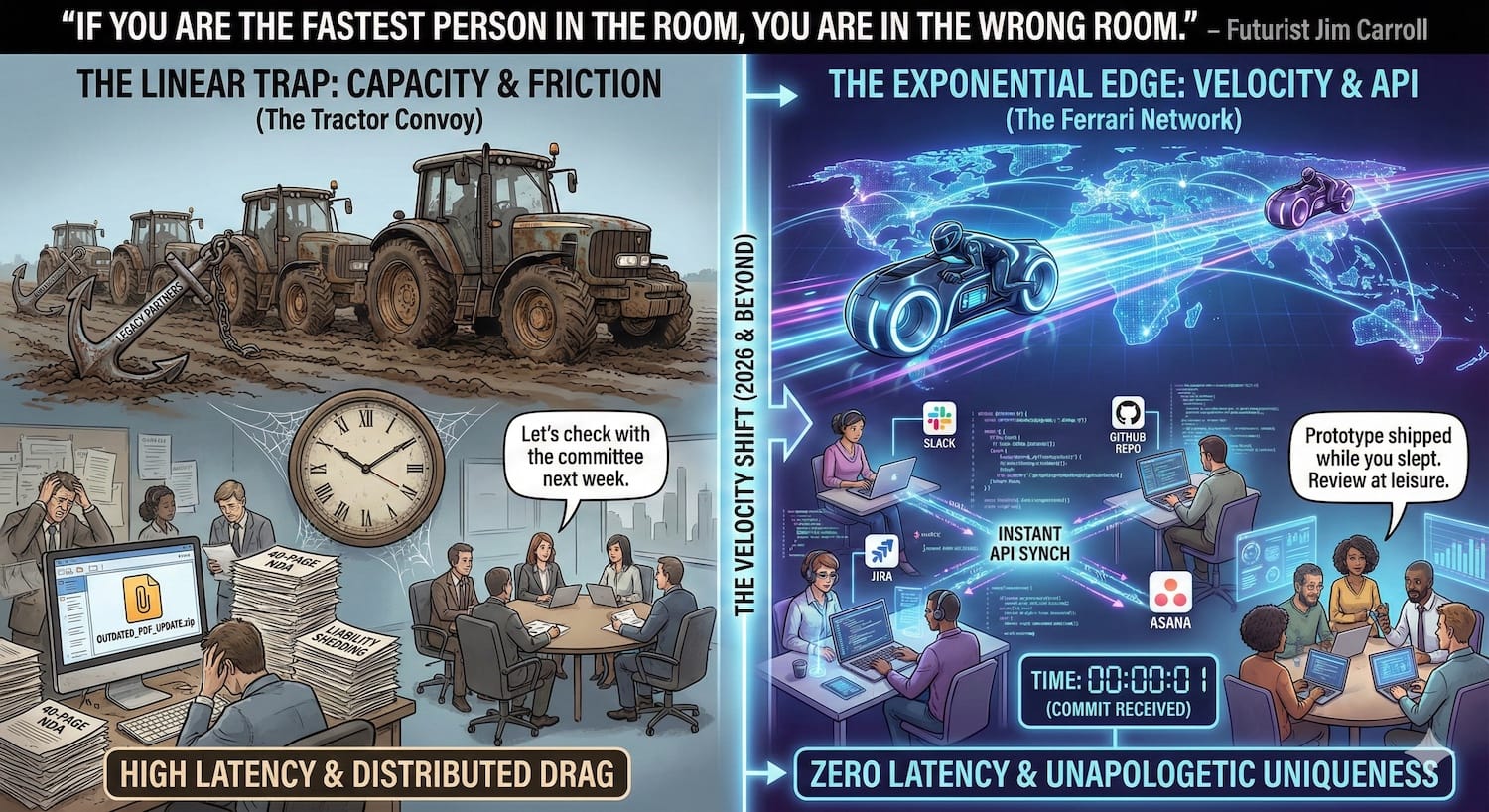
And here's the thing about what this means to the networked organization, and perhaps your role in it as a freelancer: in a linear world, we picked partners based on stability, history, and comfort. We stuck with the vendor we’d used for 20 years because "they know us."
In an exponential world, loyalty to the past is a guarantee for failure. If your supply chain, your technology vendors, or your peer group are evolving linearly while the market accelerates exponentially, they aren't just slowing you down.
They are anchors.
This means that another discipline you must master going forward is Network Velocity.
The Networked Organization is No Longer a Theory
It's worth revisiting the idea of the networked organization to think about how it is now impacted by exponential speed. The New York Times article predicted a "wall-less company" where a small central hub would coordinate a massive, decentralized web of resources.
That future has already happened. The most successful organizations today are structured exactly this way. And for many people, their career path as a global freelancer fits perfectly into this business model:
- GitLab (The Handbook as Hub): This software giant operates as a fully remote company with team members in 60+ countries and no corporate office. Their "hub" isn't a headquarters; it is a 2,000+ page public Handbook. This document acts as the single source of truth, replacing middle management with documentation. By forcing everything into text and code, they decouple their ability to scale from the need for physical oversight. Go take a look at the site - handbook.gitlub.com. That's the heart and soul of the company right there.
- Automattic (The Cognitive Orchestrator): The company behind WordPress employs over 2,000 people across 96 countries. Their "hub" is a shared digital reality and culture that coordinates global talent without physical boundaries, proving that "culture" is the only wall that matters in a digital firm.
- Arup (The "Hollywood Model"): This global engineering firm operates like a movie studio. For massive projects like the Beijing Olympics, they assemble a temporary "hub" of specialists—structural engineers from London, acoustic experts from New York—who form a cohesive unit for the project and then disband.
This model works because it solves for scale. It allows a small core to leverage massive resources, scaling up and down as requirements change and as new skills and capabilities are required.
It goes to the heart of one of the key trends that I often talk about: the future of every organization comes from the ability to access the right skills at the right time for the right purpose. Your role as a freelancer? Providing those skills - but now - just in time!
The Master of Scale: A Lesson from Li & Fung
To understand the power—and the danger—of this model, we have to look at the original master of the network: the Hong Kong trading giant Li & Fung. It's a good lesson as to why the speed of the network now matters more than ever before.
For decades, Li & Fung was the ultimate "network orchestrator." They didn't own factories; they owned the process. They would break a single garment down into steps: spinning the yarn in Pakistan (for cost), weaving it in China (for capacity), and stitching it in Vietnam (for labor rates). They managed 15,000 suppliers without owning a single needle.
How did they keep this massive, decentralized beast from collapsing? They invented the concept of "Little John Waynes."
They broke their central trading hub into small, autonomous cells. The leader of each cell—the "Little John Wayne"—acted like an independent entrepreneur running their own small business within the giant group. They had total autonomy to serve their specific customers, giving the massive conglomerate the "local feel" of a small shop.
It was brilliant. It solved the problem of size. They mastered scale. They could get the right skills and the right partner at the right time.....
But it failed to solve the problem of time. A faster world!
As the world moved from "seasons" to "fast fashion," Li & Fung’s analog network of phone calls and relationships became too slow. They had the biggest network in the world, but slow speed began to kill them. They began to lose out to fast-fashion movers like Zara. They couldn't compete against the weird new networked world, which involved an influencer posting a picture of some new outfit on Instagram, and a series of small Chinese factories beginning to produce knockoffs within hours for shipping the next day.
This is the world of exponential change, and where we will find ourselves in 2026 and beyond!
The Freelancer Impact
Let's spin into this, a key component of this global network - you. Your skills. The freelancer. The person who makes their skills available to a global economy.
If you are this person - a freelancer, a nomadic worker offering your skills to this globally outside world - you now need to work at a new and different speed. You need to be fast. Stunningly fast!
Why? Because in the 1987 model, you were "outsourced help." In the 2026 model, you need to be part of a faster machine.
The client isn't hiring you to "add capacity" (they can get that from a junior employee). They are hiring you to inject velocity. They are paying a premium because they believe you can do in 4 hours what their internal team takes 4 weeks to approve.
If you are slow to respond, slow to onboard, or slow to deliver, you aren't just annoying; you are breaking their value proposition.
The data proves this shift is already here. High-value freelancing is no longer about junior talent "gigging" between jobs. Today, 72.8% of fractional professionals have 15+ years of experience. These are seasoned executives who operate as autonomous, high-speed units. They win not because they are cheaper, but because they have zero "latency.' They know how to operate at speed.
If you treat your freelance business like a traditional 9-to-5—with "I'll get back to you next week" energy—you are acting like a linear component in an exponential machine. The system will reject you.
If you can't provide the right skills at the right time, you're toast! Your freelance opportunities will be over.
The Velocity Trap: Why Scale Is No Longer a Moat
And so, with all that in mind, here's where we are in the context of that 1987 article: many organizations discovered the power of scale through partnership. They won the war on "walls." But they are now losing the war on time.
In the era of 2026, scale has become a commodity, but velocity has become scarce.
Here is the brutal reality: Access to a "massive global network" is no longer a competitive advantage. Everyone has access to Upwork, AWS, Alibaba, and ChatGPT. The differentiator is no longer who you can reach, but how fast you can synchronize with them. If you have a network of 1,000 partners, but it takes three weeks to get a decision, you don't have a network; you have a bureaucracy that spans multiple time zones.
You have replaced "corporate bloat" with "distributed drag."
The simple fact is this - in an exponential world, organizations now need faster partners. To be a partner, you need to be faster than everyone else!
In 2026, network scale has become a commodity. The new scarcity is Velocity.
1. The Exponential Mindset
We spent the last thirty years dismantling vertical silos and replacing them with horizontal networks. But what has been lost is speed. We've replaced old bureaucracies with new ones - because we let our partners show us down.
The brutal reality is that access to a "massive global network" is no longer a competitive advantage. Everyone has access to Upwork, AWS, and ChatGPT. Everyone can access new skills on a dime. The global freelance economy is bigger than ever before - read the previous post. We are closer than ever to the goal I often share - "our success comes from our ability to access the right skills at the right time for the right purpose." Aka just-in-time knowledge.
But going forward, the differentiator is no longer who you can reach, but how fast you can synchronize with them.
Think of it this way: if your partners can not operate as fast as you, you are running a race with a slow team
2. The Linear Trap
To understand the danger of the old model, look at what happened to Li & Fund, the original master of the skilled network.
As the world moved to "fast fashion," their analog network of phone calls and relationships became too slow. They had the biggest network in the world, but slow speed killed them.
The simple fact is this: you cannot have an exponential strategy with a linear network. If you are running an AI-driven business model but your legal counsel takes two weeks to review a prompt, your "scale" is irrelevant.
You are stalled.
And doomed.
3. The Exponential Edge
When you prepare for Network Velocity, you unlock the secrets to the new style of "companies without walls."
In the past, you were hired for your Capability ("Can you design a logo?"). In 2026, you will be hired for your API("Can you plug into our workflow instantly?").
For the independent worker or the agile firm, this means the difference between a Linear Partner (who sends an email, asks for a meeting, deliberates) and an Exponential Partner (who grants access to the GitHub repo, tags you in the tool, links you into Slack, and expects the commit by 5:00 PM).
Bottom line? The highest-paid consultants in 2026 and beyond won't be the ones with the most experience; they will be the ones with the lowest friction.
4. The Immediate Pivot
You need to audit your orbit! Take a look at your network! Figure out if your skills and partnership network are fast enough, or falling behind. If you freelance, you need to check your speed.
Speed is easily faked. Every potential partner will claim to be "agile."
In the sales pitch, everyone looks like a Ferrari. It is only when you get on the highway that you realize you hitched your wagon to a tractor.
You need to do an audit.
So let's jump there!
The Velocity Audit: How to Spot a "Ferrari" Partner
Here is your 3-point inspection checklist to judge if a partner can keep up with your 2026 trajectory.
- The "Digital Nervous System" Test (Metric: Information Latency)
- The Question: Does this partner communicate via APIs and shared platforms, or via email and meetings? Are they a Slack organization, or are they still using Microsoft Office?
- Fail: A partner who sends you a PDF attachment of a project update that is already 24 hours out of date.
- Pass: A partner who invites you into their project management tool (Asana, Monday, Jira) on Day 1. In a digital ecosystem, email is the new snail mail.
- The "Speed of Trust" Test (Metric: Transaction Costs)
- The Question: How much legal and bureaucratic "tax" do I pay to start working?
- Fail: A partner who requires an NDA to have a coffee, or whose "standard contract" is 40 pages of liability shedding.
- Pass: A partner who operates on standard, clean agreements and focuses on the idea of "minimum viable bureaucracy." If the "Procurement" phase is longer than the "Execution" phase, walk away.
- The "Asynchronous" Test (Metric: Decision Autonomy)
- The Question: Can they make progress while you are sleeping?
- Fail: The partner who says, "I need to check with the committee."
- Pass: The partner who posts a decision or a prototype for you to review at your leisure. You want partners who care more about the outcome than the ownership.
Here's what I know - I experience slow organizations regularly. My wife and I know when an organization is stuck in a slow lane - they take our 3-page simple speaking contract, and layer on top of it 40 pages of legal addendum. They view a simple one-hour speaking gig as a 40,000-hour consulting contract, with IP ownership and other clauses as part of the deal. They end up paying our deposit via credit card because they can't figure out how to get us into their ERP system. (American Express actually did this once, via Amex, and we still have a good laugh about that!)
And the running joke with all of this is that they've booked me to do a leadership keynote on speed and agility - and don't realize how massive a hill they have to climb!
For 2026 and beyond? Their world is going to be 'interesting.'
Because in an exponential world, you can't be a slow partner in a fast world!
Futurist Jim Carroll now works really fast to not have to go and get a job!