
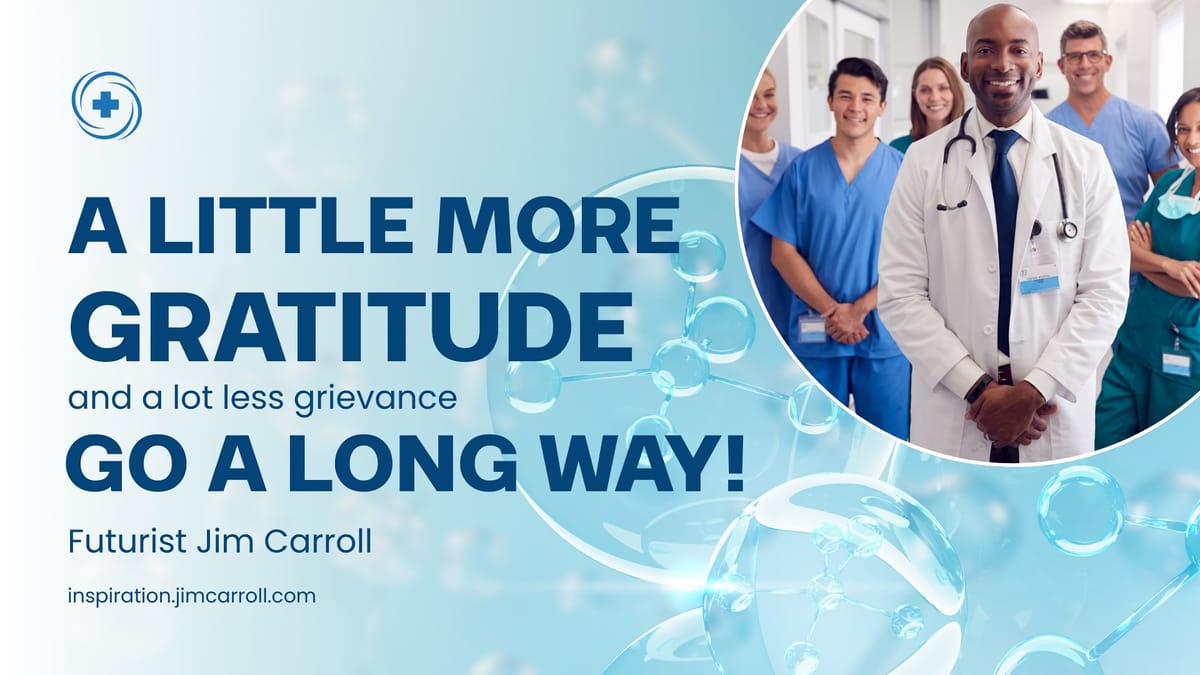
"A little more gratitude and a lot less grievance go a long way!" - Futurist Jim Carroll
I've spent 30 years advising companies to speed up! If you think about it, I preach the gospel of the need for speed!
One of the reasons involves heightened expectations. We live in a fast world - instant online shopping, instant delivery, instant follow-up, instant updates on our phones. Instant everything. For years, I've been sharing the idea that every organization needs to align with the new reality of increased expectations - delivering the same instant, high-quality service we get through the fastest retail networks.
But my world in 2026 so far has taught me - through my own spinal injury and my wife's recent Achilles tear- that when systems are under stress, the correct exponential mindset isn't "more demands," it's "more gratitude."
A little more gratitude and a lot less grievance go a long way.
If you’ve read my recent posts, you know that my wife and I have become "frequent flyers" in the healthcare system lately. Between my fall in November and her injury this January, we’ve spent more time in waiting rooms than we ever planned. And sitting there, observing the world around me, I’ve noticed something troubling.
We are living through a "crisis of decorum."
People are demanding instant attention in a system that is not engineered to deliver it at the speed of expectations.
I wrote earlier this year about the New York Times article detailing the disappearance of respect. You see it everywhere, but it is most visceral in places like an ER or a specialist's waiting room. People are angry. They are demanding. They treat the intake nurse like a malfunctioning customer service bot. We have "Uber-ized" the world around us, convincing ourselves that because we can demand a car or a meal instantly via an app, we should be able to demand complex medical care with the same speed and entitlement.
And that won't happen.
Here is the reality I’ve seen from the other side of the hospital gurney: The system isn’t "broken" because the people are lazy. The system is fragile because it is under exponential pressure.
To borrow a metaphor I used for my own recovery: the engine is fast, but the chassis is cracked. The doctors, nurses, and technicians are the engine—they are skilled, working incredibly hard, and running at maximum capacity. But the chassis - the infrastructure, the funding, the sheer volume of patients- is under massive stress because of increasing demand, a shortage of workers, and never-ending funding challenges.
When you are in a system that is flashing red, the worst thing you can do is add more friction.
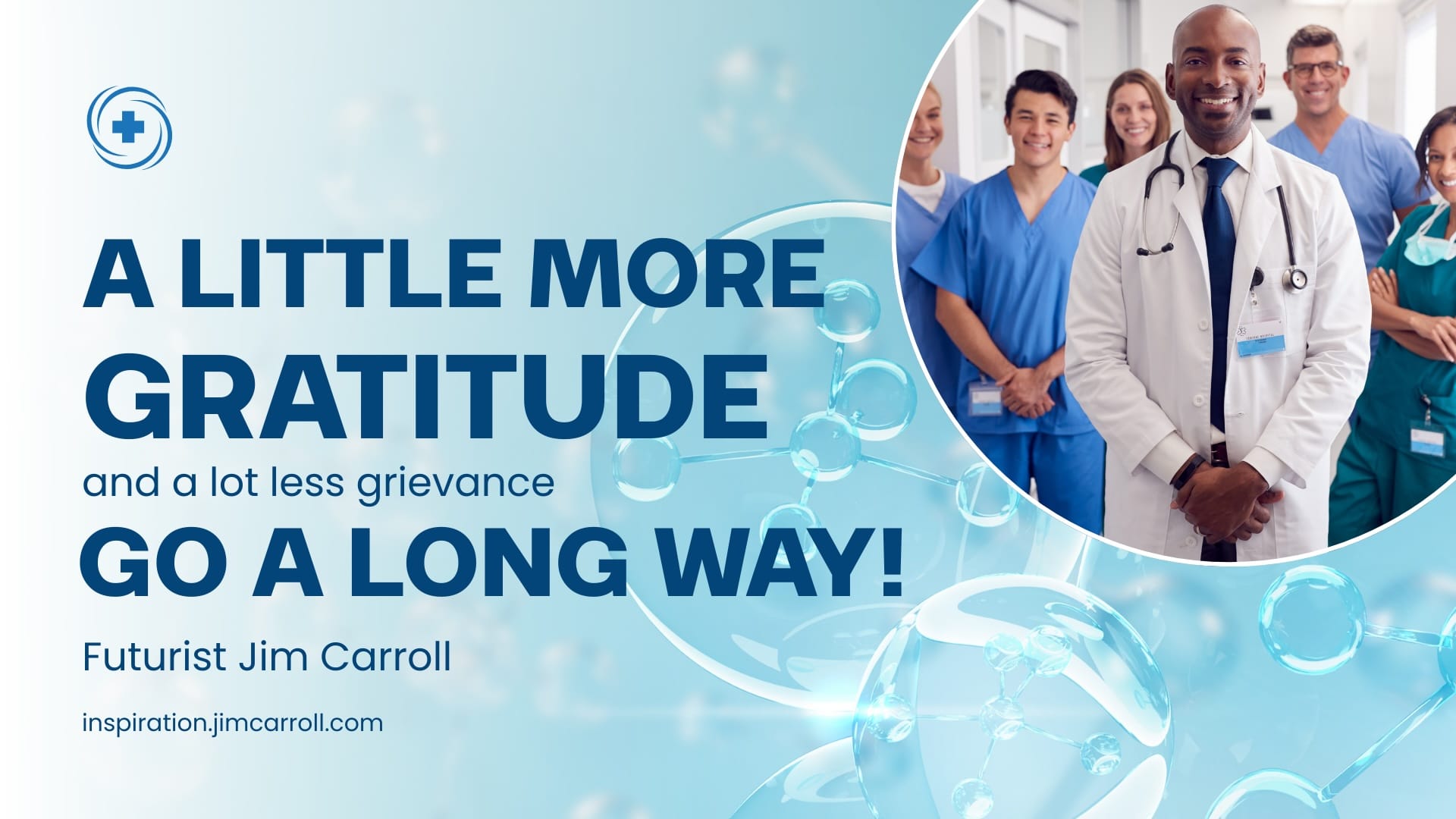
During our recent visits, I've tried to make a conscious choice. I've tried to be the patient who smiles, who says "take your time," and who actually looks the staff in the eye and says, "Thank you for what you’re doing."
I've tried hard to be kind to everyone I meet, and to thank them for the hard work they are doing.
And it goes a long way to changing the relationship. The energy in the room instantly shifts. You can physically see the shoulders of the staff drop an inch. By simply acknowledging their humanity rather than screaming about our wait time,we didn't just get better care, we had a better experience. We stopped focusing on the "loss" of our time and started focusing on how we were being helped.
And that's an important reality to think about in the context of our world today. I've been writing about the fact that we are currently in an "attention recession," where the loudest voices and the most aggressive complaints get the spotlight.
But in the real world, out in the quiet, stressful corners of a hospital, noise doesn't solve problems.
Connection does.
You can't do a mean tweet and fix things.
I'm not trying to say the healthcare system is perfect - it's not. It has huge challenges that will never be easily solved.
And it's all we've got.
So, the next time you find yourself stuck in the gears of a slow-moving system, try pressing the brake on your ambition and the gas on your empathy.
A little more gratitude and a lot less grievance don't just help the person helping you.
It helps you, too.
Futurist Jim Carroll has not been a big fan of 2026 so far!