
"We are rich in AI potential, but still bankrupt in its application." - Futurist Jim Carroll
We talk constantly about the "promise" of artificial intelligence, but there is a massive difference between a brilliant algorithm and actual, real-world implementation.
Need an example? Take a look at this image.
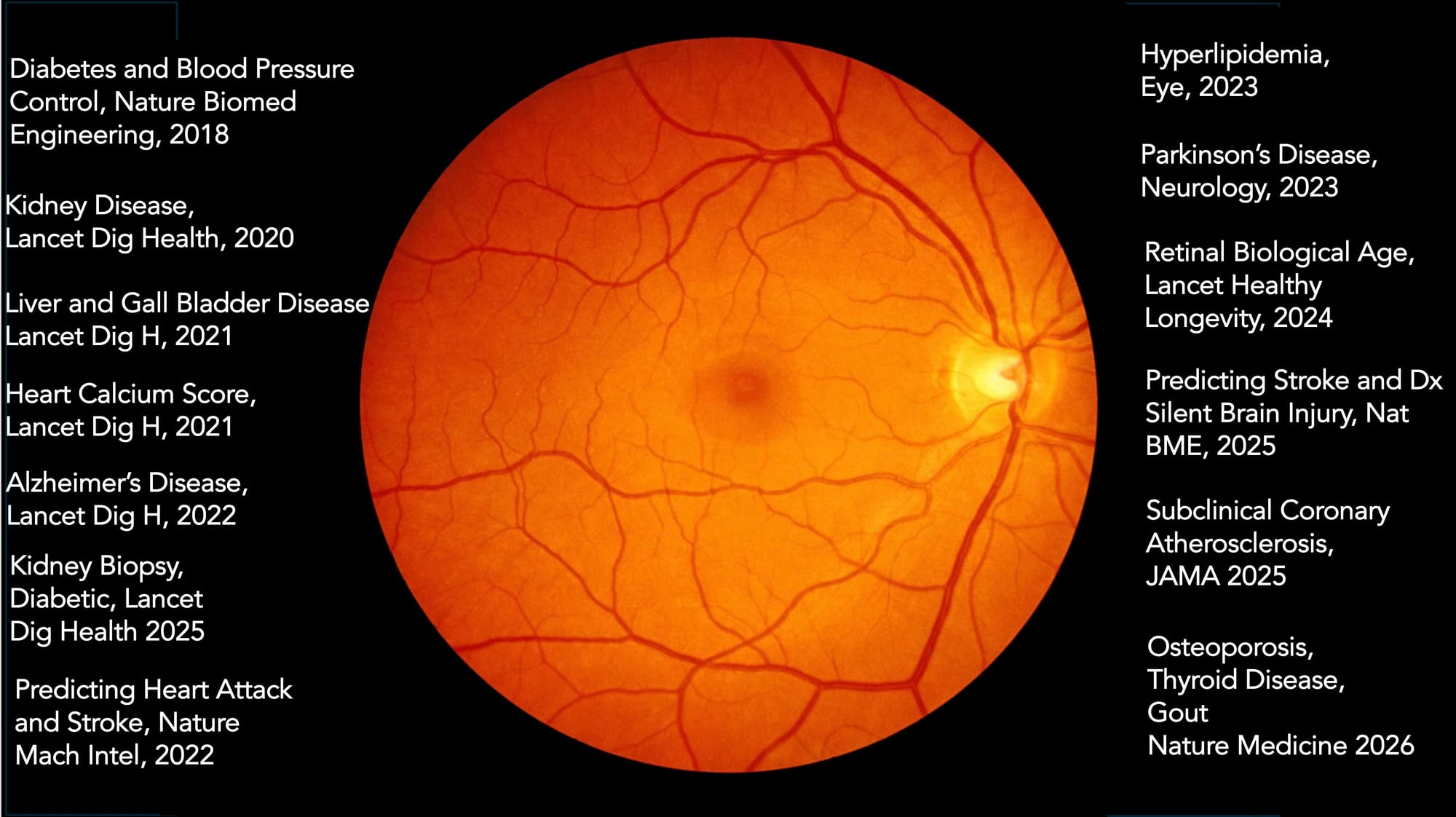
What does it describe? In a recent analysis by Dr. Eric Topol on The Paradox of Medical AI Implementation, he highlights that a single image of the retina can be used by AI analysis to identify a vast array of medical conditions (with the publication and year of the discovery noted). And yet, he also notes a frustrating reality that little of these astounding medical advances have actually been implemented within the healthcare system - there's a vast gap between the promise and potential of AI, and the reality of its implementation.
And the fact is, this isn't restricted to healthcare - that gap exists across virtually every single industry. Everyone talks a great game with AI and goes on about its potential and disruptive reality - and yet very few are actually successful in using it to any extent.
Go back to the main point and dig deeper into his analysis - in his post, The Hidden Wealth of Medical Data, he shared that a single retina photo can reveal over 15 systemic medical conditions when processed by AI, yet it remains completely unadopted in routine clinical practice.
What's going wrong? He points out that:
- we leave extensively validated technology on the shelf:The fact is, the image above shows us that over a decade of research has given us "superhuman vision" in medical imaging. Think about it - one picture of an eye can detect things like Parkinson’s, Alzheimer's, kidney disease, and heart disease, for a very small cost. Few are using this capability. It doesn't stop there - an AI analysis of a colonoscopy consistently outperforms gastroenterologists in detecting polyps across 44 randomized trial. Tools like China's PANDA AI can catch aggressive pancreatic cancer on standard CT scans up to three years ahead of a radiologist. Yet, due to fragmented healthcare infrastructure and broken business models - as well as a vast education gap - these tools are virtually absent from standard medical practice.
- we rush into unproven tech because the friction is lower: While heavily validated imaging AI like this sits on the sidelines, generative AI tech like ChatGPT (LLMs) has seen explosive adoption because it is highly accessible and easily understood. By March 2026, an American Medical Association survey found that 72% of physicians were already using generative AI in their practice, with 35% utilizing it for direct patient care. Millions of patients are turning to chatbots for health information. This massive adoption is occurring despite a distinct lack of real-world clinical trials proving that LLMs improve patient health outcomes. People like to do the easy stuff first, but the real potential is in the hard stuff.
- the risk of premature deployment: When tested outside of simple administrative support, the lack of real-world infrastructure shows. In simulated emergency room scenarios, interactive LLMs have made blatant triage errors with critical, life-threatening emergencies like diabetic ketoacidosis or impending respiratory failure. Additionally, studies show that the quality of symptoms a patient reports to an AI chatbot is significantly lower than what they provide to a human physician during an interview.
The takeaway? Innovation is exciting, but integration is where the value lives.
True progress isn't just about getting excited about AI and talking about its potential; - it's about having the discipline to implement the deep, data-driven solutions that are already proven to work.
Sadly, from what I am seeing, this seems to be the common case across every industry, from agriculture to manufacturing, insurance to energy. Everyone is talking a brave game - but few are showing up.
So today, ask yourself this: are you focusing on AI's potential, or are you doing the hard work of building it into your daily infrastructure?
Read the full deep-dive by Dr. Eric Topol: https://erictopol.substack.com/p/the-paradox-of-medical-ai-implementation.
It's an eye opener.