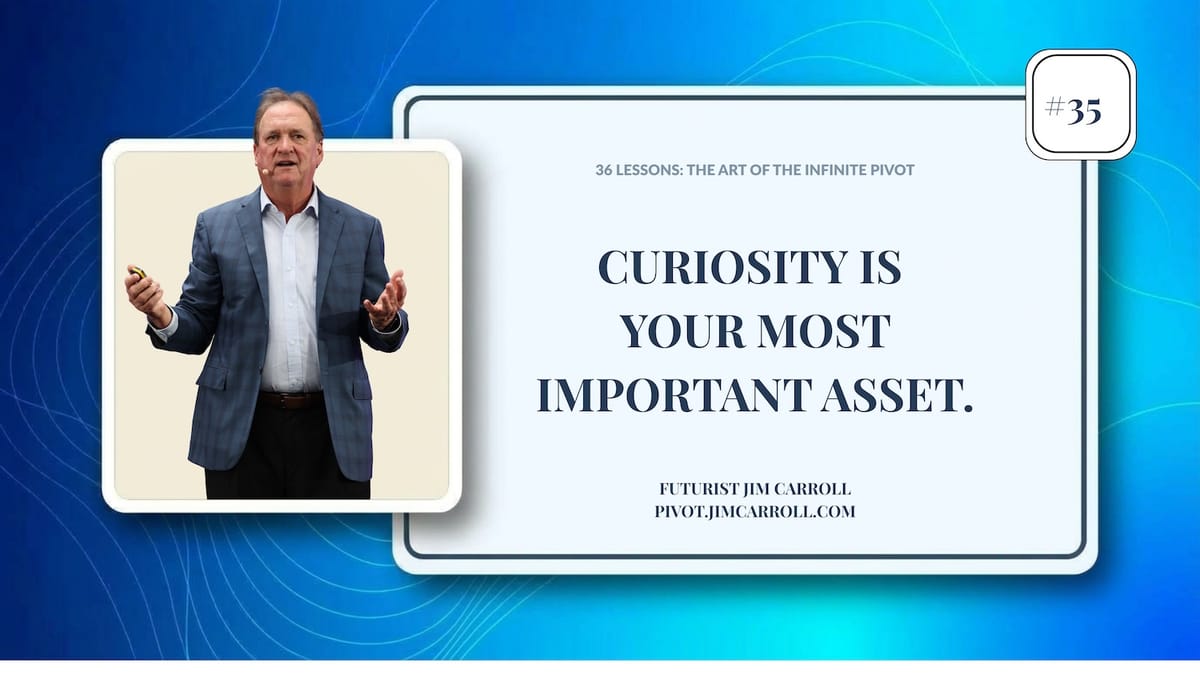
"Curiosity is your most important asset." - Futurist Jim Carroll
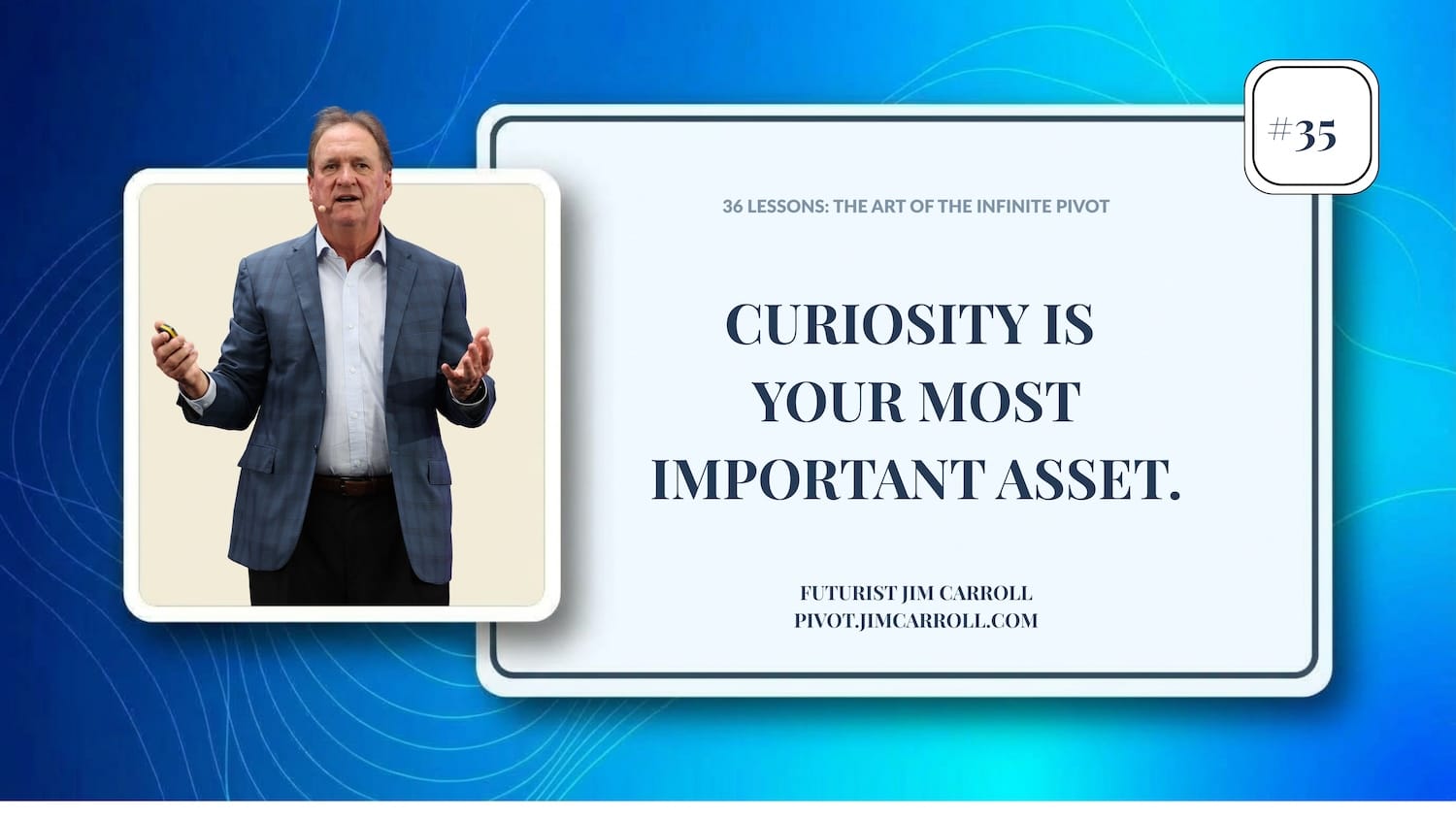
Futurist Jim Carroll is writing a series, The Art of the Infinite Pivot, based on 36 lessons from his 36 years as a solo entrepreneur, working as a nomadic worker in the global freelance economy. The series is unfolding here, and at pivot.jimcarroll.com.
Be like Curious George.
I'll often share that quizzical observation on stage to an audience of serious business executives - and the fact is, I mean it.
Here's why: curiosity is not a personality trait that allows you to accelerate innovation, spot trends before others do, or think differently in a world in which everyone is thinking the same thing.
It is an economic asset. And in 2026, with the acceleration of AI, it could very well be the single most valuable thing you can own.
Why? In an AI economy, almost everything you can know has been commoditized. Information is free. Expertise is downloadable. Knowledge has lost most of its scarcity. Everyone is pumping out the same stuff as everyone else. Heck, I'm feeling it with what I write and speak about.
In that context, what remains scarce, and therefore valuable, is a mindset of exploration, the ability to explore new ideas, and a willingness to let go of the norms and find new ones. That's curiosity - the actual human drive to follow things down a rabbit hole, to spend an evening reading about something you have no business reading about, or to tinker with something simply because it seems interesting. That drive to explore cannot be outsourced. It cannot be downloaded. It cannot be faked. It is intrinsic to your value.
In the era of AI, curiosity is the one asset that does not lose value.
And it's powerful. I learned this almost by accident. In the early 1980s, I spent thousands of hours on obscure BBS boards, clunky early communication software programs, and bizarre online communities most of my coworkers had never heard of, via. 300-baud and 1200-baud modems. I didn't know what was going on, but I wanted to know more. To a casual observer and to my co-workers, I was wasting my time sitting up till 2 am or 3 am exploring online worlds. They often told me so in blunt terms. I was throwing away my career. I should be doing more important things.
I didn't care. I just wanted to know what this strange new "thing" was. That apparently frivolous curiosity became the foundation of my entire career as an Internet author, a futurist, and eventually whatever it is I am now.
I wasn't lucky. I was curious.
This is why Richard Feynman spent his evenings breaking spaghetti noodles in his kitchen and watching plates wobble in the cafeteria - that's a story I tell in my still-upcoming Being Unique book. The "frivolous" investigations he undertook were where his Nobel-level insights came from. He understood that looking where no one else is looking is the only way to see what no one else sees. It is no coincidence that curiosity is the first word of the subtitle of the book: I wrote about this at length in my forthcoming book, Being Unique: Turning Curiosity, Creativity, and Courage into Your Competitive Edge. It is the trait that makes the other two possible.
There is also data behind this, for those who need it. A 2018 Harvard Business School study found that curious employees were 34% better at creative problem-solving, and earned job performance ratings 3.1 times stronger than their less-curious peers. A 2016 study in Neuron showed that curiosity activates reward-related brain regions and accelerates learning. The shorter version: when you are curious, you remember more, learn faster, and outperform everyone around you.
So here is the practical version. Weaponize your curiosity. Schedule it. Defend it. Block thirty minutes a week to chase something you have no business chasing. Read the article outside your industry. Try the tool you don't yet need. Ask the question that makes you sound naive in the meeting. Tolerate the feeling of being a beginner. Reward yourself for asking why instead of pretending you already know.
Because in 2026, the people who will navigate the infinite pivot are not the ones with the most knowledge.
They are the ones with the most curiosity quotient.
That metric: your CQ, is the one to optimize for the rest of your career.
It is the only credential that the algorithms cannot copy.
Futurist Jim Carroll is looking forward to reading the entire Curious George series to his new grandson.