
Three trends that could reshape farming — and what you should do about them now.
I've been speaking about the future of agriculture since 1993. That's more than three decades of watching one of the world's oldest industries confront some of the most extraordinary technological, scientific and economic changes imaginable.
In December 2005, I published 10 Big Trends for Agriculture, exploring everything from new energy opportunities and intelligent packaging to changing consumer expectations and the arrival of a new generation of technology-savvy farmers.
Much of what I was exploring then has become part of the reality of modern agriculture. Other developments have taken far longer than the technology enthusiasts might have expected. That's the nature of farming: the future might arrive quickly in a laboratory or at an agricultural technology demonstration, but it often takes much longer to make financial and operational sense in a field.
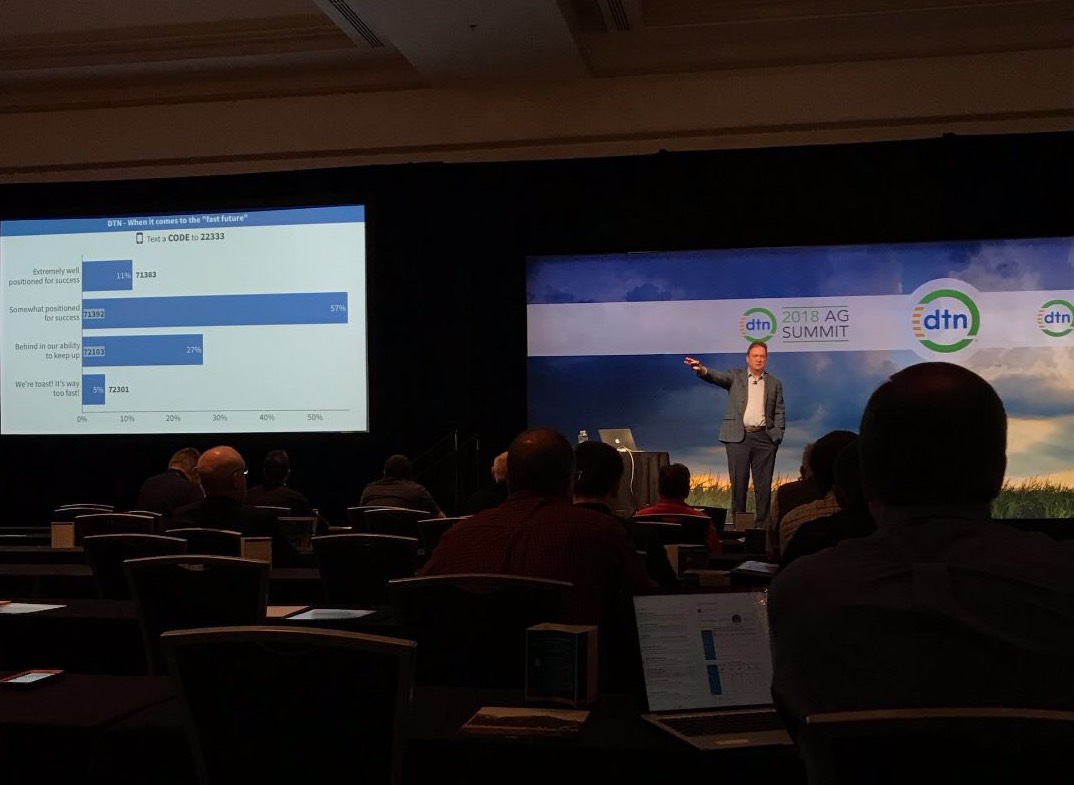
Through keynotes for organizations such as Western Growers, Simplot, the United Soybean Board, DTN Agriculture, Purina and CattleCon, I've continued to explore how these developments are reshaping the business of feeding the world. In my 2026 Agriculture Trends Scorecard, I revisited many of those earlier ideas and considered how the industry had evolved.
And here's something I've learned: farmers don't have much patience for technology predictions that ignore the realities of farming.
Nor should they. Rising input costs, expensive equipment, labour shortages, unpredictable commodity markets, trade uncertainty and increasingly volatile weather are enough to keep anyone occupied.
But tomorrow isn't going away simply because today has become difficult.
With that in mind, here are three agricultural trends I'm watching for 2027. Not necessarily the most obvious ones, and certainly not technologies that every farmer will suddenly adopt next year. But three developments that raise fascinating questions about where farming goes next.

1. The scarcest person on the farm isn't a picker. It's a robot mechanic.
For years, the agricultural technology industry has promised autonomous tractors, robotic harvesters, intelligent spraying systems and automated weed control. The goal has been straightforward: address labour shortages, improve efficiency and reduce costs.

When I addressed DTN Agriculture, I explored the possibility of farming operations increasingly managed through continuous streams of information. More recently, at Western Growers, robotics and automation were central to my discussion about the industry's future.
But I've been thinking about an interesting consequence of all this technology.
What happens when the biggest challenge isn't finding someone to operate the equipment, but finding someone who can repair it?
Agricultural robots increasingly combine machinery, sensors, cameras, electronics and sophisticated software. Keeping them operational requires an entirely different combination of skills. And when a machine stops working during a critical harvest window, it doesn't matter how clever its technology is. What matters is how quickly somebody can get it running again.
This is already becoming a practical issue. A 2026 Ontario agricultural robotics demonstration highlighted the importance of timely repairs and service support. The technology is advancing, but keeping it working reliably remains a challenge.
I don't expect fields to be suddenly filled with robots in 2027. The economics and reliability challenges remain significant.
But I do believe the next agricultural skills shortage could be less about finding people to do the work and more about finding people who can keep the technology working.
And that raises some immediate questions for farmers and equipment suppliers: How quickly can your dealer respond during harvest? Who on your team can troubleshoot a sensor or software problem? What does one lost day of equipment availability actually cost?
You don't need to buy a robot tomorrow. But you should probably start getting to know the people who build, service and repair them.
2. The farm becomes a power plant that also grows food.
Here's a story I've been telling for more than twenty years.
Back in 2004, I wrote an article called Manure and You!, exploring how something most people thought of as waste might become an increasingly valuable resource. I later expanded on that theme in a piece with one of my favourite titles: I Found the Future in Manure!
It wasn't just about manure. It was about the idea that agriculture might increasingly produce value in ways that went far beyond traditional crops and livestock.
My 2005 agricultural trends list also identified new energy opportunities for farmers, including wind power. And when I spoke to the United Soybean Board, I explored how advances in science could reinvent the value of agricultural production itself.
Now consider what's happening with energy.
Solar installations, wind generation, biogas and battery storage are creating new opportunities for farms to reduce costs or diversify income. Agrivoltaics takes the concept further, allowing agricultural production and solar electricity generation to share the same land.
But there's a big difference between an interesting idea and a profitable one.
Research published in Nature Sustainability examining agricultural solar installations has demonstrated the potential economic and energy-security benefits, while also identifying the conditions that can make some projects financially unattractive. Grid access, crop yields, energy prices, installation costs and land-use restrictions all matter.
So I'm certainly not predicting that every farmer will become an electricity producer in 2027.
What I am suggesting is that our definition of a productive agricultural asset is continuing to change.
A farm's future value might increasingly involve not just the food it produces, but the electricity it generates, the biological materials it supplies and the new markets it can serve.
What should a farmer do right now? Start by understanding energy costs, available grid connections, local regulations and whether any diversification opportunity makes financial sense. Talk to farmers who've pursued these projects, and learn from those whose experiences haven't worked out as planned.
Sometimes the best innovation decision is recognizing an opportunity isn't ready yet. But you need to understand it before you can make that decision.
3. The buyer wants the data with the crop.
Of all the trends I've been watching, this one has particularly deep roots in my earlier thinking.
In my original 2005 agricultural trends, I wrote about intelligent packaging, connectivity, food safety, traceability and country-of-origin information. The underlying idea was that agricultural products would increasingly become connected to much more sophisticated systems of information.
At the time, that was a fairly futuristic concept.

Today, it's becoming an increasingly important part of doing business.
Through keynotes for organizations such as Simplot, the Canadian Produce Marketing Association and CattleCon, I've continued exploring the convergence of agriculture, technology, consumer expectations and supply-chain intelligence.
And here's the next development I'm watching.
The ability to produce a great crop might no longer be enough. Increasingly, you'll need to produce the information that goes with it.
Where did it originate? How was it grown? Which lot did it come from? Can its movement through the supply chain be reconstructed if there's a food-safety problem?
This isn't simply a technology prediction. It's increasingly a commercial and regulatory issue.
The United States has established additional traceability requirements for certain foods under FSMA 204, with enforcement deferred until July 2028. That gives affected producers and supply-chain organizations a very practical reason to use 2027 to improve their recordkeeping and data-sharing capabilities.
But better data won't automatically command a premium price. In some cases, it will simply become another cost of doing business.
That's why the practical question isn't whether a farmer needs some elaborate new digital platform. It's whether they understand what information their customers will increasingly require and how efficiently they can provide it.
Start with a conversation with your buyers. Ask what records they expect, where their requirements are changing and how information needs to move between organizations. Review what you already collect, identify the gaps and look for affordable ways to improve accuracy and accessibility.
You might discover that the most valuable agricultural technology investment isn't a new machine. It might be a better way of managing the information you already have.
What should you do now — and into 2027?
Three trends. Three very different developments. But one common theme.
The future of agriculture isn't simply about producing more with less. It's increasingly about developing new capabilities, new relationships and new sources of value.
And I recognize that for many farmers, simply managing today's financial and operational pressures is difficult enough. The USDA's September 2026 forecast projected a 4.5% increase in American farm production expenses for the year. That's hardly an invitation to start making speculative technology investments.
So here's what I'd suggest.
1. Understand the future before you invest in it. Identify the research organizations, technology developers, agricultural associations and online communities working on these developments. Follow their progress, attend demonstrations and learn what's working—and what isn't.
2. Start with a problem, not a technology. Calculate the cost of equipment downtime. Examine energy expenses and potential diversification opportunities. Review the data your customers require. These practical business questions should guide which innovations deserve your attention.
3. Build relationships before you need them. Talk to equipment dealers about future service capabilities, researchers about emerging technologies and customers about changing expectations. The knowledge and connections you develop now could prove more valuable than an expensive purchase made too early.
4. Try something small when it makes sense. Visit a demonstration farm, explore an energy feasibility assessment, test a modest data-management improvement or give someone on your team an opportunity to learn a new technical skill. Keep the costs manageable and the objectives clear.
I've often explored a related idea in my work on Dancing in the Rain: we can't control all the uncertainty around us, but we can control how we respond to it.
Farmers understand uncertainty better than most people. They're dealing with weather, markets, costs and circumstances that can change almost overnight.
But the future doesn't disappear simply because the present has become difficult.
And after more than three decades of watching agriculture evolve, I've come to believe that the farmers and agricultural organizations best prepared for tomorrow aren't necessarily those who rush to adopt every new technology. They're often the ones who remain curious, stay connected to new ideas and develop the knowledge to recognize when something finally makes sense.
It's what happens to your industry. And what you do next.
This is the first of my 27 industry outlooks for 2027, each identifying three developments I believe deserve closer attention.
It's also part of a larger effort to connect what I've learned from decades of industry research, keynotes and conversations with leaders to the practical decisions organizations face today.
You can follow the complete series, alongside my 27 Leadership Strategies for Innovative Thinking in 2027, at 2027.jimcarroll.com.
Because the future of farming isn't standing still.
Neither should your thinking about it.
— Futurist Jim Carroll