
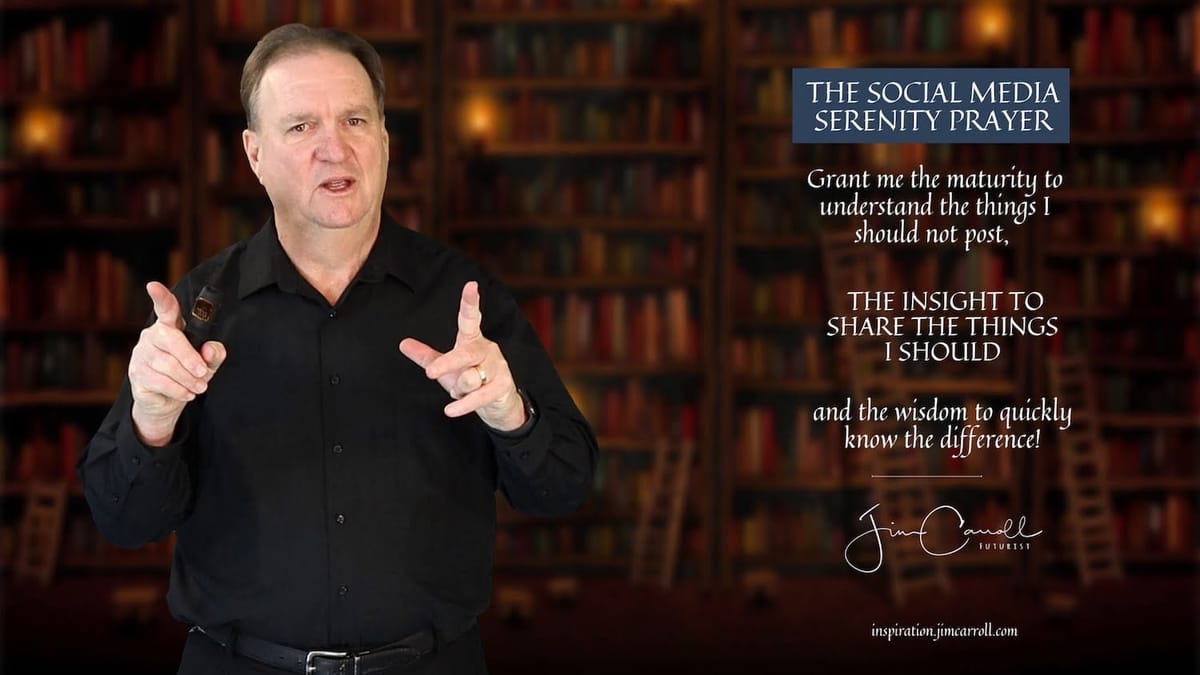
I am trying very hard not to post what I think.
I'm mostly successful, but I do slip. So I need a 2026 version of my Social Media Serenity Prayer. Maybe something like this: “Grant me the ability to avoid the stress, rage anxiety from things I cannot control, the courage to change the things I can, & the wisdom to know the difference!”
Every morning, I open the news and encounter another statement, tariff announcement, threat, insult, provocation, bizarre claim, or astonishing bit of political theatre coming out of the United States. As a Canadian, I get angry, sometimes really angry, and my instinct is to fire up LinkedIn, Facebook, Threads, or my blog and say exactly what is on my mind.
And then I stop.
Or at least, I am trying very hard to stop.
I keep coming back to my Social Media Serenity Prayer, something I wrote and shared years ago:
"Grant me the maturity to understand the things I should not post, the insight to share the things I should, and the wisdom to quickly know the difference!"

I first wrote that back in January 2022, during another particularly ugly period of social media insanity, and returned to it again in November 2024. It was this:
"Grant me the ability to avoid the stress, rage anxiety from things I cannot control, the courage to change the things I can, & the wisdom to know the difference!”
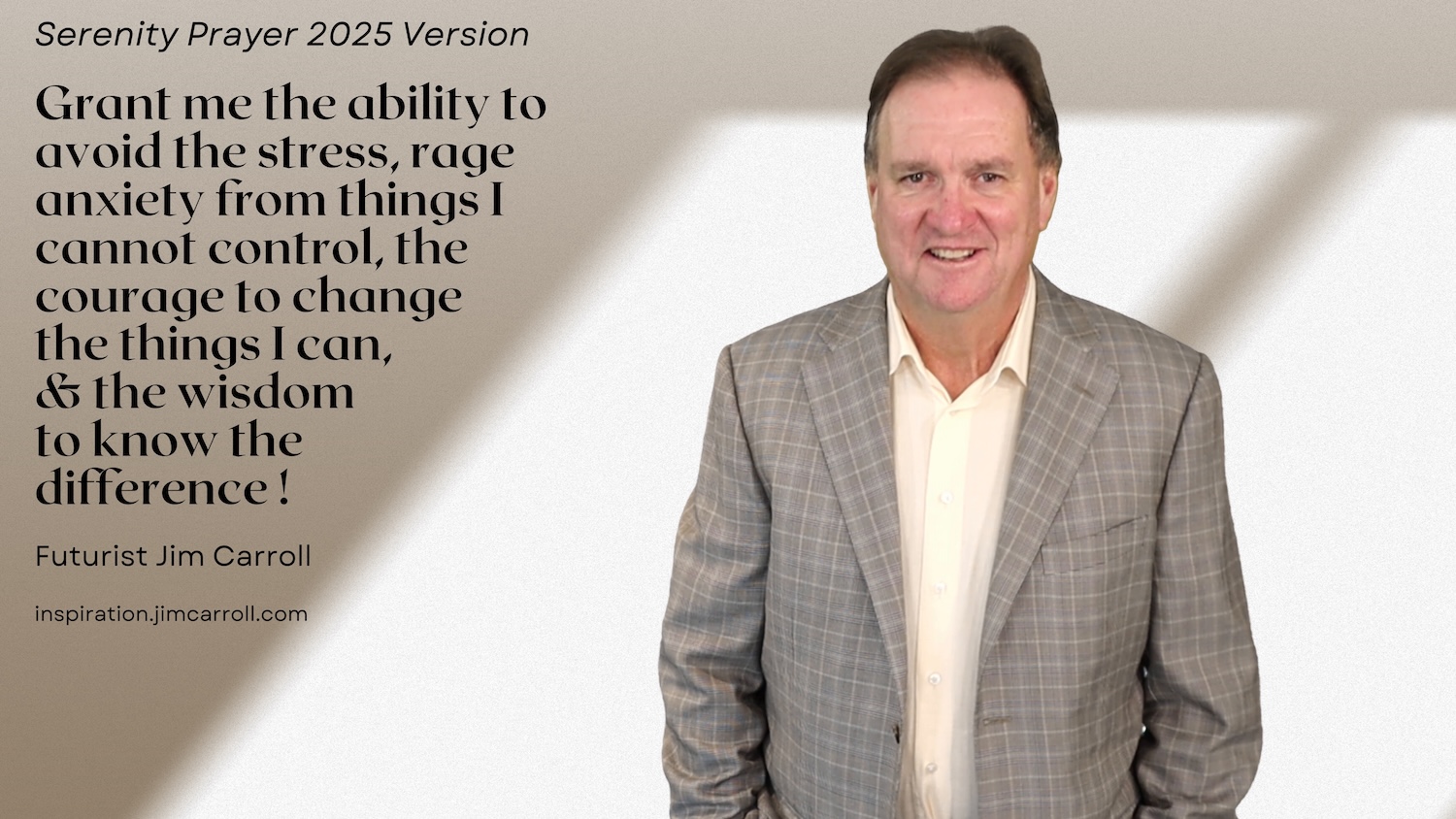
At the time, I wrote about what happens when I consume the news and find myself bubbling with rage, consumed with incredulity, and struggling with disbelief.
I want to lash out, respond, and try to set things straight.
And often, to my credit, I don't.
Welcome to 2026.
I need that prayer more than ever.
Right now, the provocation machine is running at full speed. The tariff situation between Canada and the United States has become absurdly damaging, the rhetoric has become increasingly insulting, and the relationship between two countries that spent generations building one of the deepest economic partnerships in the world is being deliberately fractured.
As a Canadian, I find much of what is happening infuriating.
And yet, what exactly would be accomplished if I reacted to every provocation?
I might feel better for five minutes, get a few likes, receive some supportive comments from Canadians who are equally angry, or get into a pointless argument with someone whose worldview I am never going to change. Then tomorrow morning there would be another provocation, another headline, another outrageous statement, and another invitation to get angry all over again.
And the algorithm wants me to feed it.
That's the trap.
The outrage machine wants your outrage, the provocation machine wants your reaction, and the algorithm wants your anger. Increasingly, I don't want to give it any of those things.
That does not mean I am indifferent, that I approve, or that I am surrendering my beliefs. Restraint is not agreement, and serenity is not passivity. Sometimes restraint is simply strategy, and sometimes the most effective response is not what you say but what you actually do.
There are things I cannot control. I cannot control the decisions of the current U.S. administration, what political leaders say, what gets posted at 2 in the morning, or whether someone decides that a relationship built over generations should suddenly be managed through threats, grievances, tariffs, and insults.
But I can control what I do, where I go, what I buy, and where I spend my money.
That is where the Serenity Prayer gets interesting.
For example, my wife and I have no interest in spending our vacation dollars in the United States right now, so we're going to Cancun instead with the family. That's a decision we can make, with no rage required and no social media battle necessary. We simply take our money somewhere else.
The same principle applies to what we buy. Canadians have been making very deliberate choices about American products, including alcohol. That particular one doesn't have much practical impact on me because I don't drink. I've been sober for ten years, so I'm not exactly wandering through the liquor store trying to decide between a Canadian whisky and a Kentucky bourbon.
But if I still drank, I'd participate.
Absolutely.
Because this is one of the things we actually can control.
We can decide what we buy. We can decide where it was made. We can decide which country gets our tourism dollars, which products go into our shopping carts, and which ones stay on the shelf. Individually those decisions might seem insignificant, but collectively they become leverage, and they become a perfectly legitimate form of protest.
You don't have to scream to make a point.
Sometimes you simply don't buy the bourbon.
That, to me, is a much healthier response than spending every waking hour furious online. The Serenity Prayer is about recognizing the difference between things over which we have no control and those where our decisions actually matter. I cannot change the mind of someone sitting in Washington, but I can change what goes into my shopping cart.
At the same time, I will continue to work with my American clients.
Absolutely.
I've worked with organizations throughout the United States for more than three decades and have met thousands upon thousands of smart, thoughtful, innovative, decent people across that country. I refuse to confuse ALL of them with their government, refuse to confuse an American company trying to figure out its future with the administration currently occupying the White House, and refuse to believe that a temporary political moment defines several hundred million people.
In fact, I think American organizations need good future insight now more than ever. After all, we know that the inevitability of the biological clock will lead to the certainty of a certain outcome. Maybe things will change at that point.
Think about what they are dealing with. Long-standing assumptions about trade are changing, supply chains are being reconfigured, global alliances are shifting, investment patterns are changing, manufacturing strategies are being reconsidered, and energy, technology, AI, science, skills, and infrastructure are all accelerating at the same time. Markets that once looked predictable suddenly aren't, and decisions that made perfect sense five years ago might be completely wrong five years from now.
That's exactly the type of uncertainty I've spent my career helping organizations understand, so why would I stop doing that?
If anything, the need is greater.
There is also an important distinction here. Administrations are temporary. Countries, companies, people, and relationships endure much longer, while history just keeps moving. The current U.S. administration will eventually come to an end - we all know it will. Biology wins in the long run. And things might (hopefully) change. What follows it remains to be seen, and maybe some sanity will prevail. I certainly hope so.
Canada has adopted a hockey metaphor - "Elbows up" - to shape its mindset. There's another hockey metaphor some are adopting - rag the puck. Go visit ragthepuck.ca. You'll understand. You are probably thinking the same way.
But I also believe something more permanent has changed. In my view, the United States has damaged - for a long time - the global respect, trust, and unquestioned dominance it once enjoyed. Other countries have noticed, businesses have noticed, investors have noticed, scientists have noticed, trading partners have noticed, and Canadians have certainly noticed. I've covered that in multiple posts over the years.
Those relationships will not necessarily snap back to exactly where they were simply because a different group eventually occupies the White House.
That's not anger talking.
That's the futurist in me.
Trust is a trend. Reputation is a trend. Investment confidence is a trend. Talent mobility is a trend. Trading relationships are a trend. Once trajectories change, they can develop momentum of their own, and once people discover that they can vacation somewhere else, buy something made somewhere else, source a product somewhere else, or build a new trading relationship somewhere else, some of those behaviours will stick.
That's how structural change begins.
It is also a far more useful thing for me to think about than whatever outrageous statement crossed my screen this morning.
Which brings me back to my Social Media Serenity Prayer.
I have spent years learning that one of the most important skills in life is understanding where you actually have agency. My rage cannot change a tariff, a furious social media post cannot repair the Canada-U.S. relationship, a clever bit of snark will not change a political leader's behaviour, and arguing with someone online will rarely change their mind.
But I can choose where I travel, where I spend my money, what I buy, which clients I work with, which ideas I share, and how I spend my time. I can choose to help organizations understand the future rather than simply rage about the present, and I can choose not to let somebody else's chaos occupy every corner of my brain.
Most important, I can choose not to react every single time someone tries to provoke a reaction.
That last one is difficult. I'm working on it.
Maybe my Social Media Serenity Prayer needs a 2026 edition:
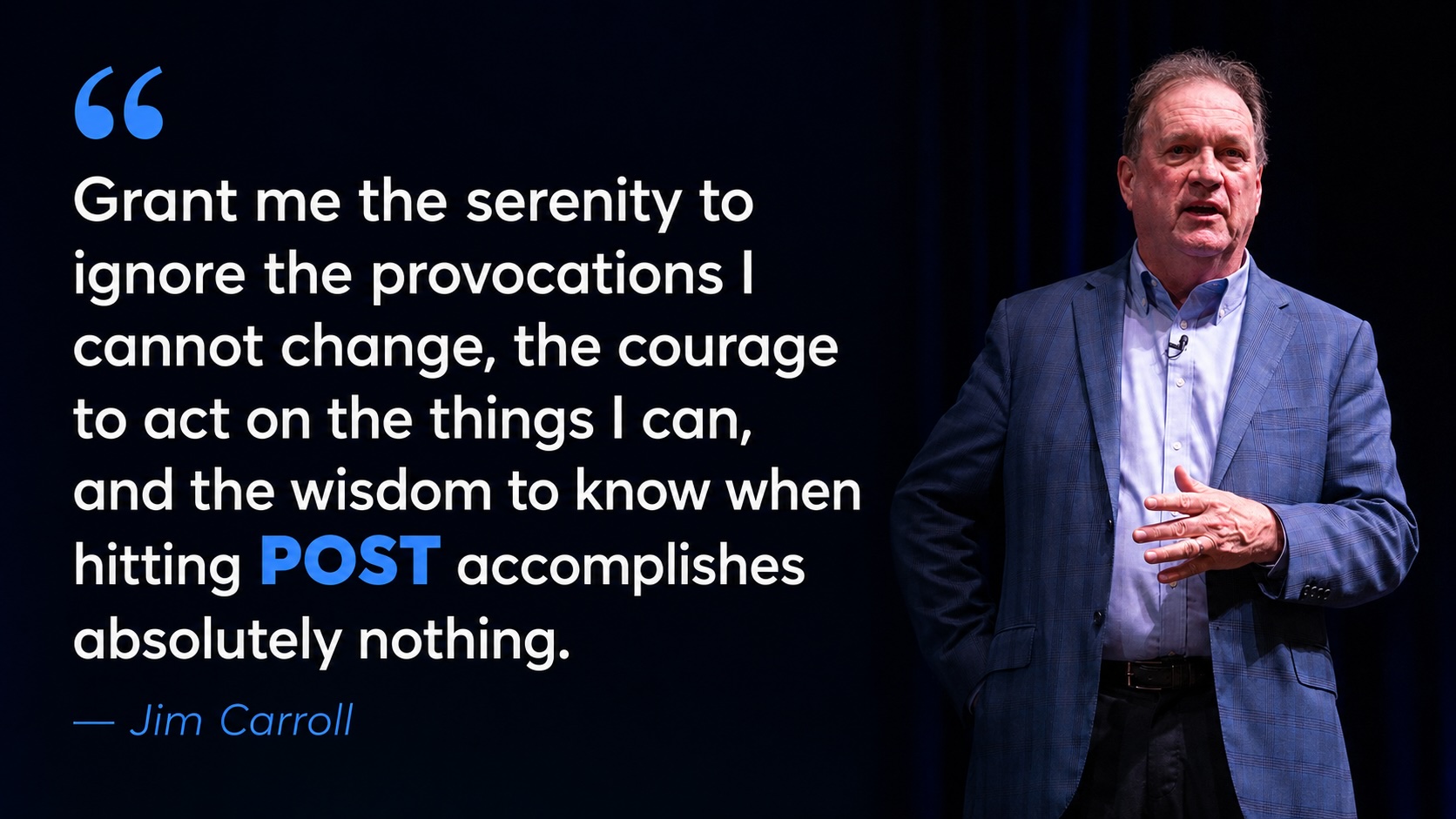
Grant me the serenity to ignore the provocations I cannot change, the courage to act on the things I can, and the wisdom to know when hitting POST accomplishes absolutely nothing.
I'm Canadian. I'm angry about what is happening, and I'm making choices because of it. I can spend elsewhere, travel elsewhere, buy differently, and support Canadian products when I have the choice. Those are real actions, and collectively they can become real leverage.
But I'm also playing the long game.
Governments change. Political eras end. Economic relationships evolve. The future keeps moving.
And I've got better things to do than spend every day yelling at the television or reacting to the provocations on the keyboard.
Onwards.