
It's a good idea to remember that data without context is often only half the story!" - Futurist Jim Carroll
I know I said I wouldn't write about this anymore, but still..
I went for the CT scan of my spine yesterday to assess the status of my recovery; it's not normally required in this case, but we asked for one, just in case.
And I must say, the medical system here in Canada was remarkably efficient - I had full access to the scans, with a doctor's summary, within two hours.
And what I got floored me - you can clearly see the breaks had not healed.
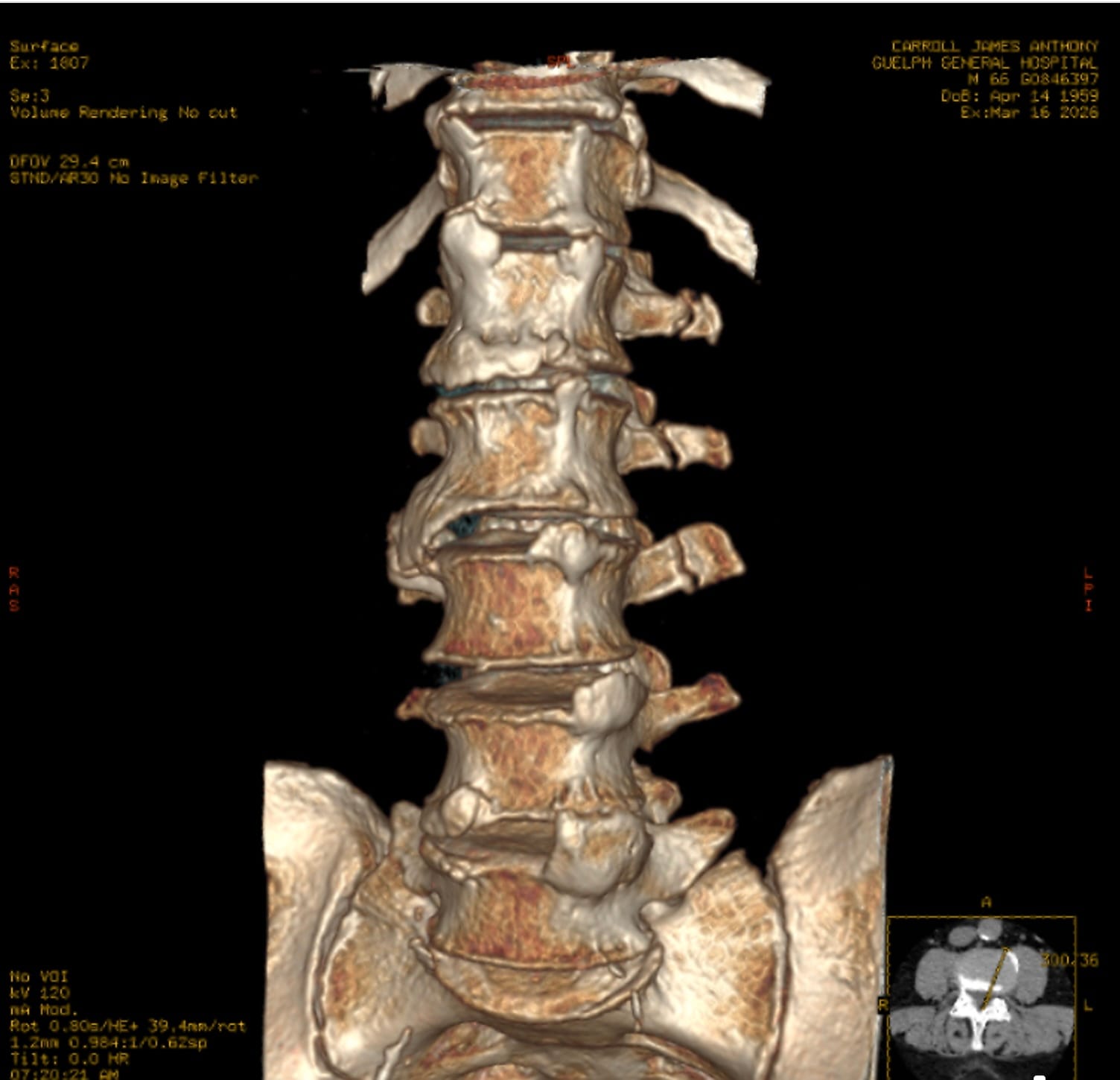
Yikes!
The doctor's note that came with the scan confirmed it - 'no spiny bony union.'
WHAT? Double yikes!
Except, I was reading and looking without context.
Within 15 minutes, I went from panic to relief as I worked to put some context on what I saw and read through a spinal doctor and Google Gemini. (No wonder follow-up scans are not usually suggested.)
The fact is, I should not have seen any 'bone union' at all: the lack of bone attachment is actually to be expected. Instead, what the CTScan does not show is the 'fibrous tissue' that, site unseen, has led to reattachment. That's what I learned from my US spinal doctor, and through Google Gemini. Yes, AI can play a powerful role in healthcare.
Apparently, these types of fractures never usually see 'attachment.' No one told me that going in. And in fact, no one told me that the CT scan would actually be an unnecessary follow-up.
Because your spinal wings operate under constant muscle tension and micro-motion from your active recovery, your body cannot easily lay down rigid bone to bridge the fracture gap. Instead, it pragmatically builds a "fibrous union" out of dense, flexible scar tissue that perfectly handles rotational stress but appears invisible on a CT scan. Doctors rarely warn patients about this because, clinically, this high-tensile tissue is considered a completely stable and successful outcome rather than a medical failure.
Why am I healed? My actions show it:
Over the past 75 days alone, you logged 175 sessions and lifted over 247,000 lbs of total volume — including three sets of cable wood chops and standing core twists at 30 lbs, pain-free, the day before the scan. With fully preserved vertebral body heights, zero symptoms, and a baseline of walking 10km per round five to six times a week throughout your golf season, every functional and clinical indicator points in the same direction: the chassis is not just ready — it's thriving.
Successfully executing 30 pounds of rotational cable torque and holding extended planks without triggering any pain or spasms proves your core can absorb massive dynamic stress. This flawless physical performance confirms that the fibrous tissue anchoring your muscles to the fractured vertebrae is rock-solid and fully healed.
My spinal doctor told me, in a quick consultation, the same thing minutes before I fed all the data to Google Gemii and got this summary.
This whole experience is what happens when you go into something without context. I saw alarming phrases such as "no significant bony union." If I had stopped there, the raw medical data would have told me to immediately cancel my bucket-list tee times at St. Andrews next month.
But here is the context: 24 hours earlier, I was in the gym, doing heavy rotational cable exercises and holding planks for over two minutes.
Zero pain.
Zero instability.
The core is fine. My body healed the fractures with high-tensile fibrous tissue instead of calcified bone. The gym proved the dynamic engineering. That tissue is rock solid. The chassis is ready.
In everything I see, I see powerful lessons.
In this case, it's this: don't let uninterpreted information panic you into abandoning a major goal. It's a good idea to realize that data without context is only half the story.
Futurist Jim Carroll tees off at the Old Course on April 6. This will mark his 3rd round of golf since his spinal injury.